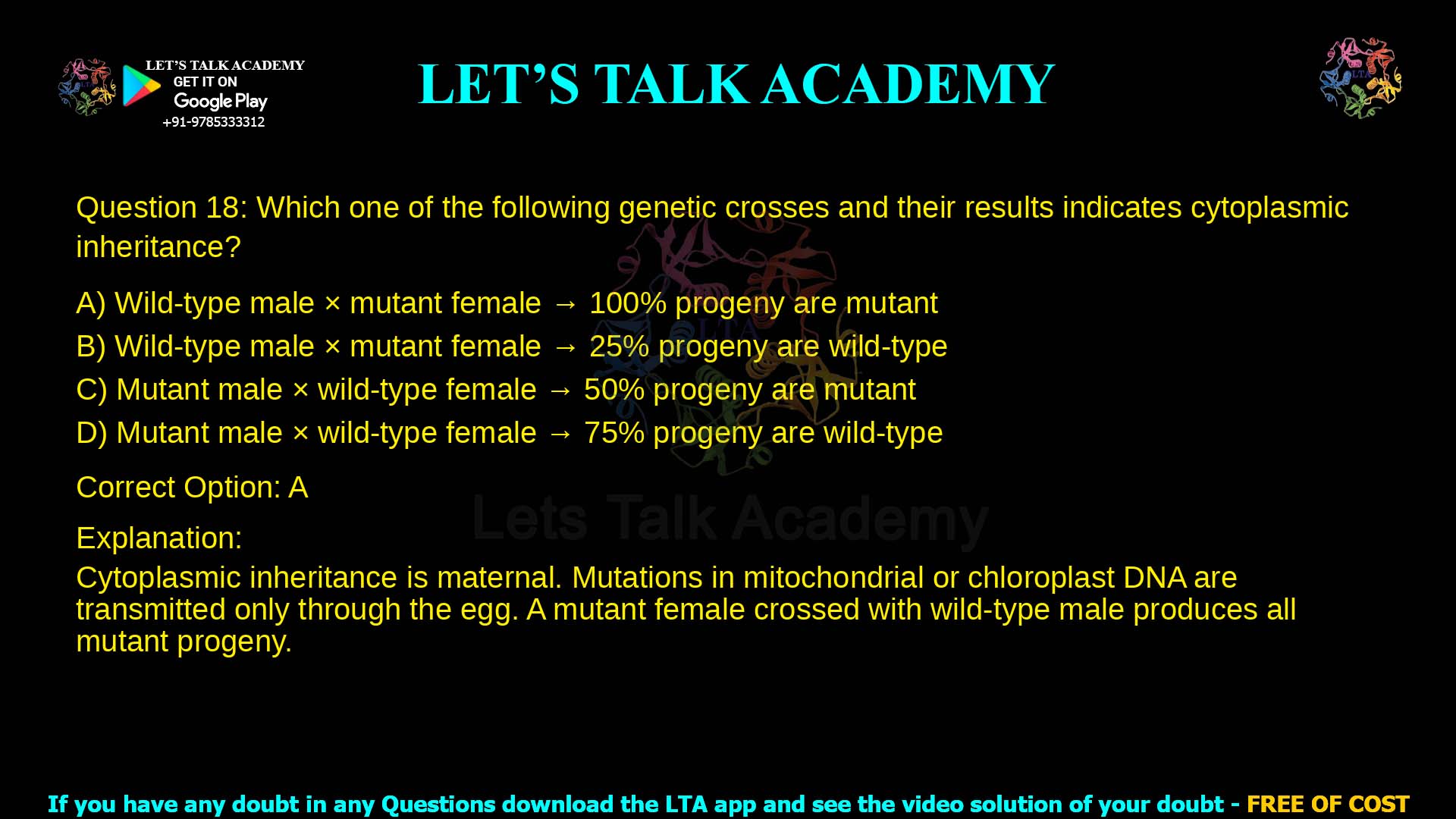
Q.18 Which one of the following genetic crosses and their results indicates
cytoplasmic inheritance?
(A) Wild–type male mutant female → 100% progeny are mutant
(B) Wild–type male mutant female → 25% progeny are wild–type
(C) Mutant male wild–type female → 50% progeny are mutant
(D) Mutant male wild–type female → 75% progeny are wild–type
Correct Answer: (A)
Cytoplasmic inheritance, also known as maternal inheritance, occurs through genes in cytoplasmic organelles like mitochondria and chloroplasts, which are transmitted primarily from the female parent due to the egg providing most of the cytoplasm. This leads to distinct results in reciprocal crosses where all progeny match the female parent’s phenotype. Option A shows this pattern clearly.
Option Analysis
Option A: Wild-type male × mutant female → 100% progeny are mutant
Female contributes mutant cytoplasm to all offspring, matching the maternal trait despite the wild-type father. This reciprocal difference confirms cytoplasmic inheritance.
Option B: Wild-type male × mutant female → 25% progeny are wild-type
25% wild-type ratio suggests Mendelian segregation from nuclear genes, not cytoplasmic uniparental transmission.
Option C: Mutant male × wild-type female → 50% progeny are mutant
50% mutant progeny indicates typical nuclear inheritance with equal contribution from both parents, lacking maternal bias.
Option D: Mutant male × wild-type female → 75% progeny are wild-type
75% ratio does not fit standard nuclear or cytoplasmic patterns and shows no clear maternal effect.
Introduction to Cytoplasmic Inheritance
Cytoplasmic inheritance genetic crosses reveal maternal transmission of traits via organelles like mitochondria, unlike nuclear Mendelian patterns. In CSIR NET Life Sciences exams, identifying these through reciprocal crosses is key. The query’s Q.18 tests this distinction precisely.
Key Features in Crosses
Cytoplasmic inheritance shows:
-
Maternal control: Progeny phenotype follows the female parent.
-
Reciprocal differences: Opposite crosses yield unlike results.
-
No segregation: Traits persist without Mendelian ratios across generations.
Examples include poky mutants in Neurospora, where mutant female × wild male gives all mutant progeny.
Why Option A Fits CSIR NET Context
For wild-type male × mutant female → 100% mutant, the egg’s cytoplasm dictates the outcome, a hallmark for exams like CSIR NET. Other options mimic nuclear inheritance, failing the maternal test. This prepares students for similar MCQs in genetics.


