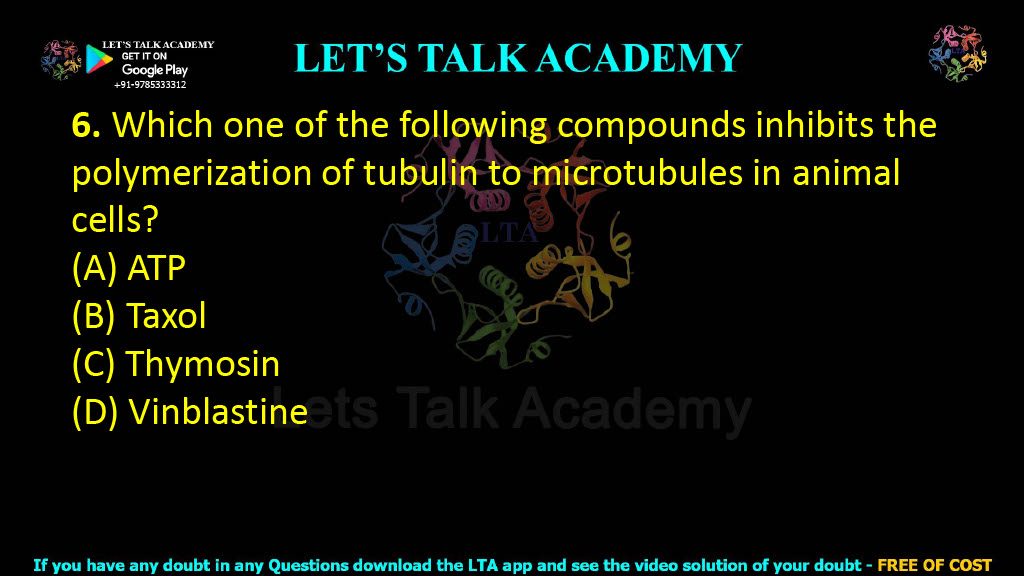
6. Which one of the following compounds inhibits the polymerization of tubulin to microtubules in animal cells?
(A) ATP
(B) Taxol
(C) Thymosin
(D) Vinblastine
Vinblastine and Microtubule Polymerization
Introduction
The cytoskeleton is an essential structural framework of every eukaryotic cell and consists of microfilaments, intermediate filaments, and microtubules. Among these components, microtubules are highly dynamic tubular structures formed by the polymerization of α-tubulin and β-tubulin heterodimers. These structures play indispensable roles in maintaining cell shape, intracellular transport, chromosome segregation during mitosis, cilia and flagella movement, and organelle positioning. Because rapidly dividing cancer cells depend heavily on proper microtubule function, drugs that interfere with microtubule dynamics have become some of the most effective chemotherapeutic agents.
Correct Answer
Correct Option: (D) Vinblastine
Detailed Explanation
Microtubules are dynamic polymers assembled from α- and β-tubulin heterodimers through a process known as polymerization. This process requires GTP-bound tubulin dimers that assemble into long hollow cylinders. The continuous growth and shrinkage of microtubules, known as dynamic instability, is essential for chromosome movement during mitosis, intracellular transport, maintenance of cell shape, and organization of the mitotic spindle.
Several naturally occurring compounds interfere with microtubule dynamics and are widely used as anticancer drugs. Some drugs inhibit the polymerization of tubulin, preventing microtubule formation, whereas others stabilize existing microtubules and prevent their depolymerization. Since both processes interfere with normal spindle function, they arrest cells in mitosis and eventually trigger programmed cell death.
Explanation of Each Option
Option (A): ATP
This option is incorrect. ATP is the universal energy currency of the cell and participates in numerous metabolic reactions. However, tubulin polymerization depends primarily on GTP, not ATP. β-Tubulin binds GTP, and hydrolysis of GTP regulates microtubule dynamic instability. ATP neither inhibits nor directly regulates the polymerization of tubulin into microtubules. Therefore, ATP cannot be considered a microtubule polymerization inhibitor.
Option (B): Taxol
This option is incorrect. Taxol, also known as paclitaxel, binds specifically to assembled microtubules and stabilizes them by preventing depolymerization. Rather than inhibiting tubulin polymerization, Taxol promotes the formation of stable microtubules and prevents their normal disassembly. Because chromosome segregation requires continuous microtubule assembly and disassembly, excessive stabilization by Taxol also blocks mitosis. Thus, Taxol disrupts microtubule dynamics but does not inhibit polymerization.
Option (C): Thymosin
This option is incorrect. Thymosin is an actin-binding protein that regulates the dynamics of actin microfilaments rather than microtubules. Specifically, thymosin β4 binds to G-actin monomers and prevents their polymerization into F-actin filaments. Since thymosin acts on the actin cytoskeleton instead of tubulin, it has no direct role in inhibiting microtubule assembly.
Option (D): Vinblastine
This option is correct. Vinblastine is a vinca alkaloid obtained from the Madagascar periwinkle (Catharanthus roseus). It binds directly to β-tubulin dimers and prevents their polymerization into microtubules. As a result, the mitotic spindle cannot form properly, chromosomes fail to segregate during mitosis, and cells become arrested in metaphase. Prolonged mitotic arrest activates apoptotic pathways, making vinblastine an effective anticancer drug used to treat leukemia, lymphoma, testicular cancer, and several other malignancies.
Why Option (D) is Correct
Vinblastine specifically binds free tubulin dimers and prevents them from assembling into microtubules. Without functional microtubules, the mitotic spindle cannot develop, chromosome segregation is blocked, and cell division is arrested. Because the question specifically asks which compound inhibits tubulin polymerization, Vinblastine is the only correct answer.
Why the Other Options are Incorrect
Why Option (A) is Incorrect
ATP provides energy for numerous cellular reactions but is not involved in regulating tubulin polymerization. Microtubule assembly depends on GTP rather than ATP, making this option incorrect.
Why Option (B) is Incorrect
Taxol does not inhibit polymerization. Instead, it stabilizes already formed microtubules and prevents their depolymerization. Although Taxol also blocks mitosis, its mechanism is fundamentally different from that of vinblastine.
Why Option (C) is Incorrect
Thymosin regulates actin filament dynamics by binding G-actin monomers. Since it acts on microfilaments rather than microtubules, it cannot inhibit tubulin polymerization.
Comparison of All Options
| Option | Target Molecule | Effect on Cytoskeleton | Correct for This Question? |
|---|---|---|---|
| ATP | Cellular metabolism | No direct inhibition of tubulin polymerization | No |
| Taxol | Microtubules | Stabilizes microtubules and prevents depolymerization | No |
| Thymosin | Actin | Prevents actin polymerization | No |
| Vinblastine | Tubulin | Prevents tubulin polymerization into microtubules | Yes |
Comparison Between Vinblastine and Taxol
| Feature | Vinblastine | Taxol (Paclitaxel) |
|---|---|---|
| Drug Class | Vinca Alkaloid | Taxane |
| Target | Free Tubulin Dimers | Polymerized Microtubules |
| Mechanism | Inhibits Polymerization | Prevents Depolymerization |
| Effect on Mitosis | Prevents Mitotic Spindle Formation | Locks Microtubules in Stable State |
| Clinical Use | Leukemia, Lymphoma, Testicular Cancer | Breast, Ovarian, Lung Cancer |
Biological Significance of Microtubule Inhibitors
Microtubule-targeting agents are among the most successful anticancer drugs because rapidly dividing cancer cells require highly dynamic microtubules for chromosome segregation during mitosis. Drugs such as vinblastine prevent spindle formation by inhibiting tubulin polymerization, whereas Taxol stabilizes existing microtubules and blocks their normal disassembly. Although these drugs act through opposite molecular mechanisms, both ultimately arrest cells in mitosis and induce apoptosis, making them highly effective chemotherapeutic agents.
Final Answer
Correct Option: (D) Vinblastine
Vinblastine inhibits the polymerization of α- and β-tubulin dimers into microtubules, preventing mitotic spindle formation and arresting cells in metaphase. In contrast, Taxol stabilizes existing microtubules rather than inhibiting their formation, ATP is not involved in tubulin inhibition, and thymosin regulates actin filament polymerization instead of microtubule assembly.


