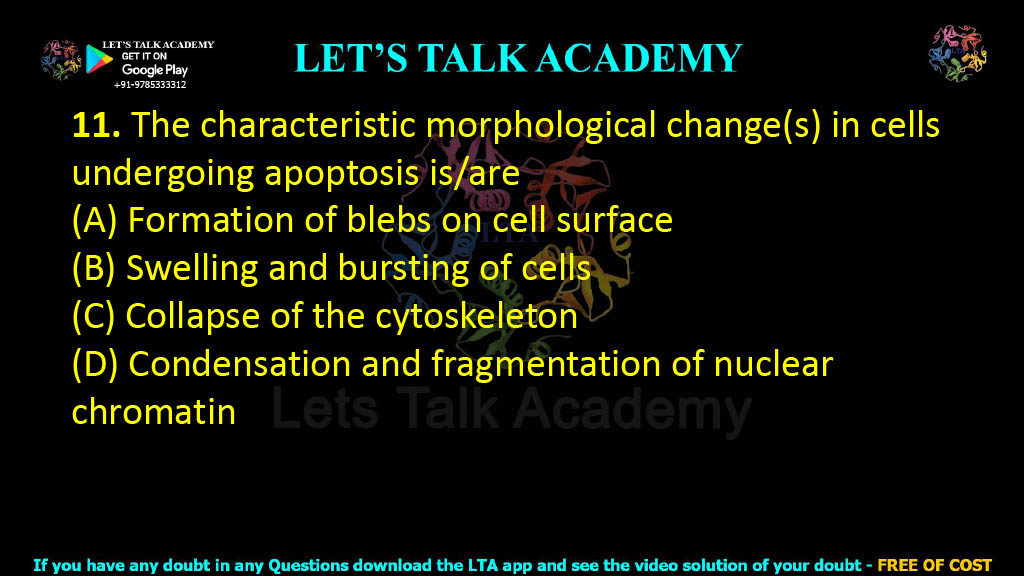
11. The characteristic morphological change(s) in cells undergoing apoptosis is/are
(A) Formation of blebs on cell surface
(B) Swelling and bursting of cells
(C) Collapse of the cytoskeleton
(D) Condensation and fragmentation of nuclear chromatin
Apoptosis: Characteristic Morphological Changes
Introduction
Apoptosis, commonly known as programmed cell death, is a highly regulated and energy-dependent process that eliminates damaged, aged, infected, or unnecessary cells without causing inflammation. Unlike necrosis, which is an uncontrolled form of cell death resulting from severe injury, apoptosis is a genetically programmed mechanism that plays a fundamental role in embryonic development, tissue homeostasis, immune system regulation, and prevention of cancer. Throughout apoptosis, cells undergo a series of characteristic biochemical and morphological changes that ensure their safe removal by neighboring phagocytic cells.
Correct Answer
Correct Option: (A), (C), and (D)
Detailed Explanation
Apoptosis is characterized by a sequence of well-organized morphological events that allow cells to die without damaging surrounding tissues. Activation of caspases, the major executioner proteases of apoptosis, leads to degradation of cytoskeletal proteins, nuclear lamins, and various structural proteins. As a result, apoptotic cells gradually shrink, lose their normal shape, develop membrane blebs, condense their chromatin, fragment their nuclei, and ultimately break into membrane-bound apoptotic bodies. These apoptotic bodies are rapidly engulfed by macrophages or neighboring cells, preventing the release of intracellular contents and avoiding inflammation.
In contrast, swelling and bursting of cells are classical features of necrosis, an uncontrolled form of cell death that leads to membrane rupture and inflammation. Therefore, distinguishing apoptosis from necrosis is essential for answering this question correctly.
Explanation of Each Option
Option (A): Formation of Blebs on Cell Surface
This statement is correct. One of the earliest visible morphological changes during apoptosis is the formation of membrane blebs. Caspase-mediated degradation of cytoskeletal proteins weakens the attachment between the plasma membrane and the underlying cytoskeleton. Consequently, portions of the plasma membrane protrude outward to form characteristic blebs. These membrane blebs eventually contribute to the formation of apoptotic bodies, which are later engulfed by phagocytic cells without triggering inflammation.
Option (B): Swelling and Bursting of Cells
This statement is incorrect. Cell swelling, loss of membrane integrity, and eventual rupture of the plasma membrane are characteristic features of necrosis, not apoptosis. During apoptosis, the cell actually undergoes shrinkage rather than swelling. Because the plasma membrane remains intact until apoptotic bodies are phagocytosed, intracellular components are not released into surrounding tissues, thereby preventing inflammatory responses.
Option (C): Collapse of the Cytoskeleton
This statement is correct. Activation of executioner caspases such as caspase-3 and caspase-7 leads to cleavage of numerous cytoskeletal proteins, including actin-associated proteins, intermediate filament proteins, and nuclear lamins. The degradation of these structural proteins causes collapse of the cytoskeleton, resulting in cell shrinkage, membrane blebbing, altered cell morphology, and eventual fragmentation into apoptotic bodies.
Option (D): Condensation and Fragmentation of Nuclear Chromatin
This statement is correct. Chromatin condensation, also known as pyknosis, is one of the hallmark morphological features of apoptosis. Following chromatin condensation, the nucleus undergoes fragmentation (karyorrhexis) into multiple membrane-bound fragments. Caspase-activated DNase (CAD) cleaves chromosomal DNA into characteristic oligonucleosomal fragments, producing the well-known DNA ladder pattern observed during apoptosis. Therefore, chromatin condensation and nuclear fragmentation are defining features of apoptotic cell death.
Why the Correct Answer is (A), (C), and (D)
Apoptotic cells undergo membrane blebbing, cytoskeletal collapse, chromatin condensation, nuclear fragmentation, and formation of apoptotic bodies while maintaining plasma membrane integrity. These highly regulated morphological changes distinguish apoptosis from necrosis. Since swelling and bursting occur during necrosis rather than apoptosis, Option (B) is incorrect. Therefore, the correct answer is Options (A), (C), and (D).
Why Option (B) is Incorrect
Swelling of the cytoplasm, disruption of organelles, rupture of the plasma membrane, and release of intracellular contents are characteristic features of necrosis. These events trigger inflammation because cellular contents spill into surrounding tissues. In apoptosis, the plasma membrane remains intact until apoptotic bodies are engulfed by phagocytes. Consequently, apoptosis is generally considered a non-inflammatory form of cell death.
Comparison of All Options
| Option | Morphological Change | Occurs in Apoptosis? | Explanation |
|---|---|---|---|
| A | Formation of membrane blebs | Yes | Occurs due to caspase-mediated cytoskeletal degradation. |
| B | Cell swelling and bursting | No | Characteristic feature of necrosis. |
| C | Collapse of cytoskeleton | Yes | Caspases degrade structural proteins. |
| D | Chromatin condensation and nuclear fragmentation | Yes | Hallmark nuclear changes during apoptosis. |
Sequence of Morphological Changes During Apoptosis
| Step | Morphological Event |
|---|---|
| 1 | Cell shrinkage |
| 2 | Collapse of cytoskeleton |
| 3 | Membrane blebbing |
| 4 | Chromatin condensation (Pyknosis) |
| 5 | Nuclear fragmentation (Karyorrhexis) |
| 6 | Formation of apoptotic bodies |
| 7 | Phagocytosis without inflammation |
Comparison Between Apoptosis and Necrosis
| Feature | Apoptosis | Necrosis |
|---|---|---|
| Cell Size | Shrinks | Swells |
| Plasma Membrane | Remains intact | Ruptures |
| Chromatin | Condenses and fragments | Random degradation |
| Inflammation | Absent | Present |
| Energy Requirement | ATP-dependent | Usually ATP-independent |
| Cell Fragments | Apoptotic bodies | No organized fragments |
Molecular Basis of Apoptotic Morphology
The characteristic morphological features of apoptosis are primarily produced by activation of caspases. Initiator caspases activate executioner caspases, which cleave structural proteins, activate DNA fragmentation enzymes, dismantle the nuclear envelope, degrade cytoskeletal components, and promote membrane blebbing. Caspase-activated DNase (CAD) cleaves chromosomal DNA into internucleosomal fragments, while phosphatidylserine becomes exposed on the outer leaflet of the plasma membrane, allowing macrophages to recognize and engulf apoptotic cells efficiently.
Biological Significance of Apoptosis
Apoptosis is essential for maintaining tissue homeostasis throughout life. It eliminates damaged or mutated cells, removes virus-infected cells, shapes developing organs during embryogenesis, regulates immune cell populations, and prevents uncontrolled cell proliferation that could lead to cancer. Because apoptotic cells are removed without releasing inflammatory molecules, apoptosis preserves tissue integrity and prevents unnecessary immune activation.
Final Answer
Correct Option: (A), (C), and (D)
Cells undergoing apoptosis exhibit membrane blebbing, collapse of the cytoskeleton, chromatin condensation, nuclear fragmentation, and formation of apoptotic bodies while maintaining plasma membrane integrity. Swelling and bursting of cells are characteristic features of necrosis rather than apoptosis, making Option (B) incorrect.


