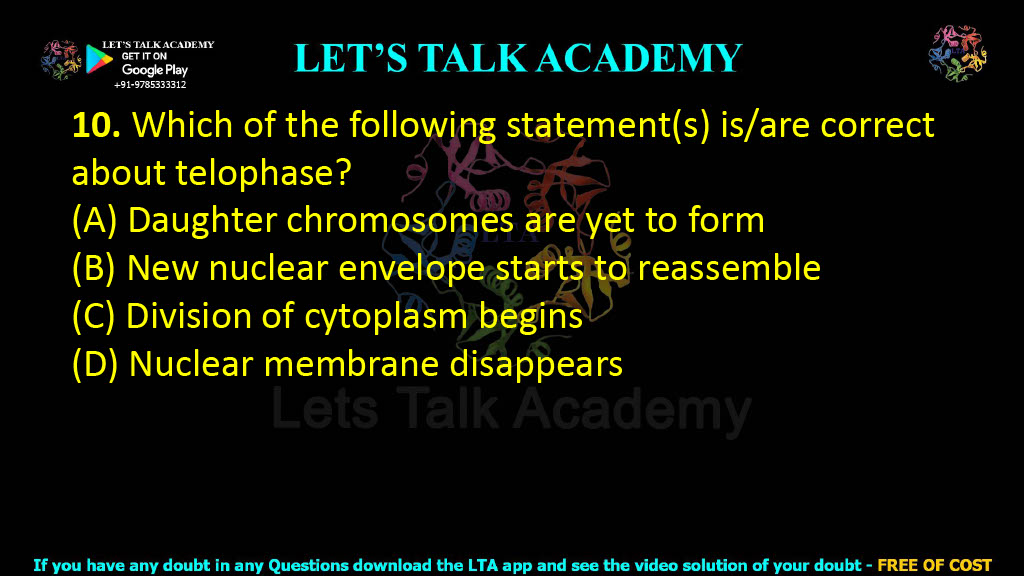
10. Which of the following statement(s) is/are correct about telophase?
(A) Daughter chromosomes are yet to form
(B) New nuclear envelope starts to reassemble
(C) Division of cytoplasm begins
(D) Nuclear membrane disappears
Telophase in Mitosis: Complete Explanation on Events During Telophase
Introduction
Mitosis is a highly coordinated process of nuclear division that ensures the accurate distribution of duplicated chromosomes into two genetically identical daughter cells. It consists of five major stages: prophase, prometaphase, metaphase, anaphase, and telophase. Among these stages, telophase is the final phase of mitosis, during which the cell begins restoring its normal interphase organization. Chromosomes that separated during anaphase arrive at opposite poles of the cell, nuclear envelopes re-form around each chromosome set, chromosomes begin to decondense, and cytokinesis is initiated or completed depending on the organism.
Correct Answer
Correct Option: (B) and (C)
Detailed Explanation
Telophase is the concluding stage of mitosis and begins immediately after anaphase, when sister chromatids have already separated and migrated to opposite poles of the cell. At this stage, each separated chromatid is now considered an individual daughter chromosome. As mitosis concludes, the spindle apparatus begins to disassemble, chromosomes gradually decondense into chromatin, nuclear envelopes re-form around each chromosome set, nucleoli reappear, and the cell prepares to return to the interphase state. Simultaneously, cytokinesis begins in most animal cells through the formation of a cleavage furrow, while plant cells initiate cell plate formation.
The primary purpose of telophase is to restore two functional daughter nuclei and initiate physical separation of the daughter cells through cytokinesis.
Explanation of Each Option
Option (A): Daughter Chromosomes are Yet to Form
This statement is incorrect. Daughter chromosomes are formed during anaphase, when sister chromatids separate following the cleavage of cohesin proteins. Once separated, each chromatid becomes an independent daughter chromosome and migrates toward opposite spindle poles. Therefore, by the time telophase begins, daughter chromosomes have already formed and reached opposite ends of the cell. Hence, this statement is biologically incorrect.
Option (B): New Nuclear Envelope Starts to Reassemble
This statement is correct. One of the defining events of telophase is the reassembly of the nuclear envelope around each group of daughter chromosomes. Vesicles derived from the endoplasmic reticulum fuse around the chromosomes, rebuilding the nuclear membrane. Nuclear pore complexes are re-established, nucleoli reappear, and each daughter nucleus becomes structurally complete. This marks the transition from mitosis back to interphase.
Option (C): Division of Cytoplasm Begins
This statement is correct. Cytokinesis generally begins during late anaphase or telophase depending on the organism and cell type. In animal cells, an actin-myosin contractile ring forms beneath the plasma membrane, producing a cleavage furrow that gradually divides the cytoplasm into two daughter cells. In plant cells, Golgi-derived vesicles accumulate at the cell center to form the cell plate, which later develops into the new cell wall separating the daughter cells. Therefore, division of the cytoplasm is indeed initiated during telophase.
Option (D): Nuclear Membrane Disappears
This statement is incorrect. The nuclear membrane disappears during prometaphase, not telophase. Breakdown of the nuclear envelope allows spindle microtubules to access chromosomes and attach to kinetochores. During telophase, the exact opposite process occurs: the nuclear membrane is reassembled around each set of daughter chromosomes. Therefore, this statement is incorrect.
Why Option (B) and (C) are Correct
Telophase is characterized by restoration of the nucleus and initiation of cytokinesis. Nuclear envelopes re-form around both chromosome sets, chromosomes decondense, nucleoli reappear, spindle fibers disappear, and cytoplasmic division begins. These events collectively prepare the cell for the completion of mitosis and the formation of two genetically identical daughter cells. Therefore, Options (B) and (C) correctly describe telophase.
Why the Other Options are Incorrect
Why Option (A) is Incorrect
Daughter chromosomes are produced during anaphase after sister chromatids separate. By telophase, these chromosomes have already reached opposite poles of the cell and are enclosed within newly forming nuclei.
Why Option (D) is Incorrect
The nuclear envelope does not disappear during telophase. Instead, it reassembles around each chromosome set. Nuclear envelope breakdown is a hallmark of prometaphase, making this statement biologically incorrect.
Comparison of All Options
| Option | Statement | Correct or Incorrect | Explanation |
|---|---|---|---|
| A | Daughter chromosomes are yet to form | Incorrect | Daughter chromosomes are already formed during anaphase. |
| B | New nuclear envelope starts to reassemble | Correct | Nuclear membranes reform around each chromosome set. |
| C | Division of cytoplasm begins | Correct | Cytokinesis begins during late anaphase or telophase. |
| D | Nuclear membrane disappears | Incorrect | Nuclear envelope breakdown occurs during prometaphase. |
Major Events During Telophase
| Cellular Event | Occurs During Telophase? |
|---|---|
| Daughter chromosomes reach opposite poles | Yes |
| Nuclear envelope reassembles | Yes |
| Chromosomes decondense into chromatin | Yes |
| Nucleolus reappears | Yes |
| Mitotic spindle disassembles | Yes |
| Cytokinesis begins or continues | Yes |
Comparison of Mitotic Stages
| Mitotic Stage | Main Event |
|---|---|
| Prophase | Chromosome condensation and spindle formation begin. |
| Prometaphase | Nuclear envelope breaks down and spindle attaches to kinetochores. |
| Metaphase | Chromosomes align at the metaphase plate. |
| Anaphase | Sister chromatids separate and become daughter chromosomes. |
| Telophase | Nuclear envelopes reform, chromosomes decondense, and cytokinesis begins. |
Biological Significance of Telophase
Telophase restores normal nuclear organization after chromosome segregation and ensures that each daughter cell receives a complete and genetically identical set of chromosomes. Reformation of the nuclear envelope protects the genome, chromosome decondensation allows transcription to resume, nucleolar reappearance restores ribosome production, and cytokinesis physically separates the daughter cells. These coordinated events complete mitosis and prepare each daughter cell for entry into the G1 phase of the next cell cycle.
Final Answer
Correct Option: (B) and (C)
During telophase, new nuclear envelopes begin to reassemble around each set of daughter chromosomes, chromosomes decondense into chromatin, nucleoli reappear, spindle fibers disassemble, and cytokinesis begins or continues. Daughter chromosomes have already formed during anaphase, while nuclear envelope breakdown occurs during prometaphase rather than telophase.


