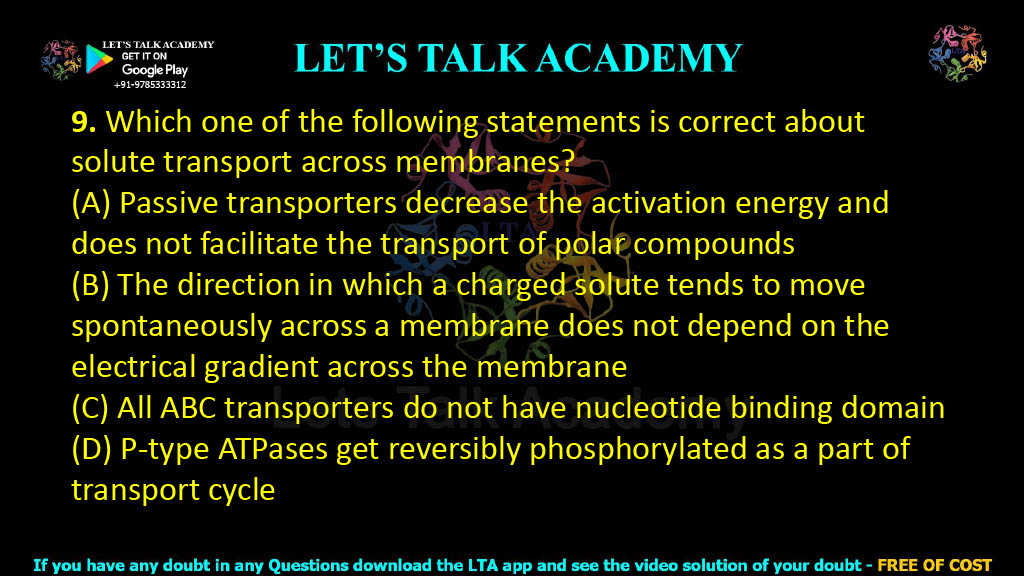
9. Which one of the following statements is correct about solute transport across membranes?
(A) Passive transporters decrease the activation energy and does not facilitate the transport of polar compounds
(B) The direction in which a charged solute tends to move spontaneously across a membrane does not depend on the electrical gradient across the membrane
(C) All ABC transporters do not have nucleotide binding domain
(D) P-type ATPases get reversibly phosphorylated as a part of transport cycle
Solute Transport Across Membranes: Passive Transporters, ABC Transporters, P-Type ATPases, and Membrane Potential
Introduction
The plasma membrane acts as a selectively permeable barrier that regulates the movement of ions, nutrients, metabolites, and waste products into and out of the cell. Since the lipid bilayer is hydrophobic, most polar molecules and charged ions cannot cross it freely. Cells therefore employ specialized membrane transport proteins that facilitate or actively drive the movement of solutes across biological membranes. These transport systems are essential for nutrient uptake, ion homeostasis, electrical signaling, maintenance of osmotic balance, and cellular metabolism.
Correct Answer
Correct Option: (D) P-type ATPases get reversibly phosphorylated as a part of transport cycle.
Detailed Explanation
Transport across biological membranes occurs through passive and active mechanisms. Passive transport moves substances down their concentration or electrochemical gradient without ATP consumption, whereas active transport requires metabolic energy to move solutes against their gradients. Different transporter families utilize distinct molecular mechanisms to accomplish this task. Among these transporters, P-type ATPases are unique because they undergo transient phosphorylation during each transport cycle, a defining feature of their mechanism.
To answer this question correctly, it is necessary to understand the structure and function of passive transporters, electrochemical gradients, ATP-dependent transporters, and the characteristic transport cycle of P-type ATPases.
Explanation of Each Option
Option (A): Passive Transporters Decrease the Activation Energy and Does Not Facilitate the Transport of Polar Compounds
This statement is incorrect. Passive transporters, including carrier proteins and channel proteins, do lower the activation energy required for solute movement across the membrane. However, they specifically facilitate the transport of polar molecules and charged ions that cannot diffuse through the hydrophobic lipid bilayer on their own. Examples include glucose transporters (GLUT proteins), aquaporins for water transport, and ion channels for sodium, potassium, calcium, and chloride ions. Therefore, the statement becomes incorrect because passive transporters indeed facilitate the movement of polar compounds.
Option (B): The Direction in Which a Charged Solute Tends to Move Spontaneously Across a Membrane Does Not Depend on the Electrical Gradient Across the Membrane
This statement is incorrect. The movement of charged molecules depends on the electrochemical gradient, which consists of both the concentration gradient and the electrical potential difference across the membrane. Positively charged ions tend to move toward negatively charged regions, whereas negatively charged ions move toward positively charged regions. Consequently, both concentration differences and membrane potential determine the spontaneous direction of movement for charged solutes. Ignoring the electrical gradient makes this statement biologically incorrect.
Option (C): All ABC Transporters Do Not Have Nucleotide Binding Domain
This statement is incorrect. ATP-Binding Cassette (ABC) transporters are named specifically because they contain highly conserved ATP-binding nucleotide-binding domains (NBDs). These nucleotide-binding domains bind and hydrolyze ATP to provide the energy required for active transport. In addition to nucleotide-binding domains, ABC transporters also possess transmembrane domains that form the pathway through which substrates are transported. Since nucleotide-binding domains are defining structural features of ABC transporters, this statement is completely incorrect.
Option (D): P-Type ATPases Get Reversibly Phosphorylated as a Part of Transport Cycle
This statement is correct. P-type ATPases are a family of ATP-driven ion pumps that transport cations such as Na+, K+, Ca2+, and H+ across biological membranes. During every transport cycle, ATP transfers a phosphate group to a conserved aspartate residue on the ATPase, producing a transient phosphorylated intermediate. This phosphorylation induces a conformational change that transports ions across the membrane. Subsequent dephosphorylation restores the original conformation, allowing the cycle to repeat. The reversible phosphorylation step is the defining characteristic of all P-type ATPases.
Why Option (D) is Correct
P-type ATPases are unique among membrane transport proteins because they undergo reversible phosphorylation during each transport cycle. ATP hydrolysis transfers a phosphate group to the transporter itself rather than directly to the transported substrate. This transient phosphorylation drives conformational changes responsible for ion transport across the membrane. Since this phosphorylation-dephosphorylation cycle is a defining molecular feature of P-type ATPases, Option (D) is the correct answer.
Why the Other Options are Incorrect
Why Option (A) is Incorrect
Passive transporters facilitate the movement of polar molecules and ions across membranes by lowering the activation energy required for transport. Therefore, stating that they do not facilitate the transport of polar compounds is incorrect.
Why Option (B) is Incorrect
Charged molecules always move according to their electrochemical gradient, which includes both concentration differences and electrical potential across the membrane. Therefore, the electrical gradient plays a crucial role in determining the direction of ion movement.
Why Option (C) is Incorrect
ABC transporters possess highly conserved ATP-binding nucleotide-binding domains that hydrolyze ATP to fuel active transport. Without these domains, they could not function as ATP-dependent transporters. Therefore, this statement directly contradicts the defining characteristic of ABC transporters.
Comparison of All Options
| Option | Statement | Correct or Incorrect | Reason |
|---|---|---|---|
| A | Passive transporters do not transport polar compounds | Incorrect | They specifically facilitate transport of polar molecules and ions. |
| B | Electrical gradient does not affect charged solute movement | Incorrect | Charged solutes move according to the electrochemical gradient. |
| C | ABC transporters lack nucleotide-binding domains | Incorrect | ATP-binding domains are defining structural features of ABC transporters. |
| D | P-type ATPases undergo reversible phosphorylation | Correct | Transient phosphorylation drives conformational changes during ion transport. |
Major Types of Membrane Transport Proteins
| Transport Protein | Energy Source | Main Function | Example |
|---|---|---|---|
| Channel Proteins | No ATP | Facilitated diffusion | Potassium channel |
| Carrier Proteins | No ATP | Facilitated diffusion | GLUT glucose transporter |
| P-Type ATPases | ATP Hydrolysis | Active ion transport through reversible phosphorylation | Na+/K+ ATPase, Ca2+ ATPase |
| ABC Transporters | ATP Hydrolysis | Transport of diverse molecules using ATP-binding domains | MDR transporter, CFTR protein |
Biological Significance of P-Type ATPases
P-type ATPases are essential for maintaining ionic homeostasis in virtually every living cell. The sodium-potassium ATPase establishes the membrane potential required for nerve impulse transmission and muscle contraction. Calcium ATPases regulate intracellular calcium concentration, enabling proper muscle relaxation, neurotransmitter release, and signal transduction. Proton ATPases help maintain intracellular pH and generate proton gradients required for nutrient transport. Because these transporters rely on reversible phosphorylation during every transport cycle, they represent one of the most important classes of active transport proteins in biology.
Final Answer
Correct Option: (D) P-type ATPases get reversibly phosphorylated as a part of transport cycle.
P-type ATPases transport ions across biological membranes through a characteristic cycle involving transient phosphorylation and dephosphorylation of the transporter protein. In contrast, passive transporters facilitate the movement of polar compounds, charged solute movement depends on the electrochemical gradient, and ABC transporters possess ATP-binding nucleotide-binding domains that are essential for their function.


