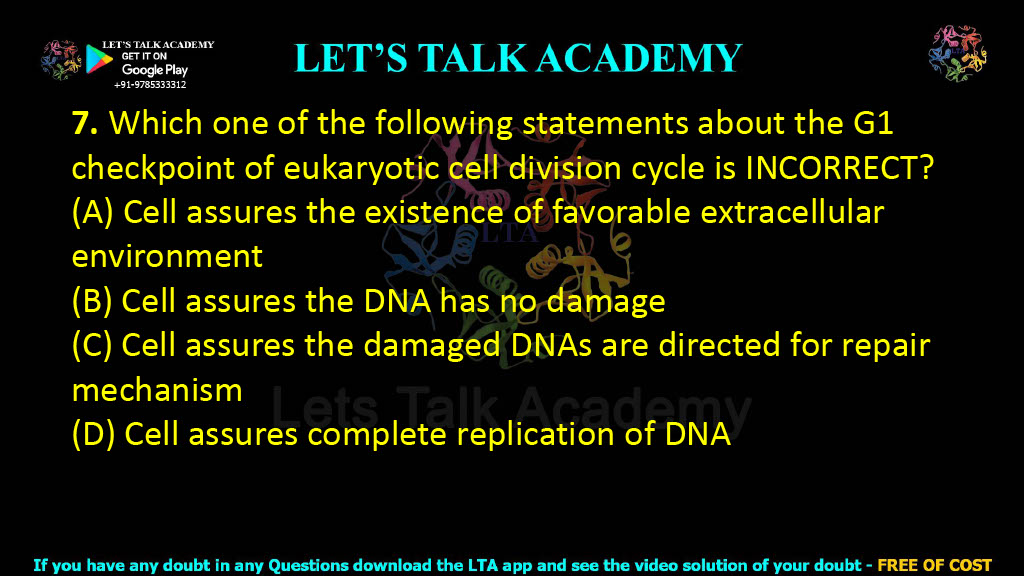
7. Which one of the following statements about the G1 checkpoint of eukaryotic cell division cycle is INCORRECT?
(A) Cell assures the existence of favorable extracellular environment
(B) Cell assures the DNA has no damage
(C) Cell assures the damaged DNAs are directed for repair mechanism
(D) Cell assures complete replication of DNA
G1 Checkpoint of the Eukaryotic Cell Cycle
Introduction
The cell cycle is a highly regulated sequence of events that ensures accurate growth, DNA replication, and cell division. To maintain genomic integrity, eukaryotic cells possess multiple surveillance systems known as cell cycle checkpoints. These checkpoints monitor whether critical cellular events have been completed correctly before allowing the cell to progress to the next stage. Among all checkpoints, the G1 checkpoint, also called the restriction point or Start checkpoint, is considered one of the most important because it determines whether a cell will commit to DNA replication and cell division.
The G1 checkpoint evaluates several intracellular and extracellular conditions before the cell enters the S phase. It ensures that nutrients, growth factors, and environmental conditions are favorable, verifies that DNA is free from significant damage, and activates DNA repair mechanisms if damage is detected. If these conditions are not satisfied, the cell cycle is arrested or the cell may enter a resting state (G0) or undergo programmed cell death.
Correct Answer
Correct Option: (D) Cell assures complete replication of DNA
Detailed Explanation
The G1 checkpoint is positioned at the end of the G1 phase, immediately before the cell enters the S phase, where DNA replication begins. Since DNA replication has not yet started during G1, the checkpoint cannot verify whether DNA replication has been completed. Instead, its primary function is to determine whether the cell is ready to initiate DNA synthesis. The checkpoint examines nutrient availability, extracellular growth signals, cell size, energy status, and DNA integrity. If DNA damage is detected, proteins such as ATM, ATR, p53, and p21 halt cell cycle progression and activate DNA repair pathways before DNA replication is allowed to begin.
Complete DNA replication is evaluated later in the cell cycle, primarily at the G2 checkpoint, which ensures that the entire genome has been accurately duplicated before the cell enters mitosis. Therefore, the statement that the G1 checkpoint assures complete DNA replication is incorrect.
Explanation of Each Option
Option (A): Cell Assures the Existence of Favorable Extracellular Environment
This statement is correct. Before committing to DNA replication, the cell verifies whether external conditions are suitable for growth and division. Growth factors, nutrients, hormones, oxygen availability, and cell-cell interactions are evaluated during the G1 checkpoint. If these environmental conditions are unfavorable, cyclin-CDK activity remains low, preventing entry into the S phase. This mechanism ensures that cells divide only when sufficient resources are available.
Option (B): Cell Assures the DNA Has No Damage
This statement is correct. One of the principal functions of the G1 checkpoint is to monitor genomic integrity. DNA damage caused by radiation, oxidative stress, chemicals, or replication-independent mutations activates checkpoint proteins such as ATM and ATR kinases. These proteins stabilize the tumor suppressor p53, which induces expression of p21. The p21 protein inhibits cyclin-dependent kinases, preventing progression into the S phase until DNA integrity is restored.
Option (C): Cell Assures the Damaged DNA is Directed for Repair Mechanism
This statement is correct. When DNA damage is detected during G1, the checkpoint temporarily arrests cell cycle progression and activates multiple DNA repair pathways. These repair systems include nucleotide excision repair, base excision repair, mismatch repair, and double-strand break repair depending on the type of DNA damage. Only after successful repair is the cell permitted to continue into the S phase. If the damage is beyond repair, apoptosis may be initiated to prevent the propagation of genetically abnormal cells.
Option (D): Cell Assures Complete Replication of DNA
This statement is incorrect. DNA replication occurs during the S phase of the cell cycle, not during G1. Consequently, the G1 checkpoint cannot verify whether DNA replication has been completed because replication has not yet begun. The checkpoint responsible for ensuring complete and accurate DNA replication is the G2 checkpoint, which operates after the completion of DNA synthesis and before mitosis. Therefore, this statement is biologically incorrect.
Why Option (D) is Correct
The question asks for the incorrect statement regarding the G1 checkpoint. The G1 checkpoint functions before DNA replication begins and therefore cannot assess whether DNA replication has been completed. Instead, it evaluates environmental conditions, cell size, nutrient availability, and DNA integrity before permitting entry into the S phase. Since complete DNA replication is examined at the G2 checkpoint rather than the G1 checkpoint, Option (D) is the correct answer.
Why the Other Options are Correct
Why Option (A) is Correct
The G1 checkpoint ensures that extracellular conditions, including growth factors and nutrient availability, are favorable before initiating DNA synthesis. This prevents unnecessary cell division under unfavorable conditions.
Why Option (B) is Correct
The G1 checkpoint continuously monitors DNA integrity and prevents damaged DNA from being replicated. This preserves genomic stability and minimizes mutation accumulation.
Why Option (C) is Correct
Cells possessing damaged DNA activate checkpoint signaling pathways that halt the cell cycle and recruit DNA repair machinery. Successful repair allows the cell cycle to resume, whereas irreparable damage results in apoptosis or permanent cell cycle arrest.
Comparison of All Options
| Option | Statement | Correct for G1 Checkpoint? | Explanation |
|---|---|---|---|
| A | Checks favorable extracellular environment | Yes | Growth factors, nutrients, and environmental conditions are evaluated. |
| B | Checks whether DNA is damaged | Yes | DNA integrity is verified before S phase begins. |
| C | Activates DNA repair mechanisms when damage is detected | Yes | Checkpoint proteins arrest the cycle and initiate DNA repair. |
| D | Ensures complete DNA replication | No | DNA replication occurs during S phase and is verified mainly at the G2 checkpoint. |
Major Events Checked at Different Cell Cycle Checkpoints
| Checkpoint | Main Function |
|---|---|
| G1 Checkpoint | Checks cell size, nutrients, growth factors, and DNA damage before S phase. |
| S Phase Checkpoint | Monitors DNA replication and replication fork progression. |
| G2 Checkpoint | Ensures complete DNA replication and repairs remaining DNA damage before mitosis. |
| M Checkpoint (Spindle Assembly Checkpoint) | Confirms proper chromosome attachment to spindle microtubules before anaphase. |
Molecular Regulation of the G1 Checkpoint
The G1 checkpoint is controlled primarily by Cyclin D-CDK4/CDK6 and Cyclin E-CDK2 complexes. These cyclin-dependent kinases phosphorylate the retinoblastoma (Rb) protein, releasing E2F transcription factors that activate genes required for DNA replication. DNA damage activates ATM and ATR kinases, which stabilize p53. Activated p53 induces p21, an inhibitor of cyclin-dependent kinases, thereby preventing phosphorylation of Rb and blocking entry into the S phase until DNA repair is completed.
Biological Significance of the G1 Checkpoint
The G1 checkpoint serves as one of the most important safeguards against genomic instability. By preventing damaged DNA from entering the replication phase, it minimizes mutation accumulation and reduces the risk of cancer development. Mutations affecting checkpoint regulators such as p53, p21, Rb, Cyclin D, or CDKs are commonly associated with uncontrolled cell proliferation and tumor formation. Consequently, the G1 checkpoint is considered one of the most critical tumor-suppressive mechanisms in multicellular organisms.
Final Answer
Correct Option: (D) Cell assures complete replication of DNA
The G1 checkpoint ensures that environmental conditions are favorable, verifies DNA integrity, and activates DNA repair mechanisms when necessary before allowing entry into the S phase. However, it does not confirm complete DNA replication because DNA synthesis occurs during the S phase and is primarily evaluated at the G2 checkpoint.


