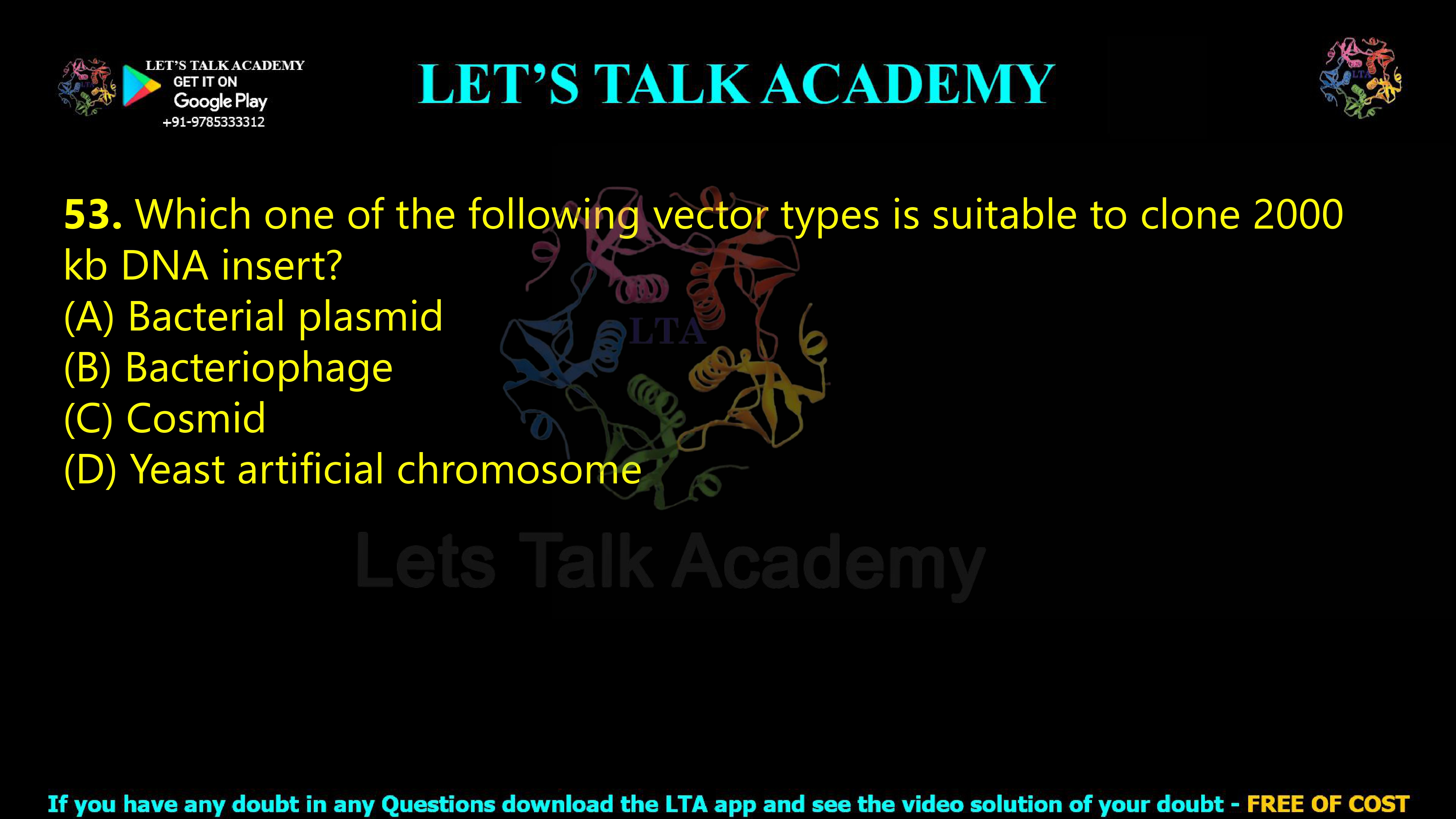
52. Which one of the following vector types is suitable to clone 2000 kb DNA insert?
(A) Bacterial plasmid
(B) Bacteriophage
(C) Cosmid
(D) Yeast artificial chromosome
Which Vector Is Suitable to Clone a 2000 kb DNA Insert?
Detailed Explanation
A DNA insert of 2000 kb is an extremely large DNA fragment. Since 1000 kb is equal to 1 megabase or 1 Mb, a 2000 kb DNA insert is equivalent to:
2000 kb = 2 Mb
The most important concept required to answer this question is the cloning capacity of different vectors. Different cloning vectors can accommodate DNA inserts of very different sizes. Small bacterial plasmids are suitable for relatively small DNA fragments, bacteriophage vectors can carry somewhat larger inserts, cosmids have a still greater capacity, and artificial chromosome vectors are designed for exceptionally large DNA fragments.
Among the given options, a Yeast Artificial Chromosome (YAC) has by far the greatest capacity for cloning very large DNA fragments. YACs can accommodate DNA inserts ranging from hundreds of kilobases to approximately one megabase or more, and exceptionally large constructs can extend into the megabase range. In the context of the given options and standard molecular cloning questions, a 2000 kb or 2 Mb insert requires the vector type with the highest available cloning capacity. Therefore, option (D), Yeast Artificial Chromosome, is the correct answer.
Why Is a Yeast Artificial Chromosome Suitable for Cloning Very Large DNA Inserts?
Option (D): Yeast Artificial Chromosome — Correct
A Yeast Artificial Chromosome, commonly abbreviated as YAC, is a specialized cloning vector designed to behave like a chromosome inside a yeast cell. Unlike an ordinary plasmid, which is generally used for relatively small DNA inserts, a YAC contains the essential structural elements required for the maintenance and replication of a very large linear DNA molecule.
The major advantage of a YAC is its exceptionally large cloning capacity. YACs were developed specifically for cloning DNA fragments that are too large to be accommodated by conventional plasmids, bacteriophage vectors, or cosmids. Their ability to carry very large genomic DNA fragments made them historically important in physical genome mapping, construction of genomic libraries, and early large-scale genome analysis projects.
A 2000 kb insert is equal to 2,000,000 base pairs or 2 megabases. This is far beyond the normal cloning capacity of bacterial plasmids, bacteriophage vectors, and cosmids. Among the choices provided in the question, the YAC is the only vector class designed for DNA inserts approaching the megabase scale.
Therefore, option (D) is correct.
What Is a Yeast Artificial Chromosome?
A Yeast Artificial Chromosome is an engineered DNA molecule that contains the essential components of a natural yeast chromosome. These elements allow the recombinant DNA molecule to replicate, segregate, and remain stable inside a yeast cell.
A functional YAC generally contains a yeast centromere, a yeast origin of replication, and telomeres. It also contains selectable markers that help researchers identify yeast cells carrying the recombinant artificial chromosome.
The centromere allows proper segregation of the YAC during cell division. The origin of replication permits DNA replication inside the yeast cell. The telomeres protect the ends of the linear artificial chromosome and help it behave like a natural eukaryotic chromosome.
Because a YAC contains these chromosome-like structural features, it can maintain DNA molecules much larger than those carried by standard plasmid vectors.
Essential Components of a YAC Vector
Centromere Sequence
The centromere, often represented as CEN, is essential for the proper distribution of the artificial chromosome during yeast cell division. It interacts with the chromosome segregation machinery and helps ensure that daughter cells receive copies of the YAC.
Autonomously Replicating Sequence
The autonomously replicating sequence, commonly abbreviated as ARS, functions as an origin of replication in yeast. It allows the YAC DNA to be replicated inside the host cell.
Telomeres
Telomeric sequences, commonly represented as TEL, are located at the ends of the linear YAC molecule. They protect the chromosome ends and help prevent degradation or inappropriate fusion with other DNA molecules.
Selectable Markers
Selectable marker genes allow researchers to identify yeast cells that contain the desired recombinant YAC. These markers are important during the selection and screening of transformed yeast cells.
The presence of all these elements enables a YAC to function as an artificial chromosome and carry very large pieces of foreign DNA.
Why Is a Bacterial Plasmid Not Suitable for a 2000 kb DNA Insert?
Option (A): Bacterial Plasmid — Incorrect
A bacterial plasmid is a small, usually circular, extrachromosomal DNA molecule that can replicate independently inside a bacterial cell. Plasmids are among the most widely used cloning vectors because they are relatively easy to isolate, manipulate, introduce into bacterial cells, and select using marker genes.
However, conventional bacterial plasmids have a limited cloning capacity. They are generally most suitable for relatively small DNA inserts, often in the range of a few kilobases. The exact capacity varies according to the particular plasmid vector and experimental system, but ordinary plasmids are not designed to carry DNA fragments approaching millions of base pairs.
A 2000 kb insert is equal to 2 Mb. Such a DNA molecule is enormously larger than the normal insert capacity of a conventional bacterial plasmid. Attempting to maintain such a large fragment in an ordinary plasmid would create major problems involving DNA stability, manipulation, replication, and maintenance.
Therefore, option (A) is incorrect.
Why Is a Bacteriophage Vector Not Suitable for a 2000 kb DNA Insert?
Option (B): Bacteriophage — Incorrect
Bacteriophage vectors are derived from viruses that infect bacteria. Some bacteriophages have been modified for use as cloning vectors because they can efficiently introduce recombinant DNA into bacterial host cells.
A well-known example is the lambda bacteriophage vector. Lambda-based cloning systems can generally accommodate larger inserts than many standard plasmid vectors. Depending on the design of the vector, such as insertion or replacement vectors, DNA fragments in the range of several kilobases to a few tens of kilobases may be cloned.
However, bacteriophage vectors have packaging constraints. The recombinant DNA must usually remain within a particular size range to be efficiently packaged into phage particles. This requirement places a strict upper limit on the amount of foreign DNA that can be carried.
A 2000 kb DNA fragment is far beyond the capacity of a conventional bacteriophage cloning vector. Therefore, although bacteriophages are valuable molecular cloning tools, they cannot accommodate a DNA insert of this enormous size.
Therefore, option (B) is incorrect.
Why Is a Cosmid Not Suitable for a 2000 kb DNA Insert?
Option (C): Cosmid — Incorrect
A cosmid is a hybrid cloning vector that combines important features of a bacterial plasmid with the cos sequences of lambda bacteriophage. Cosmids can be packaged into lambda phage particles for efficient delivery into bacterial cells, but after entering the host, they replicate like plasmids.
Cosmids have a larger cloning capacity than conventional plasmids and many bacteriophage vectors. They can typically carry DNA inserts of approximately 35–45 kb, although exact values may vary depending on vector design and experimental conditions.
This makes cosmids useful for cloning moderately large genomic DNA fragments and for constructing genomic libraries. However, their capacity is still extremely small compared with the 2000 kb insert described in the question.
To understand the difference clearly:
Required insert size = 2000 kb
Typical cosmid capacity = approximately 35–45 kb
Thus, the desired insert is many times larger than the normal capacity of a cosmid. Therefore, option (C) is incorrect.
Comparison of Cloning Capacities of the Given Vectors
The four vector types listed in the question differ greatly in the sizes of DNA fragments they can carry. A bacterial plasmid is mainly suitable for small inserts. Bacteriophage vectors can accommodate larger fragments than many conventional plasmids. Cosmids extend the cloning range to several tens of kilobases. YACs are designed for exceptionally large DNA molecules extending into the hundreds of kilobases and, in some systems, the megabase range.
A simplified comparison is:
Bacterial plasmid: generally suitable for relatively small DNA inserts
Bacteriophage vector: generally suitable for inserts of several to a few tens of kilobases, depending on the system
Cosmid: approximately 35–45 kb
Yeast artificial chromosome: hundreds of kilobases to approximately 1 Mb or more, with exceptionally large constructs extending into the megabase range
Since the DNA insert in the question is 2000 kb or 2 Mb, the correct choice among the available options is the vector with the greatest cloning capacity: the Yeast Artificial Chromosome.
Why Insert Size Determines the Choice of Cloning Vector
The choice of a cloning vector depends strongly on the size of the foreign DNA fragment. A vector must be able to accept, replicate, and stably maintain the inserted DNA inside the host cell.
For a small gene or DNA fragment, a plasmid may be sufficient. For larger genomic fragments, bacteriophage vectors or cosmids may be more appropriate. When the insert becomes extremely large and reaches hundreds of kilobases or the megabase scale, artificial chromosome vectors become necessary.
This relationship explains the progression from ordinary cloning vectors to artificial chromosomes. As the insert size increases, the required vector system must provide greater structural stability and a larger DNA-carrying capacity.
Why the Conversion of 2000 kb to 2 Mb Is Important
The size given in the question can be converted as follows:
1000 bp = 1 kb
1000 kb = 1 Mb
Therefore:
2000 kb = 2 Mb
This conversion immediately shows that the question is dealing with a DNA fragment of megabase size. A megabase-scale insert cannot be cloned using ordinary plasmids, conventional bacteriophage vectors, or cosmids.
Among the options given, a YAC is the vector class designed for the largest DNA inserts and is therefore the expected answer.
Role of YACs in Genomic DNA Cloning
YAC vectors became especially important when researchers needed to clone very large continuous regions of genomic DNA. Instead of breaking a genome into thousands of very small pieces, YACs allowed scientists to maintain much larger genomic fragments.
This ability was useful in physical genome mapping, positional cloning, analysis of large genetic loci, and the construction of genomic libraries. Large DNA inserts can preserve long-range genomic relationships that may be lost when DNA is divided into very small fragments.
Because YACs behave like chromosomes in yeast, they provide a biological system capable of maintaining DNA molecules far larger than those carried by conventional cloning vectors.
Detailed Explanation of Every Option
Option (A): Bacterial Plasmid — Incorrect
Bacterial plasmids are excellent vectors for cloning relatively small DNA fragments. They are easy to manipulate and widely used in routine molecular cloning, but their cloning capacity is far too limited for a 2000 kb DNA insert. Therefore, a bacterial plasmid is not suitable.
Option (B): Bacteriophage — Incorrect
Bacteriophage-derived vectors can carry larger DNA inserts than many standard plasmids, but their capacity remains limited by the biology and packaging requirements of the phage system. A 2 Mb DNA fragment is far beyond the capacity of a conventional bacteriophage vector.
Option (C): Cosmid — Incorrect
Cosmids can typically accommodate inserts of approximately 35–45 kb. Although this is significantly greater than the capacity of many ordinary plasmids, it is still far below the 2000 kb insert size given in the question.
Option (D): Yeast Artificial Chromosome — Correct
YACs have the greatest cloning capacity among the listed vectors. They are designed to maintain exceptionally large DNA molecules and can carry inserts extending from hundreds of kilobases into the megabase range. Therefore, among the given options, a YAC is the suitable vector type for cloning a 2000 kb DNA insert.
Final Answer
The vector type suitable for cloning a 2000 kb or 2 Mb DNA insert is:
Correct Option: (D) Yeast Artificial Chromosome (YAC)
A 2000 kb DNA insert is far too large for a bacterial plasmid, bacteriophage vector, or cosmid. A Yeast Artificial Chromosome has the greatest cloning capacity among the options and is specifically designed for maintaining very large DNA fragments. Therefore, the expected answer is Yeast Artificial Chromosome (YAC).


