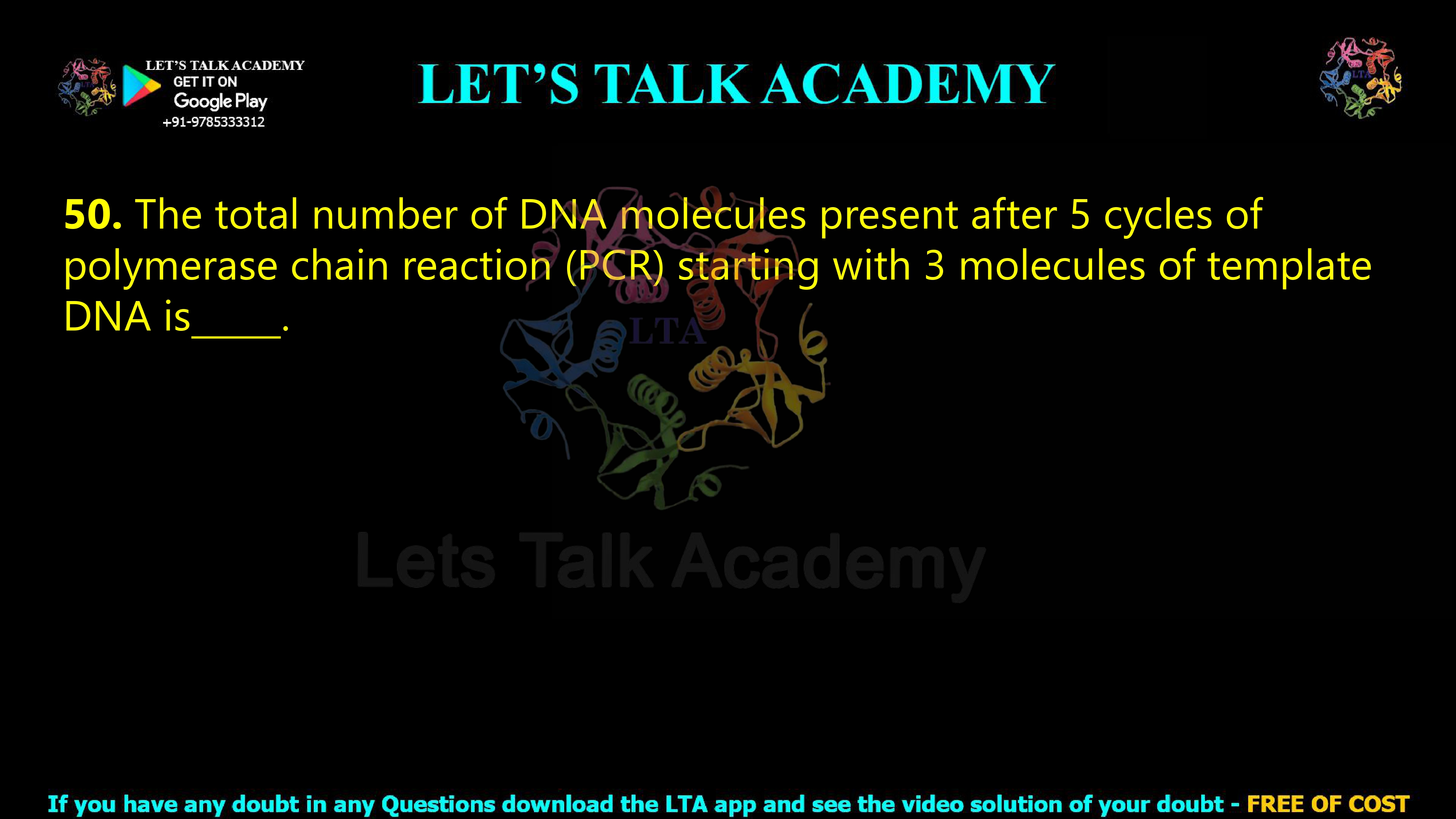
49. The total number of DNA molecules present after 5 cycles of polymerase chain reaction (PCR) starting with 3 molecules of template DNA is .
How Many DNA Molecules Are Present After 5 PCR Cycles Starting with 3 Template DNA Molecules?
Detailed Explanation
The polymerase chain reaction, commonly known as PCR, is an exponential DNA amplification technique. Under ideal conditions, every double-stranded DNA molecule produces two double-stranded DNA molecules during each PCR cycle. Therefore, the number of DNA molecules doubles after every cycle.
In this question, PCR begins with 3 template DNA molecules and continues for 5 cycles. Since each starting DNA molecule doubles during every cycle, the final number of molecules can be calculated using the standard PCR amplification formula.
N = N₀ × 2ⁿ
Here, N represents the final number of DNA molecules, N₀ represents the initial number of template DNA molecules, and n represents the number of PCR cycles.
Substituting the values given in the question:
N₀ = 3
n = 5
Therefore:
N = 3 × 2⁵
Since:
2⁵ = 32
The calculation becomes:
N = 3 × 32
Therefore:
N = 96 DNA molecules
Thus, the total number of DNA molecules present after 5 PCR cycles is 96.
Understanding the PCR Amplification Formula
The Formula N = N₀ × 2ⁿ
The ideal amplification of DNA during PCR follows an exponential pattern because every DNA molecule acts as a template for the formation of another DNA molecule.
The general formula is:
N = N₀ × 2ⁿ
In this formula, the factor 2ⁿ represents the doubling of DNA over n cycles. The initial number of DNA molecules must always be included because PCR amplification occurs independently from every starting template molecule.
If PCR begins with only one DNA molecule, the number of molecules after 5 cycles would be:
1 × 2⁵ = 32
However, this question begins with 3 template DNA molecules. Therefore, all three initial molecules undergo amplification:
3 × 2⁵ = 96
This is why the correct answer is 96, not 32.
Why Does DNA Double During Every PCR Cycle?
A standard PCR cycle consists of three major stages: denaturation, primer annealing, and extension. These stages allow each double-stranded DNA molecule to produce two double-stranded DNA molecules.
During denaturation, the two strands of each DNA molecule separate. During primer annealing, the forward and reverse primers bind to their complementary sequences. During extension, a thermostable DNA polymerase synthesizes new complementary DNA strands.
As a result, one double-stranded DNA molecule ideally becomes two double-stranded DNA molecules by the end of one complete PCR cycle.
The newly formed molecules then act as templates during the next cycle. Therefore, two molecules become four, four become eight, eight become sixteen, and the number continues to increase exponentially.
Cycle-by-Cycle Calculation Starting with 3 DNA Molecules
Before PCR Begins: Cycle 0
The reaction initially contains:
3 DNA molecules
This is the starting quantity and is represented as:
3 × 2⁰ = 3 × 1 = 3
At this stage, no amplification cycle has yet occurred.
After the First PCR Cycle
Each of the 3 starting DNA molecules produces two molecules.
Therefore:
3 × 2¹ = 6
After the first cycle, the reaction contains 6 DNA molecules.
After the Second PCR Cycle
The 6 DNA molecules present after the first cycle double again.
Therefore:
6 × 2 = 12
Using the formula:
3 × 2² = 3 × 4 = 12
After the second cycle, there are 12 DNA molecules.
After the Third PCR Cycle
The 12 molecules double during the third cycle.
Therefore:
12 × 2 = 24
Using the formula:
3 × 2³ = 3 × 8 = 24
After the third cycle, there are 24 DNA molecules.
After the Fourth PCR Cycle
The 24 molecules double again.
Therefore:
24 × 2 = 48
Using the formula:
3 × 2⁴ = 3 × 16 = 48
After the fourth cycle, there are 48 DNA molecules.
After the Fifth PCR Cycle
The 48 molecules present after the fourth cycle undergo one more doubling.
Therefore:
48 × 2 = 96
Using the formula:
3 × 2⁵ = 3 × 32 = 96
Thus, after the fifth PCR cycle, the reaction contains 96 DNA molecules.
Complete PCR Amplification Pattern
The amplification sequence can be written as:
Initial molecules: 3
After Cycle 1: 6
After Cycle 2: 12
After Cycle 3: 24
After Cycle 4: 48
After Cycle 5: 96
Therefore, the complete pattern is:
3 → 6 → 12 → 24 → 48 → 96
This clearly shows that the number of DNA molecules doubles during each PCR cycle.
Step-by-Step Mathematical Calculation
Step 1: Identify the Initial Number of DNA Molecules
The question states that PCR begins with:
N₀ = 3 DNA molecules
Step 2: Identify the Number of PCR Cycles
The total number of cycles is:
n = 5
Step 3: Apply the PCR Formula
The standard ideal PCR amplification formula is:
N = N₀ × 2ⁿ
Substituting the given values:
N = 3 × 2⁵
Step 4: Calculate the Exponential Term
2⁵ = 2 × 2 × 2 × 2 × 2
2⁵ = 32
Step 5: Multiply by the Initial Number of Templates
N = 3 × 32
N = 96
Therefore:
Final number of DNA molecules = 96
Why the Initial Number of Template Molecules Must Be Included
A frequent conceptual point in PCR calculations is that the expression 2ⁿ gives the amplification factor for each initial DNA molecule. It does not automatically represent the total number of molecules when the reaction begins with more than one template.
In this question:
2⁵ = 32
This means that each initial DNA molecule gives rise to 32 DNA molecules after five ideal cycles.
Since there are three starting molecules:
First template molecule → 32 molecules
Second template molecule → 32 molecules
Third template molecule → 32 molecules
Therefore:
32 + 32 + 32 = 96
The same calculation can be written more efficiently as:
3 × 32 = 96
Why PCR Amplification Is Called Exponential
PCR amplification is called exponential because the newly synthesized DNA molecules become templates in subsequent cycles.
During the first cycle, the number doubles once. During the second cycle, all molecules present double again. The same process continues during every subsequent cycle.
Therefore, the amplification factor follows powers of two:
2¹ = 2
2² = 4
2³ = 8
2⁴ = 16
2⁵ = 32
For one starting molecule, five cycles produce 32 molecules. For three starting molecules, the result is three times larger:
3 × 32 = 96
This exponential amplification is the reason PCR can generate an enormous number of DNA copies from a very small initial quantity of template DNA.
Ideal PCR Amplification and Real PCR Amplification
The calculation in this question assumes 100% PCR efficiency. This means that every DNA molecule successfully produces two DNA molecules during every amplification cycle.
Under ideal conditions:
Number of molecules after n cycles = N₀ × 2ⁿ
In an actual laboratory experiment, PCR efficiency may be lower than 100%. Factors such as primer efficiency, polymerase activity, reagent concentration, template quality, inhibitors, and product accumulation can reduce the actual amplification rate.
However, unless a question specifically provides a PCR efficiency value, numerical problems conventionally assume perfect doubling during every cycle.
Therefore, the correct calculation for this question is:
3 × 2⁵ = 96
Difference Between Initial DNA Molecules and Newly Synthesized DNA Molecules
The question asks for the total number of DNA molecules present after five PCR cycles. Therefore, the formula directly gives:
Total molecules = 96
If a question instead asked only for the number of newly synthesized molecules, the original three template molecules would need to be excluded from the final total.
In that different situation:
Newly synthesized molecules = 96 − 3 = 93
However, that is not what the present question asks. Since it asks for the total number of DNA molecules present, the answer remains 96.
Final Calculation
Given:
Initial template DNA molecules = 3
Number of PCR cycles = 5
Formula:
N = N₀ × 2ⁿ
Substitution:
N = 3 × 2⁵
Calculation:
N = 3 × 32
N = 96
Final Answer
The total number of DNA molecules present after 5 cycles of PCR, starting with 3 molecules of template DNA, is:
Correct Answer: 96 DNA molecules
Under ideal PCR conditions, DNA doubles during every amplification cycle. Therefore, the total number of molecules is calculated using N = N₀ × 2ⁿ. Substituting the initial number of templates and the number of cycles gives N = 3 × 2⁵ = 3 × 32 = 96.


