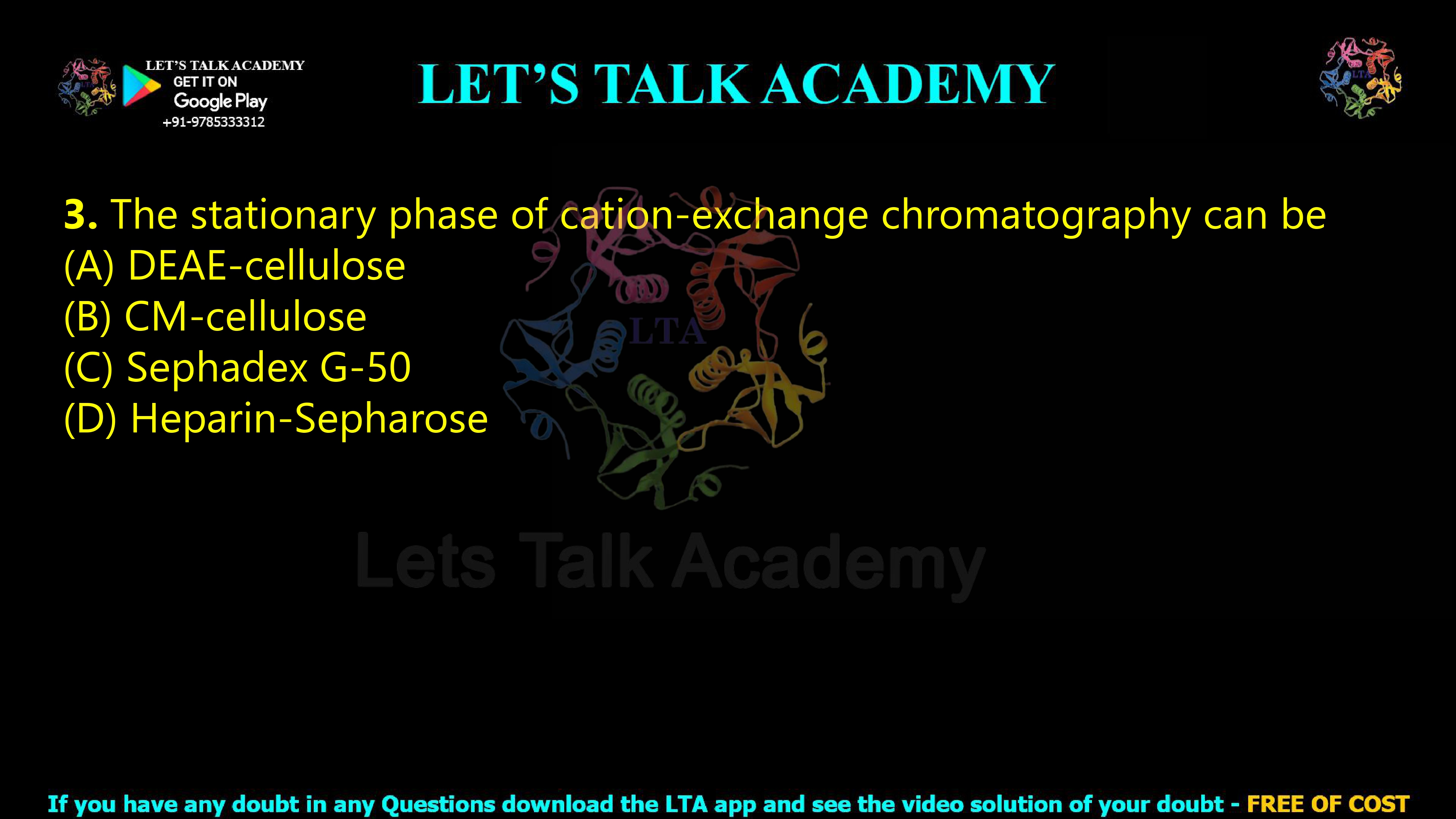
3. The stationary phase of cation-exchange chromatography can be
(A) DEAE-cellulose
(B) CM-cellulose
(C) Sephadex G-50
(D) Heparin-Sepharose
Which Stationary Phase Is Used in Cation-Exchange Chromatography?
Correct Answer: (B) CM-Cellulose
The correct answer is Option (B), CM-cellulose. CM-cellulose, also known as carboxymethyl cellulose, is a commonly used stationary phase in cation-exchange chromatography. It contains negatively charged functional groups that bind positively charged molecules, particularly proteins carrying a net positive charge under the selected experimental conditions.
The central principle required to answer this question is that the name of an ion exchanger refers to the type of ion or charged molecule that it binds. Therefore, a cation exchanger binds cations, which are positively charged species. To attract and retain positively charged molecules, the stationary phase itself must carry negatively charged functional groups.
CM-cellulose contains carboxymethyl groups. Under appropriate operating conditions, these groups are negatively charged and can electrostatically interact with positively charged proteins and other cationic molecules. For this reason, CM-cellulose is a classic example of a cation-exchange stationary phase.
What Is Cation-Exchange Chromatography?
Cation-exchange chromatography is a type of ion-exchange chromatography that separates molecules according to differences in their net electrical charge. It is widely used for the purification and separation of proteins, peptides and other charged biological molecules.
In cation-exchange chromatography, the stationary phase carries negatively charged groups. These negative charges attract and bind positively charged molecules present in the sample. Molecules that are neutral or negatively charged under the same conditions interact weakly or may pass through the column without significant binding.
The separation is therefore based on the strength of electrostatic interaction between positively charged sample molecules and the negatively charged stationary phase. Molecules carrying a stronger positive charge generally bind more strongly, whereas molecules carrying a weaker positive charge bind less strongly and can be eluted more easily.
Why Does a Cation Exchanger Carry a Negative Charge?
The terminology of ion-exchange chromatography can initially appear confusing. A cation exchanger is not positively charged simply because the word “cation” appears in its name. Instead, it is called a cation exchanger because it binds and exchanges cations.
Since opposite electrical charges attract each other, a stationary phase that binds positively charged cations must contain negatively charged groups. Therefore, the matrix of a cation-exchange column is negatively charged and selectively retains positively charged molecules.
CM-cellulose fulfills this requirement because its carboxymethyl functional groups can exist in a negatively charged form. These groups interact electrostatically with positively charged proteins, making CM-cellulose an appropriate stationary phase for cation-exchange chromatography.
What Is CM-Cellulose?
CM-cellulose stands for carboxymethyl cellulose. It is a cellulose-based chromatographic matrix modified by the addition of carboxymethyl functional groups. These functional groups provide the ion-exchange properties required for the separation of positively charged molecules.
The carboxymethyl group can be represented in its ionized form as:
Matrix–O–CH2–COO−
The negatively charged –COO− groups are responsible for attracting and binding positively charged molecules. A positively charged protein can therefore interact with CM-cellulose through electrostatic attraction.
This binding is reversible. After unwanted molecules have been washed from the column, the bound protein can be released by changing the experimental conditions, commonly by increasing the salt concentration or changing the pH of the buffer.
Why Is CM-Cellulose Called a Weak Cation Exchanger?
CM-cellulose is generally classified as a weak cation exchanger because its carboxyl functional groups can gain or lose protons depending on the pH of the surrounding solution. As a result, the ionization and charge of the functional groups are influenced by pH.
At a suitable pH, the carboxyl groups become deprotonated and negatively charged. In this state, CM-cellulose can bind positively charged proteins. Because the charge on the functional group changes with pH, CM-cellulose is described as a weak ion exchanger.
The term “weak” does not mean that CM-cellulose is ineffective or that it necessarily binds proteins weakly. It refers to the pH-dependent ionization behavior of the functional group attached to the chromatographic matrix.
How Does CM-Cellulose Bind Positively Charged Proteins?
The ability of a protein to bind to CM-cellulose depends largely on its net charge at the working pH. Protein charge is determined by the relationship between the pH of the buffer and the isoelectric point (pI) of the protein.
When the pH of the surrounding buffer is lower than the isoelectric point of a protein, the protein generally carries a net positive charge. Under these conditions, the positively charged protein can bind to the negatively charged CM-cellulose matrix.
This relationship can be summarized as:
If pH < pI, the protein tends to have a net positive charge.
If pH > pI, the protein tends to have a net negative charge.
Therefore, for a protein to bind effectively to a cation exchanger such as CM-cellulose, the buffer pH is generally selected so that the target protein carries a net positive charge while the carboxymethyl groups of the exchanger remain sufficiently ionized for binding.
How Are Proteins Eluted from CM-Cellulose?
Once positively charged proteins have bound to CM-cellulose, they can be separated according to the strength of their interaction with the negatively charged matrix. Proteins that interact weakly are generally released before proteins that interact more strongly.
One common method of elution is to gradually increase the salt concentration of the mobile phase. Salt introduces competing ions into the column. As the ionic strength increases, these ions weaken the electrostatic interactions between the positively charged proteins and the negatively charged stationary phase.
Proteins with weaker interactions elute at lower salt concentrations, while proteins with stronger positive charge and stronger interactions generally require higher salt concentrations for elution. In this way, proteins with different charge properties can be separated from one another.
Proteins can also be eluted by changing the pH. A change in pH can alter the net charge of the protein and reduce its attraction to the stationary phase. When the electrostatic interaction becomes sufficiently weak, the protein is released from the column.
Why Option (A) DEAE-Cellulose Is Incorrect
DEAE-cellulose stands for diethylaminoethyl cellulose. It is a widely used ion-exchange material, but it functions as an anion exchanger, not a cation exchanger.
Under suitable conditions, the DEAE functional group carries a positive charge. Because opposite charges attract, positively charged DEAE groups bind molecules carrying a net negative charge. Therefore, DEAE-cellulose is used to retain and separate anionic molecules, including negatively charged proteins.
The name “anion exchanger” indicates that the stationary phase binds anions. Since anions are negatively charged, the stationary phase must carry positively charged groups. DEAE-cellulose satisfies this requirement and is therefore classified as an anion-exchange material.
This is the opposite of the situation in cation-exchange chromatography. A cation exchanger requires a negatively charged stationary phase capable of binding positively charged molecules. Therefore, Option (A) DEAE-cellulose is incorrect.
Difference Between DEAE-Cellulose and CM-Cellulose
DEAE-cellulose and CM-cellulose are both important ion-exchange chromatographic materials, but they bind molecules with opposite net charges. DEAE-cellulose is positively charged under suitable conditions and binds negatively charged molecules. It therefore acts as an anion exchanger.
CM-cellulose, in contrast, contains negatively charged carboxymethyl groups and binds positively charged molecules. It therefore acts as a cation exchanger.
The essential distinction is that DEAE-cellulose binds anions, whereas CM-cellulose binds cations. Since the question asks for the stationary phase of cation-exchange chromatography, CM-cellulose is the correct choice.
Why Option (B) CM-Cellulose Is Correct
CM-cellulose is the correct answer because it contains negatively charged carboxymethyl groups capable of binding positively charged molecules. This is exactly the property required for a stationary phase used in cation-exchange chromatography.
When a sample containing different proteins is applied to a CM-cellulose column under suitable pH conditions, positively charged proteins interact with the negatively charged matrix. Proteins that do not have the appropriate positive charge bind weakly or pass through the column.
The bound proteins can subsequently be separated by changing the salt concentration or pH. Because CM-cellulose performs the defining function of a cation exchanger, Option (B) is the correct answer.
Why Option (C) Sephadex G-50 Is Incorrect
Sephadex G-50 is primarily used in size-exclusion chromatography, also known as gel filtration chromatography. This technique separates molecules mainly according to their size and ability to enter the pores of the stationary phase.
Sephadex is a cross-linked dextran gel containing pores of defined size ranges. When a mixture of molecules passes through a Sephadex G-50 column, larger molecules are unable to enter many of the pores and therefore travel through the column more quickly. Smaller molecules enter the pores and follow a longer path through the matrix, causing them to elute later.
Unlike CM-cellulose, standard Sephadex G-50 does not function as the cation-exchange material described in this question. Its primary separation principle is molecular size rather than electrostatic attraction between charged molecules and oppositely charged functional groups.
Sephadex G-50 is commonly associated with applications such as desalting, buffer exchange and the separation of molecules with suitable differences in size. Therefore, Option (C) is incorrect.
Why Do Large Molecules Elute First in Gel Filtration Chromatography?
In gel filtration chromatography, large molecules are excluded from many of the pores present within the gel beads. As a result, they travel mainly through the spaces between the beads and take a relatively short route through the column.
Smaller molecules can enter the internal pores of the gel beads. Their movement is therefore delayed because they explore a larger accessible volume within the column. Consequently, large molecules generally elute first, while smaller molecules elute later.
This mechanism is fundamentally different from cation-exchange chromatography, where separation depends on electrical charge. Therefore, Sephadex G-50 does not represent the correct stationary phase for the cation-exchange process described in the question.
Why Option (D) Heparin-Sepharose Is Not the Best Answer
Heparin-Sepharose is commonly used as an affinity chromatography medium for the purification of proteins that interact with heparin. Heparin is immobilized on a Sepharose matrix and can bind a wide variety of biologically important proteins.
Heparin-binding proteins may include certain nucleic acid-binding proteins, enzymes, growth factors, coagulation-related proteins and other proteins with an affinity for the highly sulfated heparin molecule.
Although Heparin-Sepharose carries a high density of negative charges and can show ion-exchange-like interactions, its standard chromatographic classification and major use are associated with affinity purification based on interactions with immobilized heparin. Therefore, in a conventional single-best-answer question asking for a standard stationary phase of cation-exchange chromatography, CM-cellulose is the expected and most appropriate answer.
Thus, Option (D) is not the best answer in the context of this question.
Understanding the Basic Principle of Ion-Exchange Chromatography
Ion-exchange chromatography separates molecules according to differences in their electrical charge. The stationary phase contains fixed charged groups, while molecules carrying the opposite charge can bind through reversible electrostatic interactions.
There are two major categories of ion-exchange chromatography: cation-exchange chromatography and anion-exchange chromatography. In cation-exchange chromatography, the stationary phase is negatively charged and binds positively charged molecules. In anion-exchange chromatography, the stationary phase is positively charged and binds negatively charged molecules.
The strength of binding depends on several factors, including the net charge of the molecule, the density of charge on the stationary phase, the pH of the buffer and the ionic strength of the mobile phase. By carefully controlling these conditions, researchers can separate proteins that differ only slightly in their charge properties.
Cation Exchanger Versus Anion Exchanger
A cation exchanger has negatively charged functional groups and binds positively charged molecules. CM-cellulose is a classic example because its carboxymethyl groups can provide the negative charges required for cation binding.
An anion exchanger has positively charged functional groups and binds negatively charged molecules. DEAE-cellulose is a common example because its diethylaminoethyl groups become positively charged under appropriate conditions and interact with negatively charged molecules.
Therefore, the identity of the exchanger is determined by the type of charged molecule that it binds, not simply by the charge of the stationary phase itself.
Role of pH in Cation-Exchange Chromatography
pH is one of the most important factors controlling protein binding during cation-exchange chromatography. Proteins contain many ionizable amino acid side chains, and their net charge changes according to the pH of the surrounding solution.
When the pH is below a protein’s isoelectric point, the protein generally carries a net positive charge and may bind to a negatively charged cation exchanger such as CM-cellulose. As the pH approaches or rises above the protein’s isoelectric point, its net positive charge decreases, weakening its interaction with the cation exchanger.
For successful separation, the working pH must be selected carefully. The target protein should carry sufficient positive charge to interact with the stationary phase, while other proteins in the mixture should ideally show different binding strengths. These differences allow the target molecule to be separated from contaminants.
Role of Salt Concentration in Cation-Exchange Chromatography
Salt concentration strongly influences the electrostatic interactions between proteins and the ion-exchange matrix. At relatively low ionic strength, positively charged proteins can interact efficiently with the negatively charged groups of CM-cellulose.
As the salt concentration increases, ions in the mobile phase compete with the bound proteins for electrostatic interactions. This competition progressively weakens protein binding. Proteins with weaker interactions are released first, whereas more strongly bound proteins require a higher salt concentration for elution.
A gradual increase in salt concentration, known as a salt gradient, is therefore commonly used to separate multiple proteins according to their different binding strengths.
Applications of CM-Cellulose in Protein Purification
CM-cellulose has been widely used for the purification of proteins and other positively charged biological molecules. Its usefulness comes from its ability to separate molecules according to subtle differences in surface charge.
During protein purification, a crude sample may contain many proteins with different isoelectric points and charge distributions. By selecting an appropriate buffer pH, some proteins can be made to bind strongly to CM-cellulose, while others bind weakly or do not bind at all.
After unbound molecules have been removed, the retained proteins can be eluted selectively by changing the salt concentration or pH. This makes cation-exchange chromatography a powerful technique for achieving high-resolution separation of biological macromolecules.
Final Answer
Correct Option: (B) CM-Cellulose
The stationary phase of cation-exchange chromatography can be CM-cellulose. CM-cellulose contains negatively charged carboxymethyl groups that bind positively charged molecules through electrostatic interactions.
DEAE-cellulose is primarily an anion exchanger because it binds negatively charged molecules. Sephadex G-50 is mainly used for size-exclusion or gel filtration chromatography, where molecules are separated according to size. Heparin-Sepharose is commonly used as an affinity chromatography medium for proteins that interact with immobilized heparin.
Therefore, among the given options, the standard and most appropriate stationary phase for cation-exchange chromatography is Option (B), CM-cellulose.


