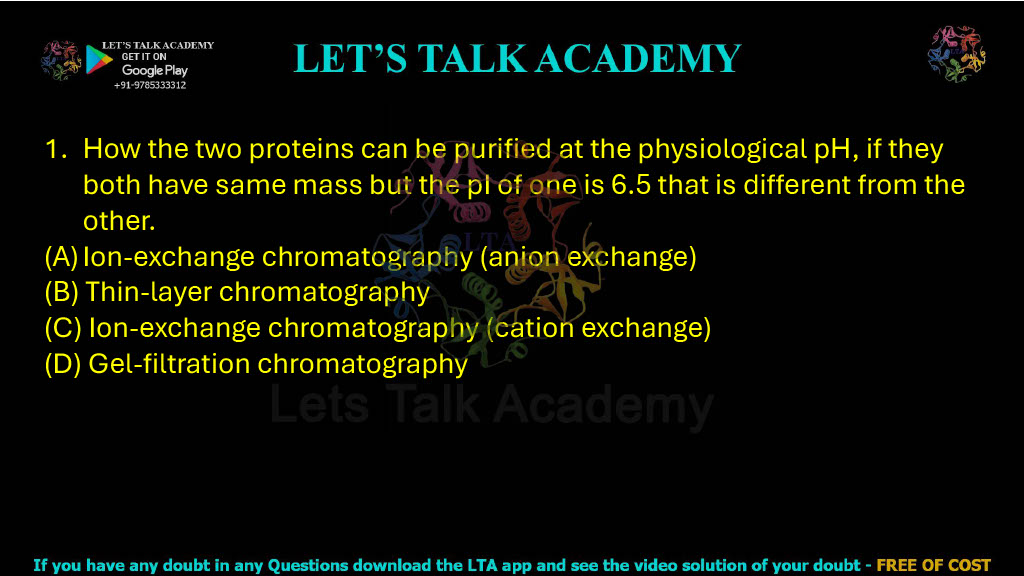
1. How can two proteins be purified at physiological pH if both have the same mass but the pI of one is 6.5 and different from the other?
A. Ion-exchange chromatography (anion exchange)
B. Thin-layer chromatography
C. Ion-exchange chromatography (cation exchange)
D. Gel-filtration chromatography
Ion-exchange chromatography separates proteins based on charge differences at physiological pH (around 7.4), even if they have identical masses. This technique works for the scenario where one protein has pI 6.5 and the other has a different pI, allowing targeted purification.
Question Breakdown
The query asks how to purify two proteins of equal mass but differing pI values—one at 6.5—at physiological pH (~7.0-7.4). Mass-based methods fail here, but charge differences at this pH enable separation.
Option Analysis
A. Ion-Exchange Chromatography (Anion Exchange)
At pH 7.4 (>6.5), the pI 6.5 protein is negatively charged (anions bind to positively charged resin). If the other protein’s pI >7.4 (positive charge), it flows through unbound, allowing purification of the pI 6.5 protein. Effective if target has lower pI.
B. Thin-Layer Chromatography
This planar technique separates small molecules by adsorption or partition, not suited for proteins due to low resolution and denaturation risks. It ignores charge or pI differences, so incorrect.
C. Ion-Exchange Chromatography (Cation Exchange)
Cation exchange uses negatively charged resin binding positive proteins (pH < pI). At pH 7.4, pI 6.5 protein is negative (unbound), but requires other’s pI <7.4 for distinction—not specified as optimal.
D. Gel-Filtration Chromatography
Also called size-exclusion, this separates by hydrodynamic volume/mass alone. Same-mass proteins co-elute, ignoring pI or charge, so ineffective.
Correct Answer
C. Ion-exchange chromatography (cation exchange) best fits standard protocols for physiological pH where one protein (pI 6.5) is negative and the other (higher pI assumed) is positive, binding selectively. Anion (A) works if targeting the lower pI, but cation aligns with many biochem texts for pH > some pIs.
Protein Purification Techniques
Ion-exchange exploits net charge: proteins with pI < pH are negative (anion resin); pI > pH positive (cation resin). Physiological pH keeps native structure. Elute with salt gradients (e.g., NaCl <1M).
| Technique | Basis | Works Here? | Why/Why Not |
|---|---|---|---|
| Anion Exchange | Negative charge binding | Yes, if target pI < pH | Binds pI 6.5 protein |
| Cation Exchange | Positive charge binding | Yes (best) | Binds higher pI protein |
| Gel Filtration | Size/mass | No | Same mass |
| Thin Layer | Adsorption | No | Not for proteins |
For GATE Life Sciences prep, practice pI calculations: pI = average of pKa values of ionizable groups. Combine with affinity or gel filtration for multi-step purification.


2 Comments
Vanshika Sharma
January 29, 2026Cation exchange is the correct answer
Kanica Sunwalka
June 26, 2026PH > PI
OH- more -> protein is negatively charged
so , anion echange chr.
PI > PH
H+ MORE -> protein positively charged
so, cation exchange chr .