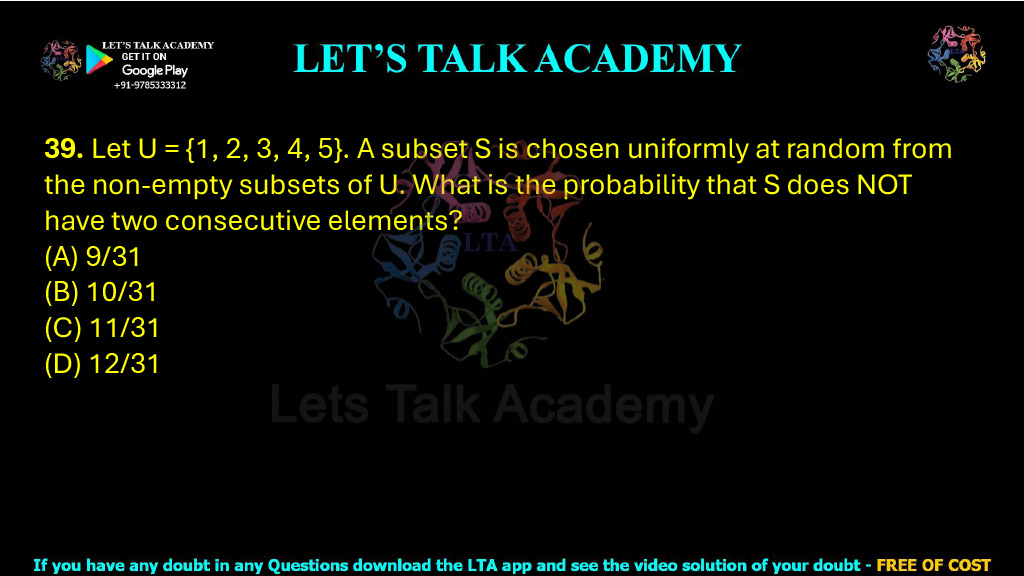
39. Let U = {1, 2, 3, 4, 5}. A subset S is chosen uniformly at random from the non-empty subsets of U. What is the probability that S does NOT have two consecutive elements?
(A) 9/31
(B) 10/31
(C) 11/31
(D) 12/31
Probability That a Subset of {1, 2, 3, 4, 5} Has No Two Consecutive Elements
Understanding the Probability Problem
This question combines two important concepts: subsets and probability. We are given the universal set:
U = {1, 2, 3, 4, 5}
A non-empty subset S is selected uniformly at random. The phrase uniformly at random means that every non-empty subset has the same probability of being selected. Therefore, the required probability can be calculated using:
Probability = Number of favourable non-empty subsets / Total number of non-empty subsets
The required subsets are those that do not contain any pair of consecutive elements. In other words, a valid subset cannot contain 1 and 2 together, 2 and 3 together, 3 and 4 together, or 4 and 5 together.
Finding the Total Number of Non-Empty Subsets
A set containing n elements has a total of:
2n
subsets, including the empty subset. Since the set U contains 5 elements, the total number of subsets is:
25 = 32
However, the question clearly states that S is selected only from the non-empty subsets. Therefore, we must exclude the empty subset.
Hence, the total number of possible non-empty subsets is:
32 − 1 = 31
Thus, the denominator of the required probability is 31.
Meaning of No Two Consecutive Elements
Two integers are consecutive when their difference is 1. In the set {1, 2, 3, 4, 5}, the consecutive pairs are:
{1, 2}, {2, 3}, {3, 4}, and {4, 5}
A favourable subset must not contain both elements of any of these pairs. For example, {1, 3} is valid because 1 and 3 are not consecutive, while {1, 2} is invalid because 1 and 2 are consecutive.
To avoid missing or repeating any subset, we count the favourable subsets according to their number of elements.
Counting One-Element Subsets
Every subset containing only one element automatically satisfies the condition because two consecutive elements cannot occur in a set containing only one element.
The one-element subsets are:
{1}, {2}, {3}, {4}, {5}
Therefore, the number of favourable one-element subsets is:
5
Counting Two-Element Subsets With No Consecutive Elements
We now list all two-element subsets in which the two selected numbers are not consecutive.
The valid two-element subsets are:
{1, 3}
{1, 4}
{1, 5}
{2, 4}
{2, 5}
{3, 5}
Each of these subsets contains two elements whose difference is greater than 1. Therefore, none of them contains two consecutive elements.
Hence, the number of favourable two-element subsets is:
6
Counting Three-Element Subsets With No Consecutive Elements
We now consider subsets containing three elements. Since the original set contains only five consecutive integers, there is very limited space to choose three elements without selecting any consecutive pair.
The only possible three-element subset satisfying the condition is:
{1, 3, 5}
In this subset, the difference between each pair of neighbouring selected elements is 2, so no two selected elements are consecutive.
Therefore, the number of favourable three-element subsets is:
1
Why No Valid Subset Can Contain Four or Five Elements
A subset containing four elements from {1, 2, 3, 4, 5} must necessarily contain at least one pair of consecutive integers. There is not enough separation between the numbers to choose four elements without selecting consecutive values.
Similarly, the five-element subset:
{1, 2, 3, 4, 5}
contains several consecutive pairs and therefore does not satisfy the required condition.
Hence, the number of favourable subsets containing four or five elements is:
0
Calculating the Total Number of Favourable Subsets
We now add all the valid non-empty subsets counted according to their sizes.
The number of valid one-element subsets is:
5
The number of valid two-element subsets is:
6
The number of valid three-element subsets is:
1
Therefore, the total number of favourable subsets is:
5 + 6 + 1 = 12
Calculating the Required Probability
The probability of an event is given by:
Probability = Number of favourable outcomes / Total number of possible outcomes
Here:
Number of favourable subsets = 12
and:
Total number of non-empty subsets = 31
Therefore:
Probability = 12/31
Alternative Combinatorial Method
The same result can also be obtained using a standard counting formula. The number of ways to choose k elements from n consecutive integers such that no two selected elements are consecutive is:
C(n − k + 1, k)
For n = 5, we count the possible non-empty subsets for different values of k.
For k = 1
C(5 − 1 + 1, 1) = C(5, 1) = 5
For k = 2
C(5 − 2 + 1, 2) = C(4, 2) = 6
For k = 3
C(5 − 3 + 1, 3) = C(3, 3) = 1
Therefore, the total number of favourable non-empty subsets is:
5 + 6 + 1 = 12
This confirms the result obtained by directly listing and counting the valid subsets.
Analysis of All the Given Options
Option (A): 9/31
This option is incorrect. There are not 9 favourable subsets. A complete count gives 5 valid one-element subsets, 6 valid two-element subsets, and 1 valid three-element subset, producing a total of 12 favourable subsets.
Option (B): 10/31
This option is incorrect. The denominator 31 is correct because there are 31 non-empty subsets, but the numerator does not represent the correct number of subsets having no two consecutive elements.
Option (C): 11/31
This option is incorrect. A count of 11 usually results from overlooking one valid subset. When all valid subsets are systematically counted according to their sizes, the total is 12.
Option (D): 12/31
This option is correct. There are exactly 12 non-empty subsets of {1, 2, 3, 4, 5} that contain no two consecutive elements, while the total number of possible non-empty subsets is 31.
Final Answer
The total number of non-empty subsets of U is:
31
The number of non-empty subsets having no two consecutive elements is:
12
Therefore, the required probability is:
12/31
Correct Option: (D) 12/31


