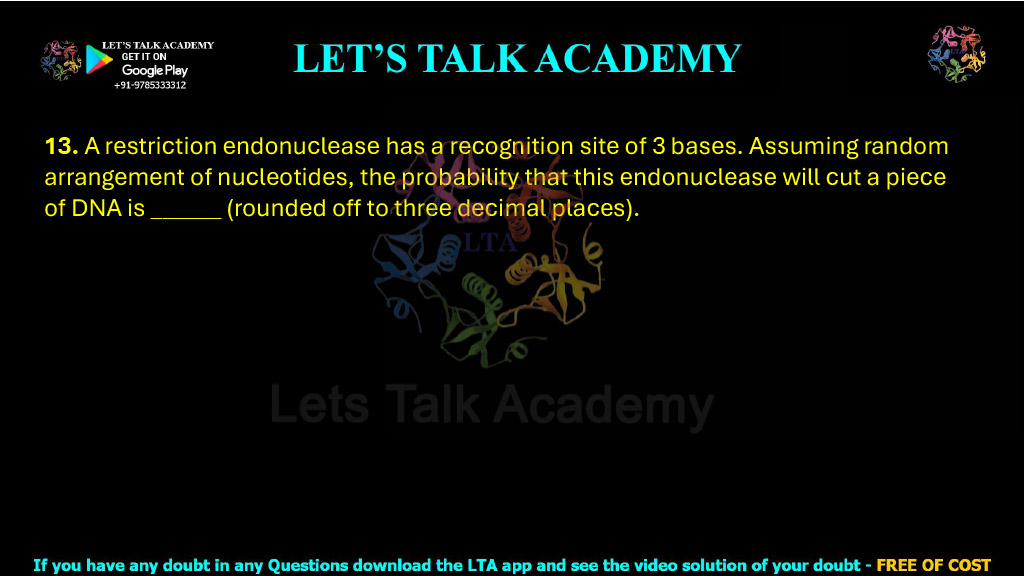
13. A restriction endonuclease has a recognition site of 3 bases. Assuming random arrangement of nucleotides, the probability that this endonuclease will cut a piece of DNA is ______ (rounded off to three decimal places).
Probability That a Restriction Endonuclease with a 3-Base Recognition Site Will Cut DNA
Understanding the Restriction Endonuclease Probability Problem
This question combines a fundamental concept of molecular biology with basic probability. A restriction endonuclease recognizes a specific nucleotide sequence in DNA and cuts the DNA when that particular recognition sequence is present. Here, the recognition site consists of three bases, and the nucleotides in the DNA are assumed to be arranged randomly.
The central question is therefore: what is the probability that a particular sequence of three specified nucleotides will occur at a given position in randomly arranged DNA?
DNA contains four possible nucleotide bases:
Adenine (A), Thymine (T), Guanine (G), and Cytosine (C)
Under the assumption of a random arrangement, each of these four nucleotides is equally likely to occur at any position. Therefore, the probability of obtaining one specific required nucleotide at a particular position is 1/4.
What Is a Restriction Endonuclease Recognition Site?
A restriction endonuclease is an enzyme that recognizes a specific DNA sequence and cleaves the DNA at or near that sequence. The specific nucleotide sequence recognized by the enzyme is called its recognition site or recognition sequence.
In this problem, the recognition site is three bases long. We can represent a hypothetical recognition sequence as:
X-Y-Z
Here, X, Y, and Z represent three specific nucleotides required by the restriction endonuclease. The enzyme will recognize and cut the DNA only when all three required bases occur in the correct order.
For example, if the hypothetical recognition sequence were A-G-C, then the first position must contain A, the second position must contain G, and the third position must contain C. Any other sequence would not match that specific recognition site.
Step-by-Step Solution
Step 1: Determine the Probability of One Specific Nucleotide
At any position in randomly arranged DNA, there are four possible nucleotides:
A, T, G, or C
Since all four nucleotides are assumed to occur with equal probability, the probability of obtaining one particular required nucleotide is:
Probability of one specific nucleotide = 1/4
Thus, if the first base of the recognition site must be a particular nucleotide, the probability of obtaining that correct base is 1/4.
Step 2: Calculate the Probability of a Specific 3-Base Sequence
The recognition site contains three specific bases. For the restriction enzyme to recognize the DNA, all three nucleotide positions must contain the correct bases in the correct order.
The probability of obtaining the correct nucleotide at the first position is:
1/4
The probability of obtaining the correct nucleotide at the second position is also:
1/4
Similarly, the probability of obtaining the correct nucleotide at the third position is:
1/4
Because the nucleotide positions are assumed to be randomly and independently arranged, the multiplication rule of probability is applied. Therefore:
Probability of the specific 3-base recognition site = (1/4) × (1/4) × (1/4)
Thus:
Probability = (1/4)3
Step 3: Simplify the Probability
Evaluating the expression:
(1/4)3 = 1/(4 × 4 × 4)
Therefore:
Probability = 1/64
Converting this fraction into decimal form:
1/64 = 0.015625
Hence, the exact decimal probability is:
Probability = 0.015625
Step 4: Round the Answer to Three Decimal Places
The question asks for the final answer rounded off to three decimal places. The calculated value is:
0.015625
To round this number to three decimal places, we retain the first three digits after the decimal point:
0.015
The next digit is 6. Since this digit is greater than or equal to 5, the third decimal digit is increased by one.
Therefore:
0.015625 ≈ 0.016
Why the Probability Is (1/4)³
The recognition sequence contains three positions, and each position must contain one particular nucleotide. At every position, one desired nucleotide must be selected from four equally probable possibilities. Therefore, the probability associated with each position is 1/4.
For the complete recognition sequence to occur, the correct nucleotide must appear at the first position, the correct nucleotide must appear at the second position, and the correct nucleotide must also appear at the third position. Since all three conditions must occur together, their probabilities are multiplied.
Therefore:
Probability = 1/4 × 1/4 × 1/4 = 1/64
This gives a probability of 0.015625, which becomes 0.016 when rounded to three decimal places.
Understanding the Problem Through All Possible 3-Base Sequences
The same answer can be understood by counting the total number of possible sequences of length three. Each position can contain any one of four nucleotides.
For the first position, there are 4 possibilities. For each of these possibilities, the second position also has 4 possibilities, and the third position again has 4 possibilities.
Therefore, the total number of possible 3-base sequences is:
4 × 4 × 4 = 43
Thus:
Total possible 3-base sequences = 64
Out of these 64 possible sequences, only one represents the particular recognition sequence required by the restriction endonuclease. Therefore:
Probability = Number of favorable sequences / Total number of possible sequences
Probability = 1/64
Probability = 0.015625 ≈ 0.016
This counting approach gives exactly the same result as the direct probability method.
General Formula for a Restriction Enzyme Recognition Site
If a restriction endonuclease recognizes a specific sequence containing n bases and the four nucleotides occur randomly with equal probability, the probability of finding that specific sequence at a given position is:
Probability of recognition site = (1/4)n = 1/4n
For the present problem:
n = 3
Therefore:
Probability = 1/43
= 1/64
= 0.015625
≈ 0.016
This general formula is useful for comparing restriction enzymes with different recognition-site lengths. As the length of the recognition sequence increases, the probability of finding that exact sequence at a given position decreases.
Biological Interpretation of the Result
A probability of 1/64 means that, under the simplified assumption of completely random and equally frequent nucleotides, a specific 3-base recognition sequence is expected at approximately one out of every 64 possible starting positions in a sufficiently long DNA sequence.
The decimal probability 0.015625 is equivalent to approximately 1.5625%. This means that the probability of obtaining the exact required three-base sequence at a particular position is relatively low, even though the recognition site is short.
In real biological DNA, nucleotide frequencies may not always be equal, and neighboring nucleotides may not be completely independent. However, the question explicitly assumes a random arrangement of nucleotides, so the equal-probability model is the correct approach.
Final Answer
The probability that the restriction endonuclease will recognize and cut the DNA at a given 3-base sequence is 1/64 = 0.015625, which is 0.016 when rounded off to three decimal places.


