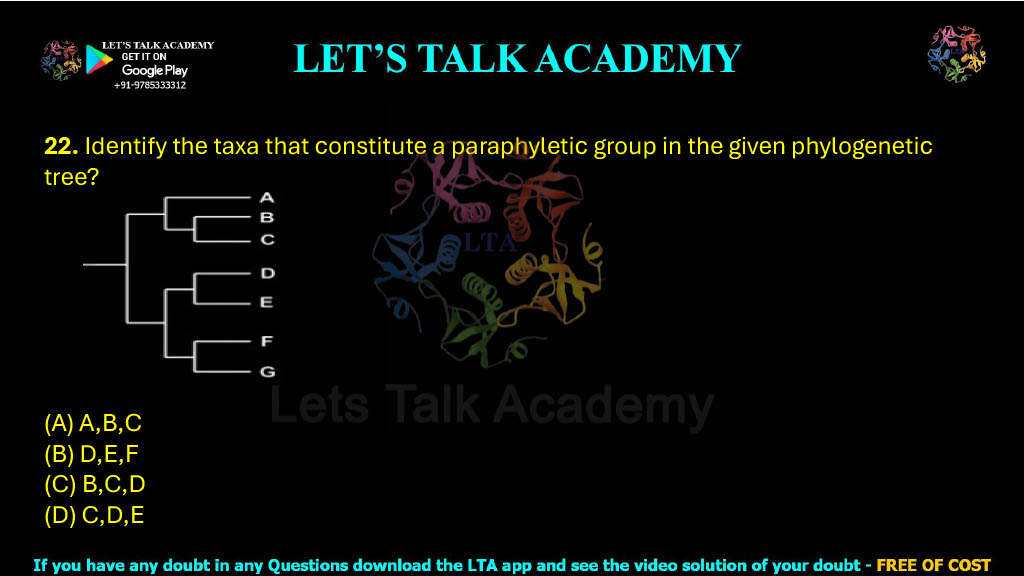
22. Identify the taxa that constitute a paraphyletic group in the given phylogenetic tree?
(A) A,B,C
(B) D,E,F
(C) B,C,D
(D) C,D,E
Paraphyletic Group in a Phylogenetic Tree: Identifying the Correct Taxa
Correct Answer: (B) D, E, F
The taxa D, E, and F constitute a paraphyletic group in the given phylogenetic tree. Therefore, the correct answer is option (B).
To understand the answer, we must follow the branching pattern carefully. The tree shows that the ancestral lineage divides into two major groups. The upper lineage contains taxa A, B, and C, whereas the lower lineage contains taxa D, E, F, and G. Within the lower group, D and E are sister taxa, while F and G are another pair of sister taxa.
The most recent common ancestor of D, E, and F also gives rise to G. However, G has been excluded from the proposed group. Thus, D, E, and F include a common ancestor but fail to include all descendants of that ancestor. This is precisely the definition of a paraphyletic group.
Understanding the Branching Pattern of the Given Phylogenetic Tree
Before identifying a paraphyletic group, it is important to read the phylogenetic tree from the ancestral branches toward the terminal taxa.
The first major branching event separates the taxa into two principal evolutionary lineages. The upper lineage contains:
A, B, and C
The lower lineage contains:
D, E, F, and G
Within the upper lineage, taxa B and C share a more recent common ancestor with each other than either shares with A. Therefore, B and C are sister taxa, and the group containing A, B, and C forms a complete evolutionary branch.
Within the lower lineage, D and E form one sister pair, while F and G form another sister pair. All four taxa—D, E, F, and G—can be traced back to the same ancestral branch.
This lower branch is crucial for answering the question. If we select D, E, and F but leave out G, we include some but not all descendants of their common ancestor. The resulting group is therefore paraphyletic.
What Is a Paraphyletic Group?
A paraphyletic group is an evolutionary group that contains a common ancestor and some, but not all, of its descendants.
The defining feature of paraphyly is incomplete inclusion of descendants. Once the relevant common ancestor has been identified, every lineage descending from that ancestor must be examined. If one or more descendant lineages are excluded, the group becomes paraphyletic.
In the given tree, the common ancestor associated with the lower major lineage produces the following descendants:
D, E, F, and G
If the selected group contains:
D, E, and F
but excludes:
G
then the group contains the ancestral lineage and only part of its complete descendant set.
Therefore:
Common ancestor + some descendants, but not all descendants = paraphyletic group
This definition directly explains why D, E, and F are the correct answer.
Why Is Option (B) D, E, F Correct?
Option (B) is correct.
The most recent common ancestor required to connect taxa D, E, and F belongs to the lower branch of the phylogenetic tree. That same ancestral branch also gives rise to taxon G.
The complete set of descendants from this branch is:
D, E, F, and G
However, option (B) includes only:
D, E, and F
Taxon G is excluded even though it is also a descendant of the same ancestral lineage. In fact, F and G are sister taxa and share an immediate common ancestor. Selecting F while excluding G makes the incomplete nature of the group especially clear.
The group D, E, and F therefore contains a common ancestral lineage but does not contain all descendants arising from it. This matches the definition of a paraphyletic group exactly.
Thus:
D + E + F = common ancestor included conceptually, but one descendant lineage G is excluded
Therefore, option (B) D, E, F is the correct answer.
Detailed Explanation of Option (A): A, B, C
Option (A) is incorrect because A, B, and C form a monophyletic group rather than a paraphyletic group.
In the upper portion of the phylogenetic tree, A, B, and C originate from a common ancestral branch. B and C are more closely related to each other, while A branches earlier from their shared lineage.
The important point is that when the most recent common ancestor of A, B, and C is identified, all descendants of that ancestor are included in the group. No descendant lineage from this particular ancestral node is omitted.
Therefore, the group contains:
the common ancestor + all descendants
This makes A, B, and C a monophyletic group, also called a clade.
A monophyletic group can be removed from a phylogenetic tree with a single conceptual cut at the branch leading to the group. The branch containing A, B, and C satisfies this condition perfectly.
Therefore, option (A) does not represent a paraphyletic group.
Detailed Explanation of Option (B): D, E, F
Option (B) is correct because D, E, and F form a paraphyletic group.
The lower major branch contains four descendant taxa:
D, E, F, and G
Within this branch, D and E are sister taxa, while F and G are sister taxa. The ancestral lineage connecting D, E, and F also has G among its descendants.
When D, E, and F are selected, G is left outside the group. The group therefore fails to include the complete descendant set of the relevant ancestor.
This is the central feature of a paraphyletic group. Such a group is based on genuine common ancestry, but its membership is incomplete because at least one descendant lineage is excluded.
Therefore:
D, E, F + exclusion of descendant G = paraphyletic group
For this reason, option (B) is the correct answer.
Detailed Explanation of Option (C): B, C, D
Option (C) is incorrect.
Taxa B and C belong to the upper major evolutionary lineage, whereas D belongs to the lower major lineage. To find the common ancestor connecting B, C, and D, we must move much farther back in the phylogenetic tree to the deeper ancestral region from which both major branches originated.
That deeper ancestor also gave rise to several other taxa, including A, E, F, and G. However, these taxa are excluded from the proposed group B, C, and D.
More importantly, the selected taxa do not represent one natural, continuous branch in the tree. B and C form a closely related pair, but D is taken from a separate major lineage while its close evolutionary associates are excluded.
Thus, B, C, and D do not represent the intended paraphyletic grouping shown by the tree. Option (C) combines taxa from separated portions of the phylogeny and is therefore not the correct answer.
Detailed Explanation of Option (D): C, D, E
Option (D) is incorrect.
Taxon C belongs to the upper major branch of the tree, whereas D and E belong to the lower major branch. D and E are sister taxa, but C is part of a separate evolutionary lineage.
To connect C with D and E, the tree must be traced back to a much deeper common ancestor. That ancestor also has several other descendants, including A, B, F, and G, none of which are included in option (D).
The combination C, D, and E therefore does not correspond to the specific paraphyletic group represented by the lower branch. Instead, it combines one taxon from the upper lineage with two taxa from the lower lineage.
For this reason, option (D) is not the correct answer.
Difference Between Monophyletic and Paraphyletic Groups
Understanding the difference between monophyletic and paraphyletic groups is essential for interpreting this question correctly.
A monophyletic group contains a common ancestor and all of its descendants. Such a group is also called a clade. In the given tree, A, B, and C form a monophyletic group because the complete descendant set of their relevant common ancestor is included.
A paraphyletic group, in contrast, contains a common ancestor but excludes one or more descendant lineages. In the given tree, D, E, and F form a paraphyletic group because taxon G, another descendant of the relevant ancestral lineage, is excluded.
Therefore:
A, B, C → Monophyletic
D, E, F → Paraphyletic
The presence or absence of all descendant lineages is the key difference between these two evolutionary groupings.
Difference Between Paraphyletic and Polyphyletic Groups
A paraphyletic group is based on a genuine ancestral lineage but leaves out one or more descendants. A polyphyletic group, by contrast, brings together taxa from separate evolutionary branches while excluding the relevant common ancestral framework that naturally connects them.
In a paraphyletic group, the selected organisms still form an incomplete section of a natural lineage. In a polyphyletic grouping, taxa are often selected from different branches because of a superficial similarity or another criterion that does not reflect their closest evolutionary relationships.
In this phylogenetic tree, D, E, and F are associated with the same lower ancestral branch, but the omission of G makes the group incomplete. This is why they represent the clearest paraphyletic group among the given options.
How to Identify a Paraphyletic Group in a Phylogenetic Tree
The most reliable way to identify a paraphyletic group is to locate the common ancestor of the selected taxa and then trace every branch descending from that ancestor.
If all descendants are included, the group is monophyletic. If one or more descendants are missing, while the selected taxa still represent an incomplete ancestral lineage, the group is paraphyletic.
Applying this method to D, E, and F reveals that their ancestral branch also leads to G. Since G is missing from the selected group, the group is paraphyletic.
The tree can be interpreted as:
Lower ancestral lineage → D, E, F, and G
The option selects:
D, E, and F
The excluded descendant is:
G
Therefore, the group is paraphyletic.
Role of Sister Taxa in Solving the Question
Sister taxa are two lineages that share an immediate common ancestor. Identifying sister taxa makes the structure of a phylogenetic tree easier to understand.
In the given tree:
B and C are sister taxa
D and E are sister taxa
F and G are sister taxa
The pair F and G is particularly important for solving the question. Option (B) includes F but excludes its sister taxon G. When the larger ancestral lineage containing D, E, F, and G is considered, this omission produces an incomplete descendant set.
This confirms that D, E, and F constitute a paraphyletic group.
Why the Exact Branching Pattern Matters
Phylogenetic questions cannot be solved simply by looking at the alphabetical order of taxa or by counting how many taxa appear together. The actual branching pattern determines the evolutionary relationship.
For example, A, B, and C appear consecutively and also form a complete clade. However, D, E, and F also appear consecutively but do not form a complete clade because the same ancestral branch also contains G.
This demonstrates why the topology of the tree is more important than the visual position or order of the labels. The correct method is always to trace the branches back to their common ancestor and then identify every descendant of that ancestor.
Final Answer
The correct answer is (B) D, E, F.
In the given phylogenetic tree, the lower ancestral lineage gives rise to D, E, F, and G. The group proposed in option (B) contains D, E, and F but excludes G.
Because a paraphyletic group contains a common ancestor and some, but not all, of its descendants, D, E, and F constitute the paraphyletic group.
Correct Answer: (B) D, E, F


