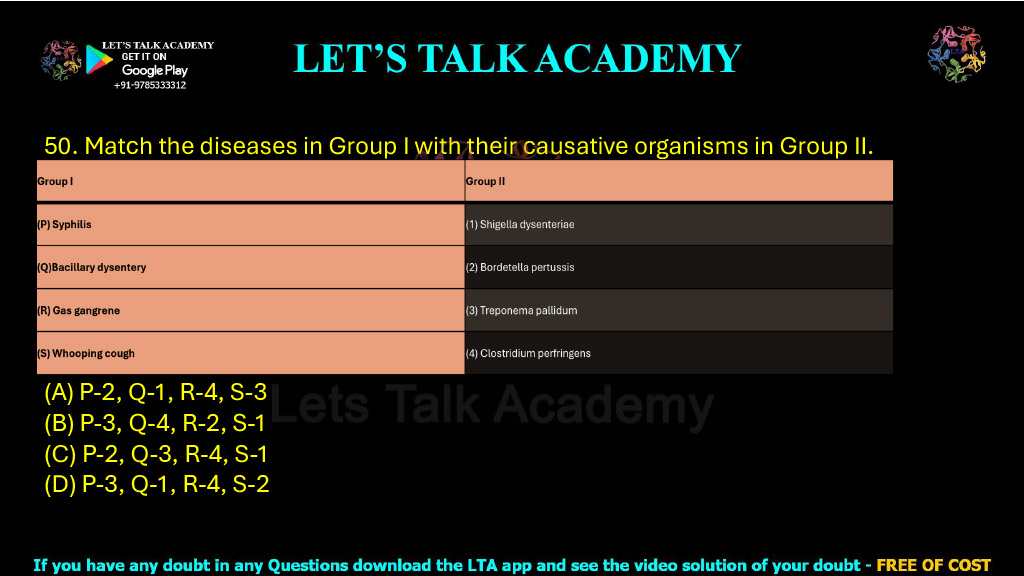
50. Match the diseases in Group I with their causative organisms in Group II.
| Group I | Group II |
| (P) Syphilis | (1) Shigella dysenteriae |
| (Q)Bacillary dysentery | (2) Bordetella pertussis |
| (R) Gas gangrene | (3) Treponema pallidum |
| (S) Whooping cough | (4) Clostridium perfringens |
(A) P-2, Q-1, R-4, S-3
(B) P-3, Q-4, R-2, S-1
(C) P-2, Q-3, R-4, S-1
(D) P-3, Q-1, R-4, S-2
Diseases and Their Causative Organisms: Syphilis, Bacillary Dysentery, Gas Gangrene, and Whooping Cough Explained
Introduction
Identifying infectious diseases and their causative microorganisms is one of the most fundamental concepts in microbiology, medical science, immunology, and biotechnology. Every pathogenic microorganism possesses unique structural, physiological, and virulence characteristics that enable it to infect specific host tissues and produce characteristic clinical symptoms. Understanding these disease-organism relationships is essential for disease diagnosis, treatment, prevention, vaccine development, and epidemiological surveillance.
Among bacterial pathogens, Treponema pallidum causes syphilis, Shigella dysenteriae causes bacillary dysentery, Clostridium perfringens is responsible for gas gangrene, and Bordetella pertussis causes whooping cough (pertussis). These pathogens are frequently tested in competitive examinations because they represent classical examples of medically important bacterial diseases.
Correct Answer
Correct Option: (D)
P-3, Q-1, R-4, S-2
Detailed Explanation
Syphilis is a sexually transmitted bacterial disease caused by the spirochete Treponema pallidum. The disease progresses through primary, secondary, latent, and tertiary stages if left untreated. The characteristic primary lesion is a painless chancre, while advanced stages may involve the nervous and cardiovascular systems.
Bacillary dysentery is caused by Shigella dysenteriae, a Gram-negative rod that invades the intestinal mucosa and produces Shiga toxin. Patients typically develop severe diarrhea containing blood and mucus, abdominal cramps, fever, and dehydration.
Gas gangrene is caused primarily by Clostridium perfringens, a Gram-positive, anaerobic, spore-forming bacterium. It produces powerful exotoxins that rapidly destroy muscle tissue and generate gas within infected tissues, making the condition a surgical emergency.
Whooping cough, also known as pertussis, is caused by Bordetella pertussis, a Gram-negative coccobacillus. The disease is characterized by severe coughing spells followed by the characteristic inspiratory “whoop.” Vaccination with the DPT or DTaP vaccine provides effective protection.
Therefore, the correct matching is:
- Syphilis → Treponema pallidum (3)
- Bacillary dysentery → Shigella dysenteriae (1)
- Gas gangrene → Clostridium perfringens (4)
- Whooping cough → Bordetella pertussis (2)
Explanation of Each Match
P. Syphilis → Treponema pallidum (3)
This match is correct. Treponema pallidum is a spiral-shaped spirochete transmitted mainly through sexual contact.
Q. Bacillary Dysentery → Shigella dysenteriae (1)
This match is correct. Shigella dysenteriae infects the large intestine and produces severe inflammatory diarrhea.
R. Gas Gangrene → Clostridium perfringens (4)
This match is correct. The bacterium produces alpha toxin and other enzymes that rapidly destroy tissues and generate gas.
S. Whooping Cough → Bordetella pertussis (2)
This match is correct. Bordetella pertussis infects the respiratory tract and produces pertussis toxin responsible for prolonged coughing episodes.
Why Option (D) is Correct
Option (D) correctly matches each disease with its well-established bacterial pathogen:
- Syphilis → Treponema pallidum
- Bacillary dysentery → Shigella dysenteriae
- Gas gangrene → Clostridium perfringens
- Whooping cough → Bordetella pertussis
Why the Other Options are Incorrect
Option (A)
This option incorrectly pairs Syphilis with Bordetella pertussis and Whooping cough with Treponema pallidum.
Option (B)
This option incorrectly matches Bacillary dysentery with Clostridium perfringens and Gas gangrene with Bordetella pertussis.
Option (C)
This option incorrectly assigns Syphilis to Bordetella pertussis and Bacillary dysentery to Treponema pallidum.
Comparison of All Options
| Option | Matching | Status |
|---|---|---|
| A | P-2, Q-1, R-4, S-3 | Incorrect |
| B | P-3, Q-4, R-2, S-1 | Incorrect |
| C | P-2, Q-3, R-4, S-1 | Incorrect |
| D | P-3, Q-1, R-4, S-2 | Correct |
Important Bacterial Diseases and Their Causative Organisms
| Disease | Causative Organism | Major Characteristic |
|---|---|---|
| Syphilis | Treponema pallidum | Sexually transmitted spirochetal infection |
| Bacillary Dysentery | Shigella dysenteriae | Bloody diarrhea caused by Shiga toxin |
| Gas Gangrene | Clostridium perfringens | Anaerobic tissue destruction with gas formation |
| Whooping Cough | Bordetella pertussis | Severe paroxysmal cough with inspiratory whoop |
Quick Revision Table
| Disease | Organism |
|---|---|
| Syphilis | Treponema pallidum |
| Bacillary Dysentery | Shigella dysenteriae |
| Gas Gangrene | Clostridium perfringens |
| Whooping Cough | Bordetella pertussis |
Biological Significance
Knowledge of disease-causing microorganisms is essential for accurate diagnosis, antimicrobial therapy, infection control, vaccination strategies, and epidemiological investigations. Each pathogen possesses unique virulence factors that determine its mode of transmission, pathogenic mechanisms, clinical manifestations, and therapeutic approach. Understanding these associations is fundamental in microbiology, medicine, biotechnology, and public health.
Final Answer
Correct Matching:
- P. Syphilis → (3) Treponema pallidum
- Q. Bacillary dysentery → (1) Shigella dysenteriae
- R. Gas gangrene → (4) Clostridium perfringens
- S. Whooping cough → (2) Bordetella pertussis
Correct Option: (D)


