Q.75 Match List I with List II : List I (A) Clonal propagation (B) Virus free plant (C) Haploid plant production (D) Secondary metabolite production List II (I) Meristem culture (II) Cell line culture in a bioreactor (III) Axillary bud (IV) Anther culture Choose the correct answer from the options given below: (1) (A)-(IV), (B)-(I), (C)-(II), (D)-(III) (2) (A)-(I), (B)-(III), (C)-(IV), (D)-(II) (3) (A)-(II), (B)-(IV), (C)-(III), (D)-(I) (4) (A)-(III), (B)-(I), (C)-(IV), (D)-(II)

Plant Tissue Culture Matching

Q.74 Bacterial artificial chromosomes (BAC) are capable of cloning fragments upto 500–750 kb 200–250 kb 50–150 kb 300–350 kb

Bacterial Artificial Chromosomes

Q.73 Arrange the following steps in E.coli translation sequentially. (A) Elongation (B) Release of polypeptide (C) Initiation (D) Folding of the polypeptide (E) Termination Choose the correct answer from the options given below: (B), (C), (D), (A), (E) (A), (D), (E), (C), (B) (C), (A), (E), (B), (D) (A), (B), (C), (D), (E)

E. coli Translation Steps Sequence

Q.72 First report of haploid production was in Brassica Mangifera Arabidopsis Datura

First Haploid Production Report in Plants

Q.71 Concept of totipotency in plant was demonstrated by CV Raman T. Morgan G. Haberlandt EC Cocking

Plant Totipotency Concept Demonstration History

Q.70 Match List I with List II : List I Enzymes List II Reaction Catalysed (A) Nitrate reductase (B) Alternative oxidase (C) Aconitase (D) ACC Oxidase (I) Conversion of 1 – aminocyclopropane-1-carboxylic acid to ethylene (II) Conversion of citrate to isocitrate (III) Reduction of oxygen to water (IV) Conversion of nitrate to nitrite Choose the correct answer from the options given below: (A)-(IV), (B)-(III), (C)-(II), (D)-(I) (A)-(I), (B)-(IV), (C)-(III), (D)-(II) (A)-(II), (B)-(I), (C)-(IV), (D)-(III) (A)-(III), (B)-(II), (C)-(I), (D)-(IV)

Nitrate Reductase Aconitase Alternative Oxidase ACC Oxidase Matching

Q.69 Given below are two statements: Statement I : The cuticle coats the outer cell walls of the epidermis on the aerial parts of plants and helps reducing water loss and entry of pathogens. Statement II : Cuticle is made up of cutin and wax which are hydrophobic and difficult to degrade. In the light of the above Statements, choose the correct answer from the options given below: Both Statement I and Statement II are true Both Statement I and Statement II are false Statement I is true but Statement II is false Statement I is false but Statement II is true

Plant Cuticle

Q.68 Choose the correct statements regarding Gibberellins. (A) All GAs possess a tetracyclic ent-gibberellane skeleton (B) GA biosynthesis inhibitors (Cycocel) help reducing plant stem length and lodging (C) GAs are diterpenoids (D) GA biosynthesis occurs in cytoplasm (E) GA is synthesised in the aleurone layer of embryo Choose the correct answer from the options given below: (A), (B), (C) only (A), (B), (C), (D) only (A), (B), (C), (E) only (A), (B), (D), (E) only

Gibberellins in Plants

Q.67 Select the enzyme involved in catalysis of substrate-level phosphorylation in citric acid cycle. Aconitase Succinate dehydrogenase Succinyl – CoA synthetase Fumarase

Enzyme Substrate-Level Phosphorylation Citric Acid Cycle

Q.66 Sucrose, a transportable form of carbon and energy in most plants, is synthesized in Chloroplast Cytosol Mitochondria Endoplasmic reticulum

Sucrose Synthesis Location

Q.65 Blue light elicits following responses for plants (A) It stimulates asymmetric growth (B) Inhibits stem elongation (C) Stimulates stomatal opening (D) Deactivates proton pump (E) Stimulates bending of stem Choose the correct answer from the options given below: (A), (B), (C) only (A), (C), (D), (E) only (A), (B), (C), (E) only (A), (E) only

Blue Light Effects

Q.64 Given below are two statements: One is labelled as Assertion (A) and the other is labelled as Reason (R): Assertion (A): Positive xylem pressure causes exudation of sap through hydathodes, a process called guttation. Reason (R): Guttation is noticed when transpiration is suppressed and relative humidity is high. In the light of the above statements, choose the correct answer from the options given below: Both (A) and (R) are true and (R) is the correct explanation of (A) Both (A) and (R) are true but (R) is NOT the correct explanation of (A) (A) is true but (R) is false (A) is false but (R) is true

Understanding Guttation and Positive Xylem Pressure

Q.63 Oxidation of H2O to produce O2 is performed by: (1) PS I in thylakoid (2) PS II in thylakoid (3) PS I in stroma (4) PS II in stroma

Oxidation of H₂O to O₂ by PS II

Q.62 The most important auxin present in higher plant is: (1) IAA (2) 4-Cl-IAA (3) IBA (4) 2, 4-D

Most Important Auxin in Higher Plants

Q.61 The active form of Phytochrome is: (1) Pfr (2) Pr (3) Fpr (4) Rp

Active Form of Phytochrome

Q.60 The main function of kinetochores in cell division is to provide the site of attachment for: (1) Centromere (2) Microtubules (3) Nucleus (4) Telomere

Main Function of Kinetochores

Q.59 Match List I with List II : List I (A) Ruminate Endosperm (B) Absence of Double Fertilization (C) Reduced embryos (D) Operculate seed List II (I) Podostemaceae (II) Lemna paucicostata (III) Coccoloba (IV) Orchidaceae Choose the correct answer from the options given below: (1) (A)-(II), (B)-(IV), (C)-(I), (D)-(III) (2) (A)-(III), (B)-(I), (C)-(IV), (D)-(II) (3) (A)-(I), (B)-(II), (C)-(III), (D)-(IV) (4) (A)-(IV), (B)-(III), (C)-(II), (D)-(I)

Ruminate Endosperm Podostemaceae Orchidaceae Seed Matching

Q.58 Parthenocarpy which arises due to mutations or hybridization is known as (1)Environmental Parthenocarpy (2)Genetic Parthenocarpy (3)Genetically Engineered Parthenocarpy (4)Chemically Induced Parthenocarpy

Parthenocarpy Mutations Hybridization Genetic Type

Q.57 Poppy plant exhibits self incompatibility of ________ type with ________ as male, and ________ as female determinants. Gametophytic / SLF / S-RNase Sporophytic / PrsS / SRK Sporophytic / SCR / SP11 Gametophytic / PrpS / PrsS

 Poppy Plant Self Incompatibility

Q.56 Cystein rich peptide involved in pollen tube attraction in the micropylar region of ovule in Arabidopsis. LeSTIG 1 LUREs GRP17 SCAs

Cystein rich peptide involved in

Q.55 Match List I with List II : List I (Types of Stomata) List II (Family Type) (A) Anomocytic (I) Cruciferous type (B) Anisocytic (II) Rubiaceous type (C) Paracytic (III) Ranunculaceous type (D) Diacytic (IV) Caryophyllous type Choose the correct answer from the options given below: (1) (A)-(III), (B)-(I), (C)-(II), (D)-(IV) (2) (A)-(I), (B)-(III), (C)-(IV), (D)-(II) (3) (A)-(II), (B)-(IV), (C)-(III), (D)-(I) (4) (A)-(IV), (B)-(II), (C)-(I), (D)-(III)

Anomocytic Anisocytic Paracytic Diacytic Stomata Match

Q.54 Match List I with List II : List I (A) Compositae (B) Umbelliferae (C) Labiatae (D) Cruciferae List II (I) Lamiaceae (II) Brassicaceae (III) Asteraceae (IV) Apiaceae Choose the correct answer from the options given below: (1) (A)-(II), (B)-(I), (C)-(IV), (D)-(III) (2) (A)-(I), (B)-(III), (C)-(II), (D)-(IV) (3) (A)-(III), (B)-(IV), (C)-(I), (D)-(II) (4) (A)-(IV), (B)-(II), (C)-(III), (D)-(I)

Compositae Umbelliferae Labiatae Cruciferae

Q.53 Match List I with List II : List I List II (A) Plesiomorphy (I) A derived trait in an evolutionary series (B) Symplesiomorphy (II) Possession of derived traits by a group of taxa (C) Synapomorphy (III) An ancestral or primitive trait/character (D) Apomorphy (IV) A group of taxa sharing a primitive trait Choose the correct answer from the options given below: (1) (A)-(I), (B)-(III), (C)-(IV), (D)-(II) (2) (A)-(III), (B)-(IV), (C)-(II), (D)-(I) (3) (A)-(IV), (B)-(II), (C)-(I), (D)-(III) (4) (A)-(II), (B)-(I), (C)-(III), (D)-(IV)

Plesiomorphy Symplesiomorphy Synapomorphy Apomorphy Matching

Q.52 Given below are two statements: Statement I : According to binomial nomenclature rules, Rosa indicum, Solanum indicus and Euonymus indica are the valid scientific names. Statement II : As Rosa, Solanum and Euonymus represent neuter, masculine and feminine genitive forms respectively, the specific epithets used are appropriate. In the light of the above Statements, choose the most appropriate answer: Both Statement I and Statement II are correct Both Statement I and Statement II are incorrect Statement I is correct but Statement II is incorrect Statement I is incorrect but Statement II is correct

 Binomial Nomenclature Rules

Q.51 Sepallata genes are considered essential for normal development of floral organs and they are grouped under the _________ category of homeotic genes. A genes B genes D genes E genes

Sepallata Genes Essential

Monophyletic vs Paraphyletic vs Polyphyletic Groups

Q.49 Match List I with List II : List I List II (A) Ontogeny repeats phylogeny (I) Doctrine of teratology (B) An abnormality is a reminiscent of a remote ancestor (II) Doctrine of sequences (C) Serial arrangement of organisms depicting gradation in a trait (III) Doctrine of association (D) In a derived trait, the primitive condition is similar to ancestral structure (IV) Doctrine of recapitulation Choose the correct answer from the options given below: (A)-(IV), (B)-(I), (C)-(II), (D)-(III) (A)-(II), (B)-(III), (C)-(IV), (D)-(I) (A)-(I), (B)-(II), (C)-(III), (D)-(IV) (A)-(III), (B)-(IV), (C)-(II), (D)-(I)

Ontogeny Repeats Phylogeny

Q.48 Match List I with List II List I List II (A) Nanda Devi (I) Meghalaya (B) Manas (II) Uttarakhand (C) Nokrek (III) Assam (D) Pachmarhi (IV) Madhya Pradesh Choose the correct answer from the options given below: (A)-(II), (B)-(III), (C)-(IV), (D)-(I) (A)-(II), (B)-(III), (C)-(I), (D)-(IV) (A)-(I), (B)-(II), (C)-(IV), (D)-(III) (A)-(I), (B)-(IV), (C)-(II), (D)-(III)

Biosphere Reserves Matching States India

Q.47 Given below are two statements: Statement I : Ecads of same species are genetically similar and interfertile. Statement II : Ecotypes are genetically different and are not interfertile. In the light of the above statements, choose the correct answer from the options given below: (1) Both Statement I and Statement II are true (2) Both Statement I and Statement II are false (3) Statement I is true but Statement II is false (4) Statement I is false but Statement II is true

Ecads vs Ecotypes

Q.46 Given below are two statements: One is labelled as Assertion (A) and the other is labelled as Reason (R): Assertion (A): Tropical regions have higher biodiversity as compared to other regions of earth. Reason (R): Tropical regions have older communities and they get more time for development and speciation as compared to other regions of earth. In the light of the above statements, choose the most appropriate answer from the options given below: Both (A) and (R) are correct and (R) is the correct explanation of (A) Both (A) and (R) are correct but (R) is NOT the correct explanation of (A) (A) is correct but (R) is not correct (A) is not correct but (R) is correct

Tropical Biodiversity Assertion Reason

Q.45 For selection of transgenic shoots, medium is essentially supplemented with: (1) Vitamins (2) Carbohydrates (3) Minerals (4) Antibiotics

Transgenic Shoots Selection Medium

Q.44 Stenohaline species can tolerate: (1) Narrow range of temperature (2) Narrow range of salinity (3) Wide range of temperature (4) Wide range of salinity

Stenohaline Species

Q.43 Match List I with List II : List I (A) Nucleic Acid (B) Bacterial Transformation (C) One gene one enzyme hypothesis (D) Restriction enzymes List II (I) George Beadle and E. Tatum (II) Johann Friedrich Miescher (III) W. Arber, H. Smith and D. Nathans (IV) Frederick Griffith Choose the correct answer from the options given below: (A)-(IV), (B)-(II), (C)-(I), (D)-(III) (A)-(II), (B)-(IV), (C)-(I), (D)-(III) (A)-(I), (B)-(II), (C)-(III), (D)-(IV) (A)-(III), (B)-(I), (C)-(IV), (D)-(II)

Nucleic Acid Bacterial Transformation Matching

Q.42 Given below are two statements: Statement I : Golden rice is a transgenic crop with enhanced levels of riboflavin (a precursor of vitamin A). Statement II : To create golden rice, the genes used were isolated from daffodil and a bacterium. In the light of the above statements, choose the correct answer from the options given below: (1) Both Statement I and Statement II are true (2) Both Statement I and Statement II are false (3) Statement I is true but Statement II is false (4) Statement I is false but Statement II is true

Golden Rice Statements

Q.41 In the chain elongation process, the factor involved in translocation of ribosome from one codon to the next along the mRNA is: (1) GDP (2) NADP (3) EF-G (4) EF-Tu

Chain Elongation Process

Q.40 Regulatory portion of plant genes located primarily upstream from the transcription site is called (1) Gene enhancer (2) Gene promoter (3) G-Box (4) Termination site

Regulatory Portion Plant Genes Upstream

Q.39 The citric-acid cycle takes place in (1) Mitochondrial matrix (2) Protoplast (3) Chloroplast membrane (4) Cell membrane

Citric Acid Cycle Location

Q.38 Given below are two statements: One is labelled as Assertion (A) and the other is labelled as Reason (R): Assertion (A): Embryo rescue technique is used for embryo culture. Reason (R): In case of embryo rescue, the objective is to rescue the developing embryo from the egg cell. In the light of the above statements, choose the most appropriate answer from the options given below: (1) Both (A) and (R) are correct and (R) is the correct explanation of (A) (2) Both (A) and (R) are correct but (R) is NOT the correct explanation of (A) (3) (A) is correct but (R) is not correct (4) (A) is not correct but (R) is correct

Embryo Rescue Technique

Q.37 Which of the following are autosomal dominant traits? (A) Colour blindness (B) Myotonic dystrophy (C) Phenylthio Carbamide Tasting (D) Phenylketonuria (E) Brachydactyly Choose the most appropriate answer from the options given below: (1) (A), (C), (D) only (2) (A), (B), (D) only (3) (A), (D), (E) only (4) (B), (C), (E) only

Autosomal Dominant Traits

Q.36 Genes which code for primary structure of enzymes in operon model are called : (1) Structural genes (2) Repressor genes (3) Regulatory genes (4) Negative genes

Genes Which Code for Primary Structure

Q.35 Double-helix structure of DNA is made up of a linear polymer comprised of subunits called (1) Nucleic acids (2) Amino acids (3) Nucleotides (4) Carbohydrates

Double Helix Structure

Q.34 The extra-chromosomal heredity unit, circular in nature is called (1) X-Factor (2) Plasmid (3) Cosmid (4) RecA Protein

Extra-Chromosomal Heredity Unit

Q.33 Given below are two statements: One is labelled as Assertion (A) and the other is labelled as Reason (R): Assertion (A): Pollen fixed in Formalin : Acetic acid : Alcohol can be used to ascertain fertility but not the viability. Reason (R): Pollen fertility refers to the ability of a plant to produce fertile pollen grains, whereas the viability refers to the ability to germinate and produce a pollen tube. In the light of the above statements, choose the most appropriate answer from the options given below: (1) Both (A) and (R) are correct and (R) is the correct explanation of (A) (2) Both (A) and (R) are correct but (R) is NOT the correct explanation of (A) (3) (A) is correct but (R) is not correct (4) (A) is not correct but (R) is correct

 Pollen Fertility vs Viability Assertion Reason

Q.32 Which plant is known for its orange-red dye from flowers? (1) Dalbergia sissoo (2) Butea monosperma (3) Lawsonia inermis (4) Clitoria ternatea

Which Plant Orange-Red Dye Flowers?

Q.31 Which one of the following plant yields foxnut? (1) Euryale ferox (2) Nelumbo nouchali (3) Nelumbo alba (4) Victoria regia

Which Plant Yields Foxnut?

Q.30 Nuclear pores present on nuclear envelope are enclosed by a circular structure called as (1) Lamina (2) Annuli (3) Granum (4) Vesicle

Nuclear Pores Annuli

Q.29 Drug ‘quinine’ used for treatment of malaria is obtained from (1) Artemisia absinthium (2) Rauwolfia serpentina (3) Cinchona spp. (4) Ipomoea violacea

Quinine Drug Malaria

Q.28 Match List I with List II: List I (Scientific Names) List II (Common Names) (A) Eugenia caryophyllus (I) Nutmeg (B) Elettaria cardamomum (II) Clove (C) Myristica fragrans (III) Cardamom (D) Carum carvi (IV) Caraway seed Choose the correct answer from the options given below: (1) (A)-(II), (B)-(III), (C)-(I), (D)-(IV) (2) (A)-(I), (B)-(III), (C)-(II), (D)-(IV) (3) (A)-(IV), (B)-(III), (C)-(I), (D)-(II) (4) (A)-(I), (B)-(III), (C)-(IV), (D)-(II)

Eugenia Caryophyllus Elettaria

Q.27 Given below are two statements: Statement I: Rauwolfia serpentina was used by native Indians for snake-bite and as tranquilizer for the treatment of mental disorders. Statement II: Taxol is a drug obtained from plant Taxus brevifolia which is used for treatment of leprosy. In the light of the above statements, choose the most appropriate answer from the options given below: (1) Both Statement I and Statement II are correct (2) Both Statement I and Statement II are incorrect (3) Statement I is correct but Statement II is incorrect (4) Statement I is incorrect but Statement II is correct

Rauwolfia Serpentina Taxol Taxus

Q.26 Match List I with List II: List I List II (A) Phyllotaxy (I) H.H. Dixon and J. Joly (B) Cohesion theory (II) E. Munch (C) Pressure flow hypothesis (III) Leonardo Fibonacci (D) Quiescent center (IV) F.A.L. Clowes Choose the correct answer from the options given below: (1) (A)-(II), (B)-(III), (C)-(IV), (D)-(I) (2) (A)-(III), (B)-(I), (C)-(II), (D)-(IV) (3) (A)-(IV), (B)-(II), (C)-(III), (D)-(I) (4) (A)-(I), (B)-(IV), (C)-(II), (D)-(III)

 Match Phyllotaxy Cohesion Theory

Q.25 P-proteins are associated with differentiation of __________ (1) Paracytic stomata (2) Paratracheal parenchyma (3) Pneumatophore (4) Phloem sieve elements

P-Proteins Differentiation

Q.24 Companion cells which are located close to the sieve tube serve the same function as (1) Strasburger cells (2) Bulliform cells (3) Phellogen (4) Cells with bars of Sanio

Companion Cells Sieve Tube

Q.23 Mycorrhizal fungi helps in delivery of which key ions to the plant system? (1) Phosphate ions (2) Sodium ions (3) Chloride ions (4) Carbonate ions

Mycorrhizal Fungi

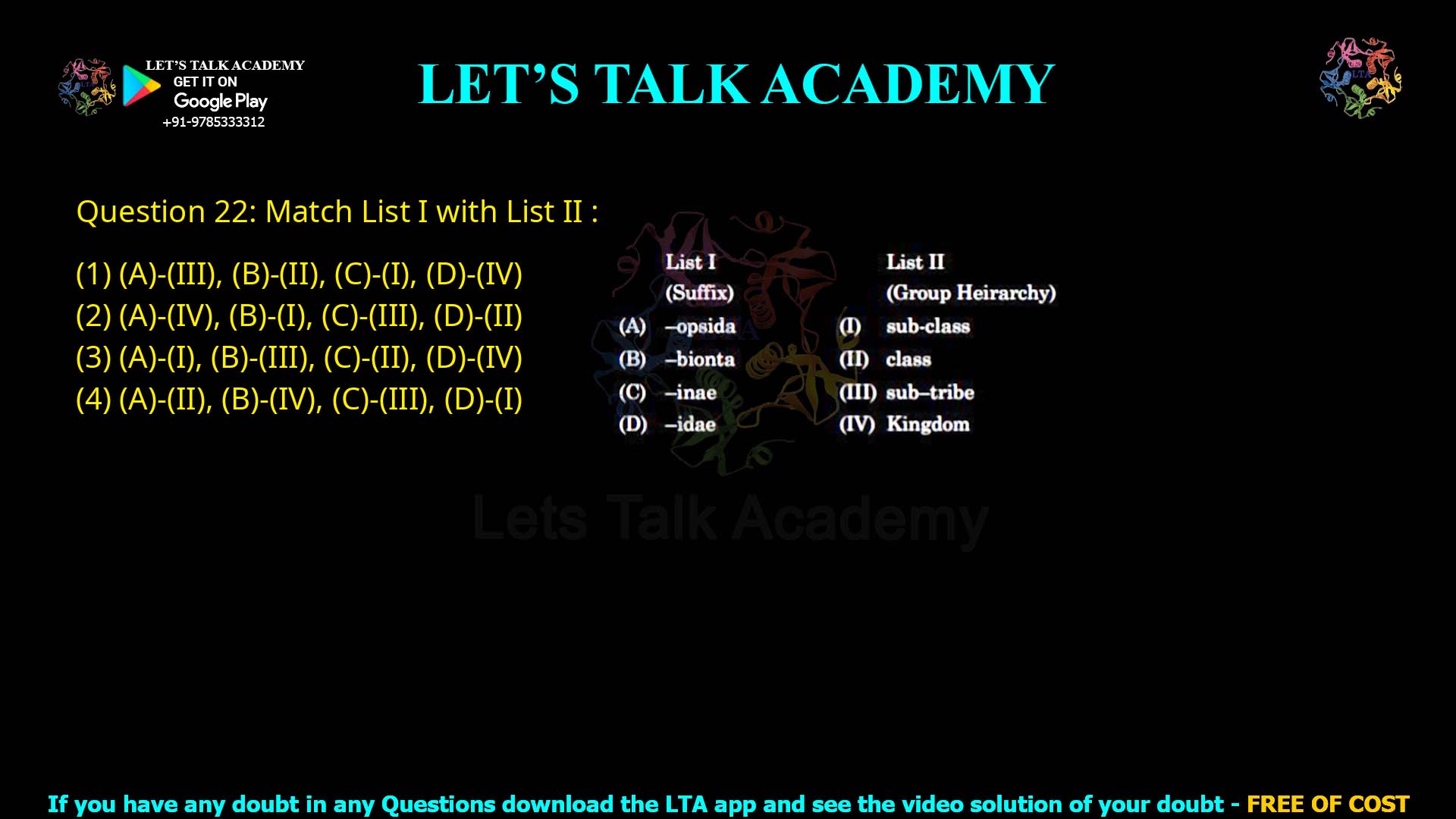
Q.22 Match List I with List II: List I (Suffix) List II (Group Hierarchy) (A) –opsida (I) sub-class (B) –bionta (II) class (C) –inae (III) sub-tribe (D) –idae (IV) Kingdom Choose the correct answer from the options given below: (1) (A)-(III), (B)-(II), (C)-(I), (D)-(IV) (2) (A)-(IV), (B)-(I), (C)-(III), (D)-(II) (3) (A)-(I), (B)-(III), (C)-(II), (D)-(IV) (4) (A)-(II), (B)-(IV), (C)-(III), (D)-(I)

Suffix Match List I List II Group Hierarchy

Q.21 Among the following pteridophytes, the initial steps in evolutionary trend of seed development can be best seen in (1) Lycopodium (2) Selaginella (3) Isoetes (4) Rhynia

Pteridophytes Evolutionary Trend

Q.20 The cells of hydrom sheath in Polytrichum are rich in: (1) oils (2) proteins (3) starch (4) chlorophyll pigments

Polytrichum Hydrom Sheath Cells

Q.19 Retort cells are present in (1) Sphagnum (2) Riccia (3) Funaria (4) Lycopodium

Retort Cells Present in

Q.18 Given below are two statements: One is labelled as Assertion (A) and the other is labelled as Reason (R): Assertion (A): Gnetum is closer to angiosperms than gymnosperms. Reason (R): There is complete elimination of archegonia in the female gametophyte of Gnetum. In the light of the above statements, choose the most appropriate answer from the options given below: (1) Both (A) and (R) are true and (R) is the correct explanation of (A) (2) Both (A) and (R) are true but (R) is NOT the correct explanation of (A) (3) (A) is true but (R) is false (4) (A) is false but (R) is true

 Gnetum Closer to Angiosperms

Q.17 The advanced characters exhibited by the members of basidiomycotina include: (A) No specialized sex organ are formed (B) Several types of spore in the life-cycle (C) Spores are endogenous in nature (D) Formation of dikaryotic cells by clamp connection (E) Presence of dolipore septa Choose the most appropriate answer from the options given below: (1) (A), (B), (C), (E) only (2) (A), (B), (C), (D) only (3) (A), (B), (D), (E) only (4) (B), (C), (D), (E) only

 Basidiomycotina Advanced Characters

Q.16 ‘Covered smuts’ disease in Barley is caused by (1) Ustilago nuda (2) Ustilago kolleri (3) Ustilago scitamineae (4) Ustilago hordei

Covered Smuts Disease Barley Ustilago hordei

Q.15 Many fungi have no known sexual stages in their life-cycle. Mycologists have traditionally grouped such fungi into (1) Ascomycetes (2) Basidiomycetes (3) Deuteromycetes (4) Zygomycetes

Fungi No Known Sexual Stages

Q.14 Morchella esculenta, often found growing under trees in orchards, with an edible ascocarp, belongs to the class ________. (1) Zygomycetes (2) Basidiomycetes (3) Ascomycetes (4) Deuteromycetes

Morchella esculenta Class Ascomycetes

Q.13 Ergotism, which is characterized by gangrene, nervous spasm, burning sensation, hallucinations and temporary ‘insanity’ is caused by (1) Claviceps purpurea (2) Phytophthora (3) Pilobolus (4) Rhizopus stolonifer

Ergotism Claviceps purpurea

Q.12 Given below are two statements : One is labelled as Assertion (A) and the other is labelled as Reason (R) : Assertion (A) : Cotton and linen textiles have long durability due to cellulose's side- by-side aggregates which form cables. Reasons (R) : Durability of cellulose is due to a -(1—6) glycosidic bonds. In the light of the above Statements, choose the most appropriate answer from the options given below : (1)Both (A) and (R) are correct and (R) is the correct explanation of (A) (2)Both (A) and (R) are correct but (R) is NOT the correct explanation of (A) (3)(A) is correct but (R) is not correct (4)(A) is not correct but (R) is correct

Cellulose Cotton Linen Durability

Q.11 Glyphosate resembles phosphoenol pyruvate and inhibits the enzyme EPSP synthetase which synthesises _________. (1) aliphatic amino acids (2) aromatic amino acids (3) basic amino acids (4) acidic amino acids

Glyphosate EPSP Synthase Inhibition

Q.10 The time interval between the formation of successive leaf primordia is termed as: (1) Apical dominance (2) Plastochron (3) Phyllotaxy (4) Parastichy

Time Interval Successive Leaf Primordia

Q.9 Which of the following is most acidic from the mentioned material? (1) Tomato juice (2) Blood plasma (3) Egg white (4) Fresh milk

Which is Most Acidic

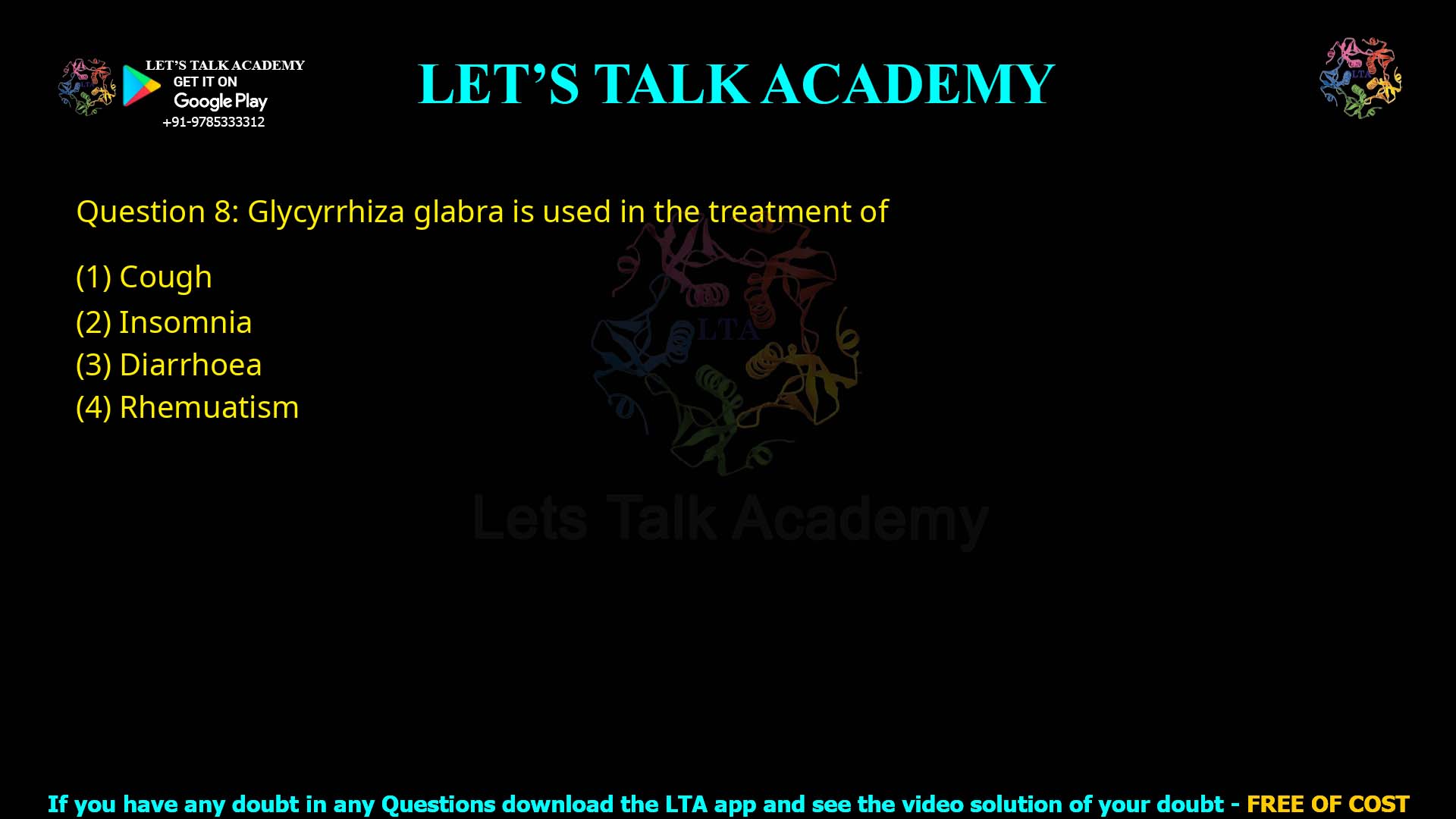
Q.8 Glycyrrhiza glabra is used in the treatment of (1) Cough (2) Insomnia (3) Diarrhoea (4) Rheumatism

Glycyrrhiza Glabra Cough Treatment

Q.7 DNA is synthesized in the cell by (1) Taq polymerase (2) DNA polymerase (3) Topoisomerase (4) RNAase

DNA Synthesized by DNA Polymerase

Q.6 Match List I with List II : List I Fruiting body List II Sub-division/order (A) Cleistothecium (I) Hemiascomycetes (B) Asci (naked) (II) Erysiphales (C) Apothecium (III) Pyrenomycetes (D) Perithecium (IV) Discomycetes Choose the correct answer from the options given below: (1) (A)-(I), (B)-(II), (C)-(III), (D)-(IV) (2) (A)-(II), (B)-(I), (C)-(IV), (D)-(III) (3) (A)-(III), (B)-(IV), (C)-(I), (D)-(II) (4) (A)-(IV), (B)-(III), (C)-(II), (D)-(I)

Cleistothecium Pyrenomycetes Matching

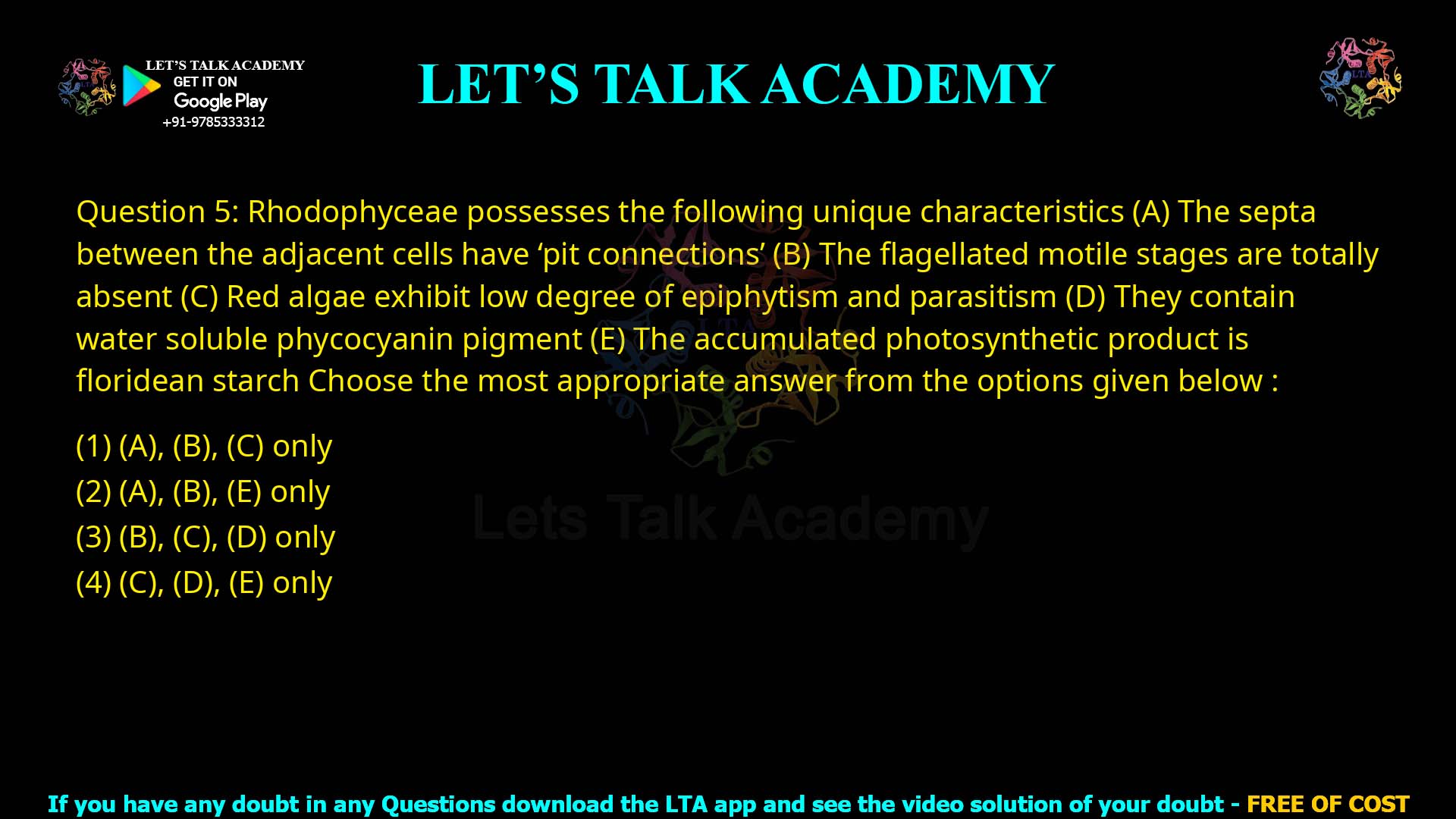
Q.5 Rhodophyceae possesses the following unique characteristics: (A) The septa between the adjacent cells have ‘pit connections’ (B) The flagellated motile stages are totally absent (C) Red algae exhibit low degree of epiphytism and parasitism (D) They contain water soluble phycocyanin pigment (E) The accumulated photosynthetic product is floridean starch Choose the most appropriate answer from the options given below: (1) (A), (B), (C) only (2) (A), (B), (E) only (3) (B), (C), (D) only (4) (C), (D), (E) only

 Rhodophyceae Unique Characteristics

Q.4 Transformation, a phenomenon responsible for recombination in microbes was discovered by (1) F. Griffith (2) J. Lederberg (3) E. Tatum (4) W. Hayes

Bacterial Transformation Discovery

Q.3 The influenza virus carries functional surface projections called spikes which contain a unique enzyme known as (1) RNA polymerase (2) DNA polymerase (3) Neuraminidase (4) Hexokinase

Influenza Virus Spikes Enzyme

Q.2 Heterocyst, a thick-walled, pale-yellow, barrel-shaped structure found in blue-green algae, helps in (1) Defence (2) N2 fixation (3) CO2 fixation (4) Sulfur metabolism

Heterocyst Function

Q.1 False branching of thallus is observed in (1) Rivularia (2) Scytonema (3) Oedogonium (4) Volvox

False Branching of Thallus in Scytonema

Latest Courses