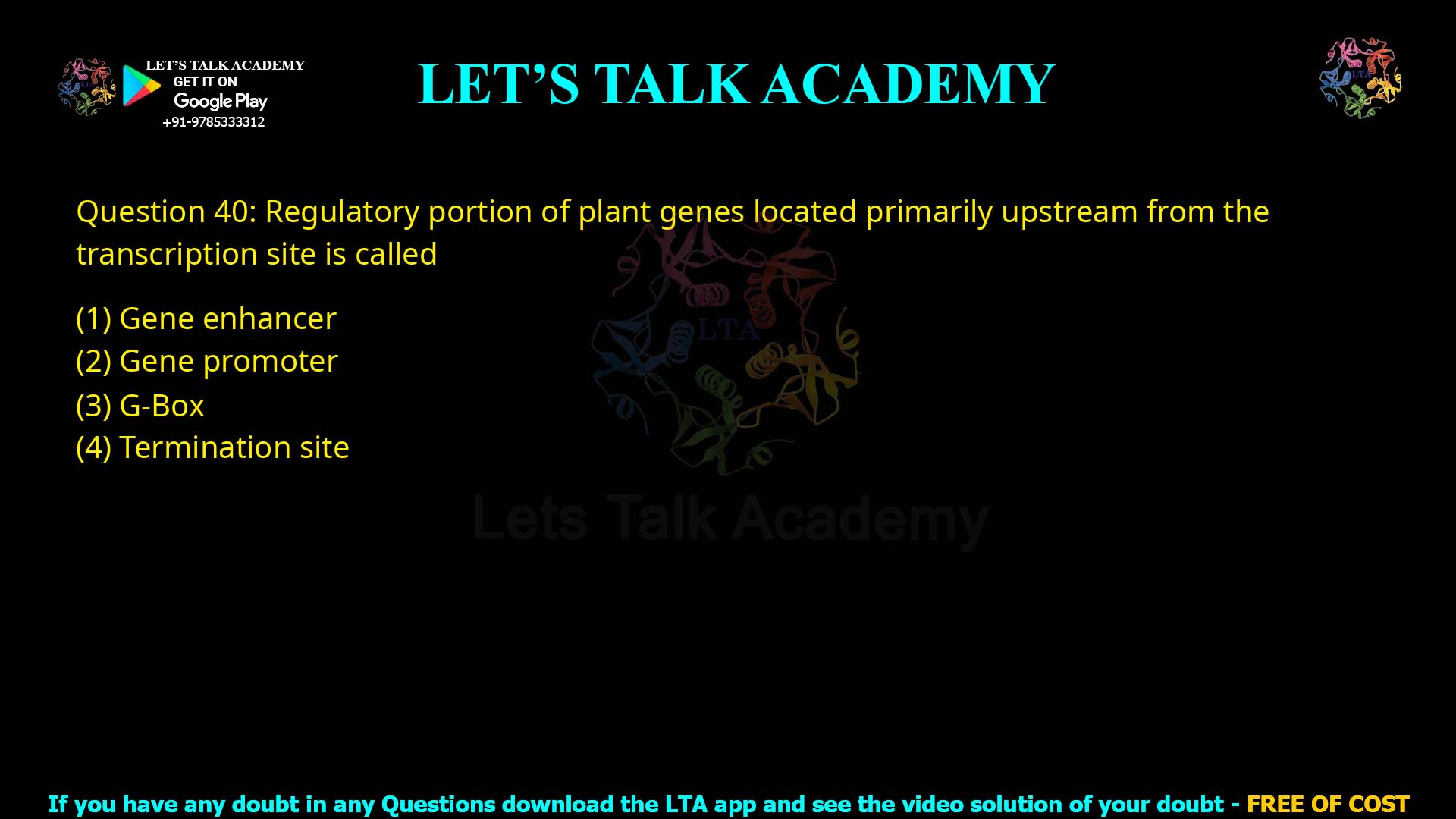
Q.40 Regulatory portion of plant genes located primarily upstream from the transcription site is called
The correct answer is (2) Gene promoter.
Gene promoters are DNA sequences located primarily upstream from the transcription start site in plant genes, serving as the regulatory portion that initiates transcription by binding RNA polymerase and transcription factors.
Option Analysis
Gene Enhancer
Gene enhancers are cis-regulatory elements that boost transcription but can be located upstream, downstream, or intronic—not primarily upstream from the transcription site. They act over long distances via DNA looping in plants.
Gene Promoter
The promoter is the core regulatory region, typically 50-200 bp upstream of the transcription start site (TSS), containing core elements like the TATA box or Y-patch (TC-rich motifs) in plants. It recruits the pre-initiation complex (PIC) including RNA Pol II for precise gene expression control.
G-Box
G-Box (CACGTG motif) is a specific cis-element in plant promoters responsive to light and stress, binding bZIP factors like HY5, but it is not the overall regulatory portion—it’s a modular element within promoters or enhancers.
Termination Site
The termination site (or terminator) is downstream of the coding region, signaling RNA Pol II release post-transcription, involving poly(A) signals—not an upstream regulatory element.
The regulatory portion of plant genes located primarily upstream from the transcription site is the gene promoter, essential for controlling gene expression in plant molecular biology. This plant genes regulatory upstream element drives transcription initiation, critical for exams like GATE Life Sciences and NEET Botany.
Defining Plant Gene Regulatory Elements
Promoters form the primary upstream regulatory portion, divided into core (near TSS), proximal (TF binding sites), and distal regions. In plants, they respond to developmental, hormonal, and environmental cues via motifs like TATA or Y-patch.
Key components:
-
Core promoter: ~50 bp upstream, basal machinery binding.
-
Proximal elements: CREs for tissue-specificity.
-
Enhancers/silencers: Modulate but not “primarily upstream.”
Gene Promoter: Upstream Transcription Regulator
Plant promoters like CaMV 35S (constitutive) or tissue-specific ones (e.g., EC1.2 for germline) precisely tune expression. They enable gene editing tools like CRISPR by driving Cas9.
Exam-Relevant Comparisons
Avoid traps: Enhancers loop distantly; G-Box is light-responsive; terminators are 3′ end.
| Feature | Gene Promoter | Gene Enhancer | G-Box | Termination Site |
|---|---|---|---|---|
| Location | Primarily upstream TSS | Upstream/downstream/intronic | Within promoters | Downstream coding |
| Function | Initiates transcription | Boosts rate/distantly | Light/stress response | Ends transcription |
| Primary? | Yes | No | No | No |
Mastering promoters is key for plant biotech questions in competitive exams.


