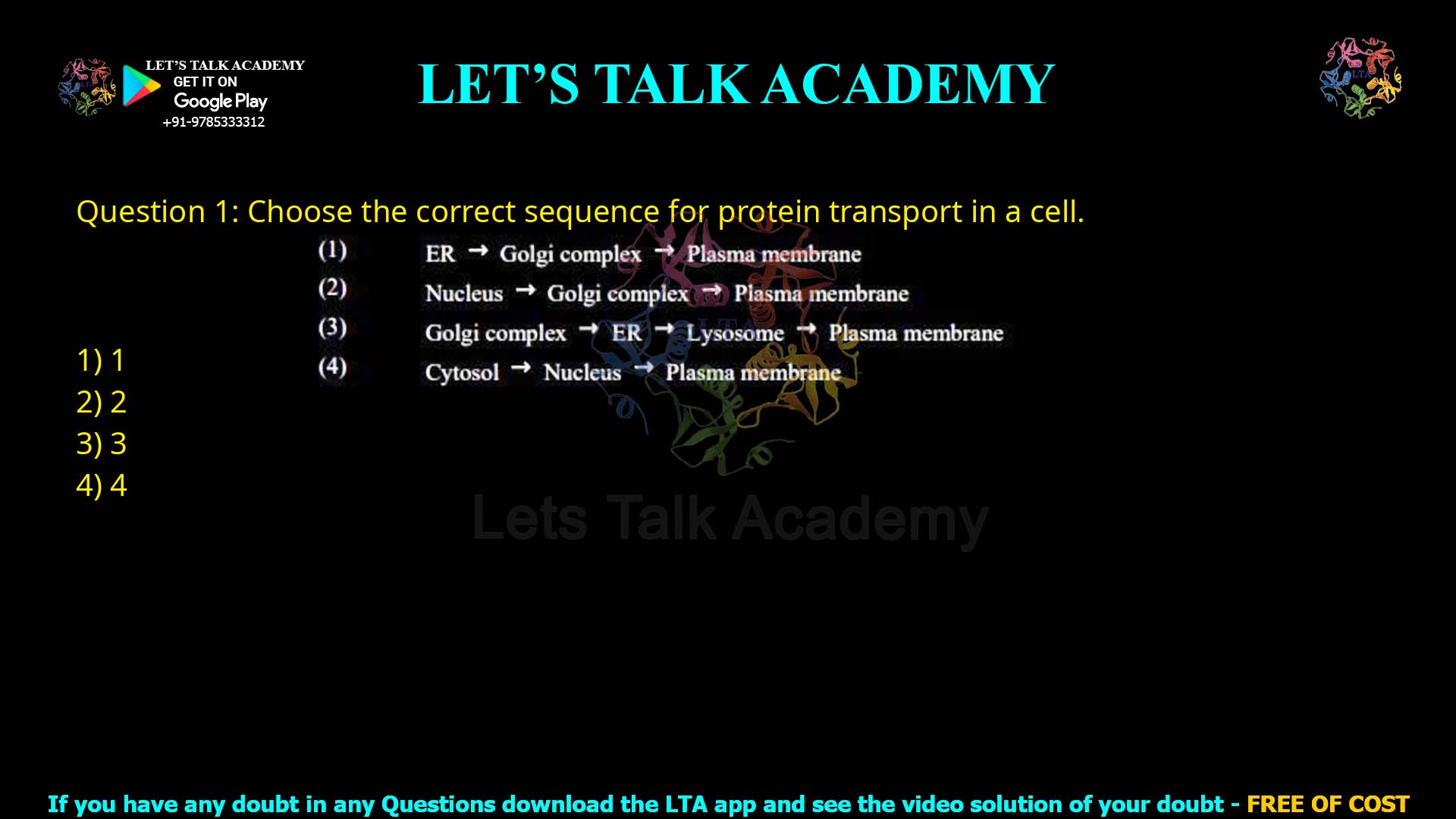
Q.1 Choose the correct sequence for protein transport in a cell.
(1) ER → Golgi complex → Plasma membrane
(2) Nucleus → Golgi complex → Plasma membrane
(3) Golgi complex → ER → Lysosome → Plasma membrane
(4) Cytosol → Nucleus → Plasma membrane
Here’s a SEO-friendly article on the correct sequence for protein transport in a cell, optimized for educational searches in molecular biology and cell biology.
Proteins destined for secretion or the plasma membrane follow a precise pathway through the endomembrane system. Understanding this protein transport sequence is crucial for biology students, researchers, and exam prep like NEET or CSIR NET.
Correct Answer: Option (1) ER → Golgi complex → Plasma membrane
This is the classic secretory pathway for proteins synthesized on rough endoplasmic reticulum (RER). Here’s how it works:
Ribosomes on the RER translate secretory proteins, which enter the ER lumen via the signal recognition particle (SRP) pathway. Vesicles then bud from the ER and fuse with the cis-Golgi, where proteins undergo modifications like glycosylation. In the Golgi complex, proteins sort into trans-Golgi network vesicles, which traffic to the plasma membrane for exocytosis.
Example: Insulin moves ER → Golgi → plasma membrane in beta cells.
This pathway ensures proper folding, quality control, and targeting.
Why Other Options Are Incorrect
-
Option (2) Nucleus → Golgi complex → Plasma membrane
Wrong because the nucleus stores DNA and transcribes mRNA, not proteins for export. mRNA exits to cytosol/RER for translation—no direct nucleus-to-Golgi transport exists. -
Option (3) Golgi complex → ER → Lysosome → Plasma membrane
Incorrect sequence and logic. Retrograde transport (Golgi to ER) occurs for quality control (COPI vesicles), but lysosomal proteins go ER → Golgi → lysosomes directly, not looping back or to plasma membrane. -
Option (4) Cytosol → Nucleus → Plasma membrane
Fails as cytosolic proteins (e.g., enzymes) stay in cytosol or enter organelles via specific signals. No routine path leads nucleus → plasma membrane; nuclear proteins recycle via nuclear pores.
Visualizing the Pathway
Rough ER → Transport Vesicles → cis-Golgi → medial-Golgi → trans-Golgi → Secretory Vesicles → Plasma Membrane
Proteins like antibodies or hormones use this route, powering immune responses and signaling.
Mastering the protein transport sequence builds foundation in cell biology. For deeper dives, check Alberts’ Molecular Biology of the Cell.


2 Comments
Ankita Pareek
April 18, 2026Correct pathway is ER-golgi complex -Plasma membrane
Rohit Meena
May 27, 20261 option