Q.75 Match List I with List II LIST I LIST II A. Glycogen B. Starch C. Cellulose D. Chitin I. Cell wall of plants II. Carbohydrate storage in animals III. Carbohydrate storage in plants IV. Cell wall of fungi Choose the correct answer from the options given below: (A)–(II); (B)–(III); (C)–(I); (D)–(IV) (A)–(I); (B)–(II); (C)–(III); (D)–(IV) (A)–(III); (B)–(II); (C)–(I); (D)–(IV) (A)–(IV); (B)–(I); (C)–(II); (D)–(III)

Polysaccharide Functions

Q.74 Match List I with List II LIST I LIST II A. Cyclin D/CDK4 B. Cyclin E/CDK2 C. Cyclin B/CDK1 D. p53 I. Triggers cell death II. Transition from G2 to M III. Initiation of DNA synthesis IV. G1 checkpoint Choose the correct answer from the options given below: (A)–(IV); (B)–(I); (C)–(II); (D)–(III) (A)–(III); (B)–(II); (C)–(IV); (D)–(I) (A)–(I); (B)–(II); (C)–(III); (D)–(IV) (A)–(IV); (B)–(III); (C)–(II); (D)–(I)

Cyclin D CDK4 G1 Checkpoint

Q.73 Match List I with List II LIST I LIST II A. DNA polymerase β B. DNA polymerase δ C. DNA polymerase α D. DNA polymerase γ I. Primase II. DNA repair III. Mitochondrial DNA replication IV. Leading and lagging strands of DNA Choose the correct answer from the options given below: (A)–(I); (B)–(II); (C)–(III); (D)–(IV) (A)–(II); (B)–(IV); (C)–(I); (D)–(III) (A)–(III); (B)–(IV); (C)–(I); (D)–(II) (A)–(IV); (B)–(II); (C)–(I); (D)–(III)

DNA Polymerase α β δ γ Functions Matching

Q.72 Match List I with List II LIST I LIST II A. DNA methylation B. Histone acetylation C. ATP-dependent chromatin remodelling D. Nucleosome I. Increase accessibility of DNA sequence II. Gene silencing III. Occurs on lysine residues of histones IV. Barrier for transcription Choose the correct answer from the options given below: (A)–(I); (B)–(II); (C)–(IV); (D)–(III) (A)–(I); (B)–(II); (C)–(III); (D)–(IV) (A)–(III); (B)–(II); (C)–(I); (D)–(IV) (A)–(II); (B)–(III); (C)–(I); (D)–(IV)

DNA Methylation Histone

Q.71 Match List I with List II LIST I LIST II A. VLDL B. Chylomicrons C. HDL D. LDL I. Transport cholesterol from peripheral tissues to liver II. Transport cholesterol from liver to other tissues III. Movement of dietary triacylglycerol to various tissues IV. Transport of endogenously synthesized triacylglycerols Choose the correct answer from the options given below: (A)–(III); (B)–(IV); (C)–(I); (D)–(II) (A)–(IV); (B)–(III); (C)–(I); (D)–(II) (A)–(I); (B)–(II); (C)–(III); (D)–(IV) (A)–(II); (B)–(III); (C)–(IV); (D)–(I)

Lipoprotein Functions

Q.70 Match List I with List II LIST I LIST II A. Leucine B. Serine C. Glutamate D. Tryptophan I. Phosphorylated by kinase II. Negatively charged R group III. Non-polar, Aliphatic R group IV. Aromatic R group Choose the correct answer from the options given below: (A)–(III); (B)–(I); (C)–(IV); (D)–(II) (A)–(I); (B)–(II); (C)–(III); (D)–(IV) (A)–(III); (B)–(II); (C)–(IV); (D)–(I) (A)–(III); (B)–(I); (C)–(II); (D)–(IV)

Amino Acid R Group Classification

Q.69 Match List I with List II LIST I LIST II A. Vitamin A B. Vitamin K C. Vitamin C D. Vitamin D I. Rickets II. Excessive bleeding III. Night blindness IV. Scurvy Choose the correct answer from the options given below: (A)–(I); (B)–(IV); (C)–(II); (D)–(III) (A)–(III); (B)–(II); (C)–(IV); (D)–(I) (A)–(IV); (B)–(III); (C)–(I); (D)–(II) (A)–(II); (B)–(III); (C)–(IV); (D)–(I)

Vitamin Deficiency Diseases Matching

Q.68 Which of the following techniques can be used for analysis of gene expression? A. Northern blotting B. Southern blotting C. Western blotting D. qRT-PCR E. RNA sequence Choose the correct answer from the options given below. A, B and D only A, C, D and E only B, C, D and E only A, B, D and E only

Gene Expression Analysis Techniques

Q.67 Two proteins X (Mol. wt. 20 kD, pI 6.3) and Y (Mol. wt. 90 kD, pI 6.4) can be separated by which of the following techniques? A. Gel filtration B. Ion-exchange chromatography C. Isoelectric focussing D. SDS-PAGE Choose the correct answer from the options given below. A and B only A and D only B and C only B and D only

Separating Proteins by

Q.66 What information about protein can be derived most accurately from gene sequence? A. Primary structure of protein B. Function of protein C. Secondary structure of protein D. Three-dimensional structure of protein Choose the correct answer from the options given below. B only A only A and C only B and D only

What Information About Protein

Q.65 Which of the following proteins do not belong to the group of chromoproteins? A. Fibroin B. Haemoglobin C. Keratin D. Cytochromes E. Flavoproteins Choose the correct answer from the options given below. B and D only A and C only A, B and E only B, C and D only

Proteins Not Chromoproteins

Q.64 Resting membrane potential is conducted by: A. Active transport B. Selective permeability of phospholipid bilayer C. Passive diffusion across lipid bilayer D. Differential distribution of ions across membrane Choose the correct answer from the options given below. A, B and D only B, C and D only A, B and C only A, C and D only

 Resting Membrane Potential Conducted By

Q.63 Which of the following statements is true about histones? A. Histones are rich in acidic amino acids. B. Histones are rich in basic amino acids. C. Histones are important for stabilizing single-stranded DNA. D. Histones bind to DNA to form chromatin. Choose the correct answer from the options given below. B and D only A and C only B, C and D only A and D only

Histones Rich in Basic Amino Acids

Q.62 What is true about steroid hormones? A. Steroid hormones bind to specific receptors. B. Steroid hormones bind to DNA to control gene expression. C. Steroid hormones travel to distant tissues through blood. Choose the correct answer from the options given below. A and B only B and C only A only A and C only

What Is True About Steroid Hormones?

Q.61 Given below are two statements: Statement–I: Cyanide results in cellular hypoxia. Statement–II: The tight coupling of electron transport and phosphorylation is uncoupled by cyanide. In the light of the above statements, choose the most appropriate answer from the options given below. Both Statement–I and Statement–II are true Both Statement–I and Statement–II are false Statement–I is true but Statement–II is false Statement–I is false but Statement–II is true

Cyanide Cellular Hypoxia Mechanism

Q.60 Given below are two statements: Statement–I: Ammonia is produced during catabolism of amino acids in muscle cells. Statement–II: In muscle cells, ammonia is converted to urea and then excreted through kidney. In the light of the above statements, choose the most appropriate answer from the options given below. Both Statement–I and Statement–II are true Both Statement–I and Statement–II are false Statement–I is true but Statement–II is false Statement–I is false but Statement–II is true

Muscle Ammonia Catabolism Urea Conversion

Q.59 Given below are two statements: Statement–I: 146 base pairs of DNA are wrapped around the histone octamer to form a nucleosome. Statement–II: Nucleosomes play important role in gene expression. In the light of the above statements, choose the most appropriate answer from the options given below. Both Statement–I and Statement–II are correct Both Statement–I and Statement–II are incorrect Statement–I is correct but Statement–II is incorrect Statement–I is incorrect but Statement–II is correct

Nucleosome DNA Base Pairs Gene Expression

Q.58 Given below are two statements: Statement–I: Enzymes lower the activation energy of reactions. Statement–II: The presence of an enzyme has no effect on Keq. In the light of the above statements, choose the most appropriate answer from the options given below. Both Statement–I and Statement–II are true Both Statement–I and Statement–II are false Statement–I is true but Statement–II is false Statement–I is false but Statement–II is true

Enzymes Lower Activation Energy Keq Effect

Q.57 Given below are two statements: Statement–I: Weak interactions like hydrogen bonds and salt bridges stabilize protein folding. Statement–II: Protein folding is assisted by chaperones. In the light of the above statements, choose the most appropriate answer from the options given below. Both Statement–I and Statement–II are correct Both Statement–I and Statement–II are incorrect Statement–I is correct but Statement–II is incorrect Statement–I is incorrect but Statement–II is correct

Protein Folding Weak Interactions Chaperones

Q.56 Given below are two statements: Statement–I: Mutation in the middle of a gene that creates stop codon is called frameshift mutation. Statement–II: Frameshift mutation can be a point mutation. In the light of the above statements, choose the most appropriate answer from the options given below. Both Statement–I and Statement–II are true Both Statement–I and Statement–II are false Statement–I is true but Statement–II is false Statement–I is false but Statement–II is true

Frameshift vs Nonsense Mutation

Q.55 Given below are two statements: Statement–I: Histone acetylation is generally associated with decrease in gene transcription. Statement–II: Acetylation occurs on lysine residues in the N-terminal tails of histones. In the light of the above statements, choose the most appropriate answer from the options given below. Both Statement–I and Statement–II are correct Both Statement–I and Statement–II are incorrect Statement–I is correct but Statement–II is incorrect Statement–I is incorrect but Statement–II is correct

Histone Acetylation Gene Transcription

Q.54 Arrange the following steps of cell signalling in chronological order: A. Reception B. Generation of signal C. Response D. Transduction Choose the correct answer from the options given below. B, A, D, C A, B, C, D D, C, B, A B, D, A, C

Cell Signalling Steps Chronological Order

Q.53 Proteins involved in DNA replication are written below. Arrange them chronologically in terms of function: A. DNA polymerase I B. DNA polymerase III C. Helicase D. Ligase E. Primase Choose the correct answer from the options given below. C, E, B, D, A C, E, B, A, D A, B, C, D, E B, A, C, E, D

DNA Replication Enzymes Order

Q.52 Gene expression is controlled at various stages written below. Arrange these stages in chronological order: A. Transcription B. Translation C. Post-transcription D. Epigenetic regulation E. Post-translation Choose the correct answer from the options given below. A, B, C, D, E A, C, B, E, D B, C, A, D, E D, A, C, B, E

Gene Expression Stages Chronological Order

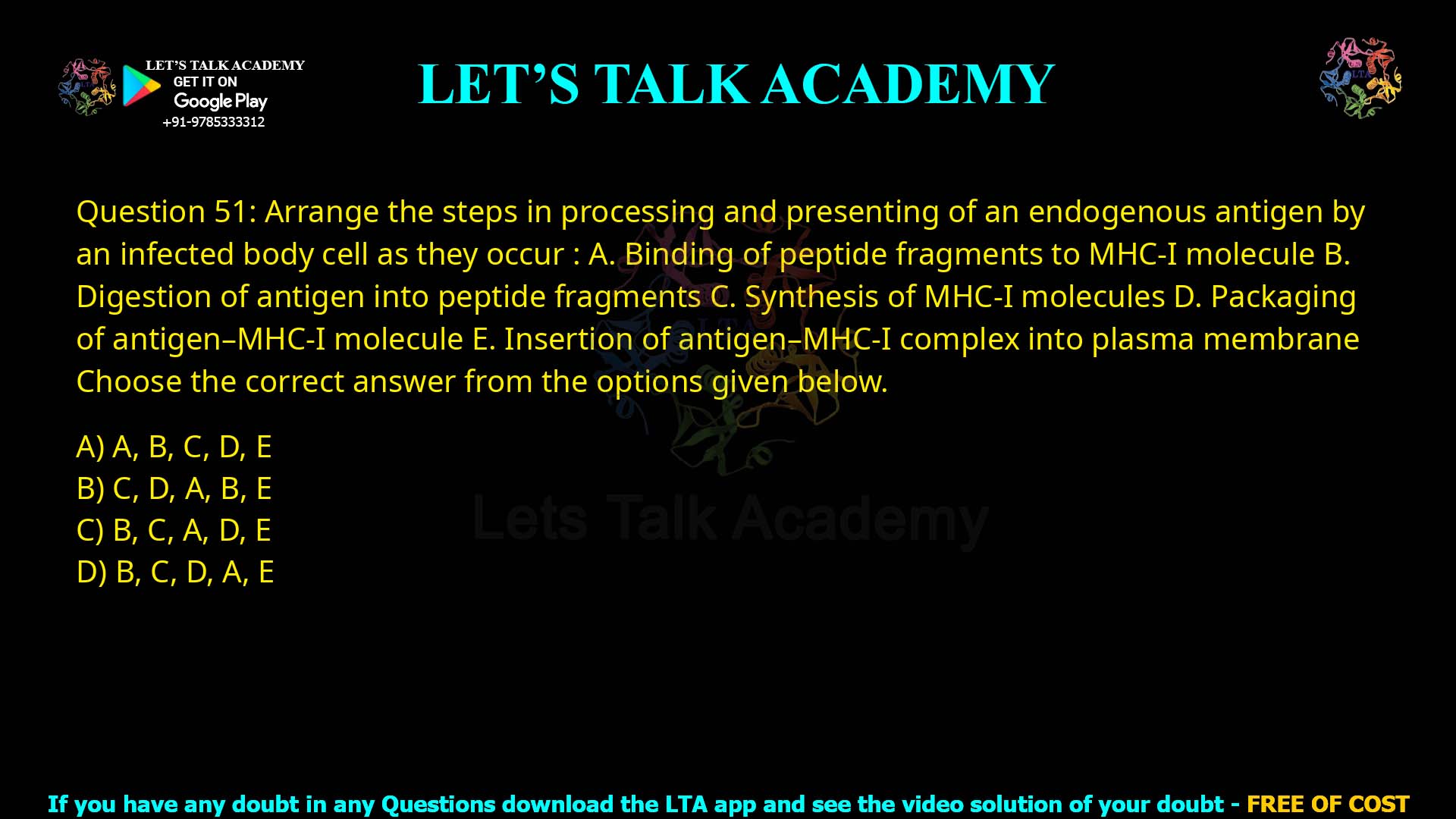
Q.51 Arrange the steps in processing and presenting of an endogenous antigen by an infected body cell as they occur: A. Binding of peptide fragments to MHC-I molecule B. Digestion of antigen into peptide fragments C. Synthesis of MHC-I molecules D. Packaging of antigen–MHC-I molecule E. Insertion of antigen–MHC-I complex into plasma membrane Choose the correct answer from the options given below. A, B, C, D, E C, D, A, B, E B, C, A, D, E B, C, D, A, E

 Endogenous Antigen Processing

Q.50 Arrange the following stages of bacterial growth curve chronologically: A. Lag phase B. Stationary phase C. Log phase D. Death phase Choose the correct answer from the options given below. A, B, C, D B, A, C, D C, A, B, D A, C, B, D

Bacterial Growth Curve Stages Chronological Order

Q.49 Arrange the stages of infection process as they occur: A. Evasion from host defence mechanism B. Entry of pathogen C. Damage to host cell D. Exit from the host Choose the correct answer from the options given below. B, A, C, D A, B, C, D B, A, D, C C, D, A, B

Stages of Infection Process Order

Q.48 Enzymes involved in urea biosynthesis from ammonia are listed below. Arrange these in order of their actions: A. Arginase B. Ornithine carbamoyl transferase C. Argininosuccinate lyase D. Carbamoyl phosphate synthetase I E. Argininosuccinate synthetase Choose the correct answer from the options given below. E, D, C, B, A D, A, B, C, E A, B, C, D, E D, B, E, C, A

Urea Cycle Enzymes Sequence

Q.47 Given below are two statements, one is labelled as Assertion (A) and the other is labelled as Reason (R): Assertion (A): Restriction endonuclease cleave the foreign viral DNA inside the bacterial cell, but bacterial DNA is protected from Restriction Endonuclease attack. Reason (R): Bacterial DNA does not contain recognition sequence of restriction endonuclease. In the light of the above statements, choose the most appropriate answer from the options given below. Both (A) and (R) are correct and (R) is the correct explanation of (A) Both (A) and (R) are correct but (R) is not the correct explanation of (A) (A) is correct but (R) is not correct (A) is not correct but (R) is correct

Restriction Endonuclease Bacterial DNA Protection

Q.46 Given below are two statements. one is labelled as Asseltion (A) and the other is labelled as Reason (R) : Assertion (A) : Salt is added as a preservative for storage of meat. Reason (R) Salt creates hypettonic environment and most bacteria cannot grow in hypettonic media. In the light of the above statements. choose the most appropriate answer from the options given below. 1. Both (A) and (R) are correct and (R) is the con•ect explanation of (A) 2. Both (A) and (R) are correct but (R) is not the correct explanation of (A) 3, (A) is conect but (R) is not conect 4. (A) is not con•ect but (R) is con•ect

Salt Meat Preservation Hypertonic Environment Bacteria

Q.45 Given below are two statements, one is labelled as Assertion (A) and the other is labelled as Reason (R): Assertion (A): Glucose gets trapped in extrahepatic tissues and does not move out of the cell. Reason (R): Glucokinase irreversibly phosphorylates glucose to glucose-6-phosphate in extrahepatic tissues. There are no transporters for glucose-6-phosphate and glucose gets trapped in extrahepatic tissues. In the light of the above statements, choose the most appropriate answer from the options given below. Both (A) and (R) are correct and (R) is the correct explanation of (A) Both (A) and (R) are correct but (R) is not the correct explanation of (A) (A) is correct but (R) is not correct (A) is not correct but (R) is correct

 Glucose Trapping in Extrahepatic Tissues

Q.44 Given below are two statements, one is labelled as Assertion (A) and the other is labelled as Reason (R): Assertion (A): Oxidative phosphorylation—the synthesis of ATP from ADP and inorganic phosphate—requires energy. Reason (R): The energy for oxidative phosphorylation is provided by the proton gradient generated during electron transport chain. In the light of the above statements, choose the most appropriate answer from the options given below. Both (A) and (R) are correct and (R) is the correct explanation of (A) Both (A) and (R) are correct but (R) is not the correct explanation of (A) (A) is correct but (R) is not correct (A) is not correct but (R) is correct

Oxidative Phosphorylation ATP Synthesis Energy Requirement

Q.43 Given below are two statements, one is labelled as Assertion (A) and the other is labelled as Reason (R): Assertion (A): Insulin acts on multiple tissues as compared to glucagon. Reason (R): Insulin is lipid soluble and easily passes through cell membrane of target cells. In the light of the above statements, choose the most appropriate answer from the options given below. Both (A) and (R) are correct and (R) is the correct explanation of (A) Both (A) and (R) are correct but (R) is not the correct explanation of (A) (A) is correct but (R) is not correct (A) is not correct but (R) is correct

Insulin vs Glucagon Action

Q.42 Given below are two statements, one is labelled as Assertion (A) and the other is labelled as Reason (R): Assertion (A): Maternal blood O2 saturation is quite low in placenta. Even at this lower saturation, O2 is readily transferred to fetal blood. Reason (R): Fetal hemoglobin binds BPG less strongly, thus having higher affinity for O2 as compared to adult hemoglobin. In the light of the above statements, choose the most appropriate answer from the options given below. Both (A) and (R) are correct and (R) is the correct explanation of (A) Both (A) and (R) are correct but (R) is not the correct explanation of (A) (A) is correct but (R) is not correct (A) is not correct but (R) is correct

Placental Oxygen Transfer

Q.41 Given below are two statements, one is labelled as Assertion (A) and the other is labelled as Reason (R): Assertion (A): During starvation, when β-oxidation of fatty acids is predominant in liver, acetylCoA formed enters citric acid cycle. Reason (R): AcetylCoA must combine with oxaloacetate to gain entry to the citric acid cycle. In the light of the above statements, choose the most appropriate answer from the options given below. Both (A) and (R) are correct and (R) is the correct explanation of (A) Both (A) and (R) are correct but (R) is not the correct explanation of (A) (A) is correct but (R) is not correct (A) is not correct but (R) is correct

β-Oxidation Starvation

Lineweaver–Burk Plot Analysis

Q.39 Molarity is a better way of expressing the concentration of solution as compared to gram percent especially 1. under all conditions 2. for anhydrous molecules 3. for molecules with different hydrated states 4. for all solids and liquids

Molarity vs Gram Percent

Q.38 Which of the following statements is true? 1. Molecular weight is expressed in Daltons. 2. Molecular mass is expressed in Daltons. 3. Relative molecular weight is expressed in Daltons. 4. Relative molecular mass is expressed in Daltons.

Molecular Weight Expressed

Q.37 Which of the following groups consists of only aromatic compounds? 1. Tyrosine, Threonine and Phenylalanine 2. Phenol, Tyrosine and Phenylalanine 3. Phenol, Histidine and Tryptophan 4. Tyrosine, Phenylalanine and Proline

Only Aromatic Group

Q.36 Kwashiorkor disease is linked with insufficient intake of 1. carbohydrates 2. proteins 3. vitamin C 4. electrolytes

Kwashiorkor Caused by

Q.35 Which of the following elements binds to protein and forms a critical DNA binding motif? 1. Manganese 2. Zinc 3. Cobalt 4. Copper

Zinc Finger DNA Binding Element

Q.34 In hypothetical enzymatic reaction A ——(enzyme 1)——> B ——(enzyme 2)——> C The end product C is allosteric inhibitor of Enzyme 1. C will also regulate the activity of Enzyme 1 by competitive inhibition feedback inhibition irreversible inhibition competitive inhibition and irreversible inhibition both

Feedback Inhibition

Q.33 Which of the following statements is not correct? 1. The presence of an enzyme has no effect on ΔGº 2. At equilibrium, the rate constants of forward and backward reaction are equal. 3. Active site histidyl residues frequently aid catalysis by acting as proton donors and acceptors. 4. Enzymes lower the activation energy for a reaction.

Enzyme Statements

Q.32 Recognition sequence of Restriction Endonuclease : BamH1 is 1. ---AAGCTA--- ---TTCGAT--- 2. ---GGATCC--- ---CCTAGG--- 3. ---GTACAG--- ---CATGTC--- 4. ---AGATCA--- ---TCTAGT---

BamHI Recognition Sequence

Q.31 If a double-stranded DNA has 30% Guanine, what will be the percentage of Adenine? 1.40% 2.20% 3.30% 4.15%

DNA 30% Guanine Adenine Percentage

Q.30 In the polarized epithelial cells of PCT of kidney, the difference in apical and basolateral membrane is maintained by 1. tight junctions 2. microvilli 3. desmosomes 4. hemidesmosomes

PCT Kidney Cells Polarity

Q.29 Who was the first scientist to prove the Germ Theory of disease? 1. Robert Koch 2. Edward Jenner 3. Louis Pasteur 4. Joseph Lister

Germ Theory Pioneer

Q.28 Some microbes survive or grow at very high temperatures because of 1. heat-shock protein synthesis 2. molecular chaperones to prevent or repair protein denaturation 3. thermostability of enzymes 4. heat-shock protein synthesis, molecular chaperones to prevent or repair protein denaturation and thermostability of enzymes

Thermophiles Survival

Q.27 Penicillin, the first found natural antibiotie acts by 1. inhibiting protein synthesis 2. inhibiting cell wall synthesis 3. inhibiting DNA replication 4. disrupting the cell membrane

Penicillin Mechanism

Q.26 To solve the mystery of spoilage of wine, Pasteur observed yeast and bacteria in the fermented grape juice (wine). Through a series of experiments, he proved 1. yeast and bacteria are required for fermentation of grape juice/ alcohol formation 2. yeasts is required for fermentation/alcohol formation and bacteria result in spoilage of wine 3. bacteria are required for alcohol formation and yeasts result in spoilage of alcohol 4. both yeast and bacteria result in spoilage of alcohol

Pasteur’s Wine Spoilage Experiments

Q.25 Which of the following factors affects the affinity of hemoglobin for oxygen? 1. pH 2. Temperature 3. Binding of 2,3-bisphosphoglycerate 4. pH, temperature and binding of 2,3-bisphosphoglycerate

pH, Temperature & 2,3-BPG Affect

Q.24 Internal respiration occurs in 1. nose 2. lungs 3. heart 4. tissue throughout the body

Internal Respiration Occurs

Q.23 At 50% saturation, each Hb molecule has ______ bound. one O2 molecule two O2 molecules three O2 molecules four O2 molecules

At 50% Saturation, Hb Binds Two O2 Molecules

Q.22 AST / ALT ratio is decreased in 1. myocardial infarction 2. acute hepatocellular damage 3. damaged kidney 4. both damaged kidney and heart

AST/ALT Ratio Decreased

Q.21 In hepatocellular disease 1. only conjugated bilirubin levels are increased 2. only unconjugated bilirubin levels are increased 3. both conjugated and unconjugated bilirubin levels are increased 4. conjugated bilirubin levels are increased and unconjugated bilirubin levels are decreased

Hepatocellular Disease Bilirubin Levels

Q.20 Glomerular filtration rate is determined by creatinine clearance test and inulin clearance test. Which of the following statements is true about GFR? 1. Inulin clearance gives the exact measurement of GFR. 2. Creatinine clearance gives the exact measurement of GFR. 3. Inulin clearance overestimates GFR. 4. Both inulin and creatinine clearance overestimate GFR.

GFR Measurement

Q.19 In E. coli, pur repressor regulates the expression of more genes as compared to lac repressor because 1. pur repressor binds to DNA without corepressor 2. pur repressor is expressed at a much higher level 3. there are more pur operator sequences in E. coli genome 4. pur repressor is expressed at a much lower level

Pur Repressor vs Lac Repressor

Q.18 How many ATP molecules are produced for each molecule of FADH2 oxidized via the respiratory chain? 1.0.5 2.1 3.1.5 4.2

How Many ATP from FADH2 in Respiratory Chain?

Q.17 Oligomyein blocks the electron transport chain by 1. inhibiting the complex III 2. inhibiting ATP synthesis by preventing influx of protons through ATP synthase 3. inhibiting the complex IV 4. inhibiting the complex III and IV both

Oligomycin Blocks Electron Transport Chain

Q.16 Which of the following is a cis-acting element? 1. cAMP response binding protein 2. Operator 3. Repressor 4. Terminator

Which is a Cis-Acting Element?

Q.15 In prolonged starvation, a minimum glucose level is maintained for supplying glucose to brain and RBCs. This is achieved by 1. glycogenolysis in liver 2. gluconeogenesis in liver and kidney 3. glycogenolysis in muscle 4. gluconeogenesis in muscle and liver

Prolonged Starvation Glucose Supply

Q.14 Glycerol kinase is not expressed in 1. adipose tissue 2. liver 3. kidney 4. heart

Glycerol Kinase Not Expressed

Q.13 Patients with Galactosemia are advised not to take dairy products because 1. they have defective B-galactosidase and cannot digest lactose in dairy products 2. they cannot metabolize galactose digestion product of lactose 3. they cannot digest the fats present in dairy products 4. they cannot digest the proteins present in dairy products

Galactosemia Dairy Restriction

Q.12 What is true about MHC class II? 1. Present extracellular peptides to CD8+ cells 2. Present intracellular peptides to CD8+ cells 3. Present extracellular peptides to CD4+ cells 4. Present intracellular peptides to CD4+ cells

What is True About MHC Class II?

Q.11 Upon re-exposure to a previous pathogen, which immune response will be most likely the fastest one? 1. Innate immunity 2. Complement activation 3. Adaptive immunity and immunological memory 4. Killer T cells

Fastest Immune Response

Q.10 What is not true about endotoxin? 1. Endotoxin is heat-stable 2. Endotoxin is strongly immunogenic 3. Endotoxin is present in gram negative bacteria 4. Endotoxin is a lipid in nature

Endotoxin Properties

Q.9 During DNA repair, which of the following enzymes is involved in phosphodiester bond formation ? 1. DNA polymerase 2. DNA ligase 3. Phosphodiesterase 4. Primase

DNA Repair

Q.8 Which of the following cellular organelle is involved in Tay-Sachs disease (TSD)? 1. Golgi 2. Lysosomes 3. Endoplasmic reticulum 4. Mitochondria

Tay-Sachs Disease

Q.7 Which of the following motor proteins is involved in intracellular transport along microtubules? 1. Myosin 2. Kinesin 3. Dynein 4. Both Myosin and Dynein

Motor Proteins on Microtubules

Q.6 Insulin-dependent glucose uptake by adipose tissue is the result of 1. cotransport of glucose with sodium against concentration gradient 2. simple diffusion of glucose down the concentration gradient 3. ATP-dependent transport of glucose against concentration gradient 4. transfer of GLUT transporters from intracellular vesicles to cell membrane

Insulin-Dependent Glucose Uptake

Q.5 Non-active protein part of an enzyme that requires cofactor for activation is 1. apoenzyme 2. holoenzyme 3. coenzyme 4. ribozyme

Apoenzyme definition

Q.4 What is the net charge of glutamate at pH 7? 1.+1 2.0 3.+2 4 .- 1

Net Charge of Glutamate at pH 7

Q.3 Which of the following antibodies can cross the placenta? 1. IgA 2. IgG 3. IgM 4. IgE

Which Antibody Crosses the Placenta?

Q.2 Which of the following is an amino acid? 1. Tryptophan 2. Proline 3. Lysine 4. Phenylalanine

Which of the Following is an Amino Acid?

Q.1 Which of the following statement is true about nucleoside? 1. Nitrogenous base attached to OH of C-1' of pentose sugar 2. Phosphoryl group attached to C-5' of pentose sugar 3. Phosphoryl group attached to C-3' of pentose sugar 4. Phosphate group is attached to 2' C of pentose sugar

Nucleoside Structure

Latest Courses