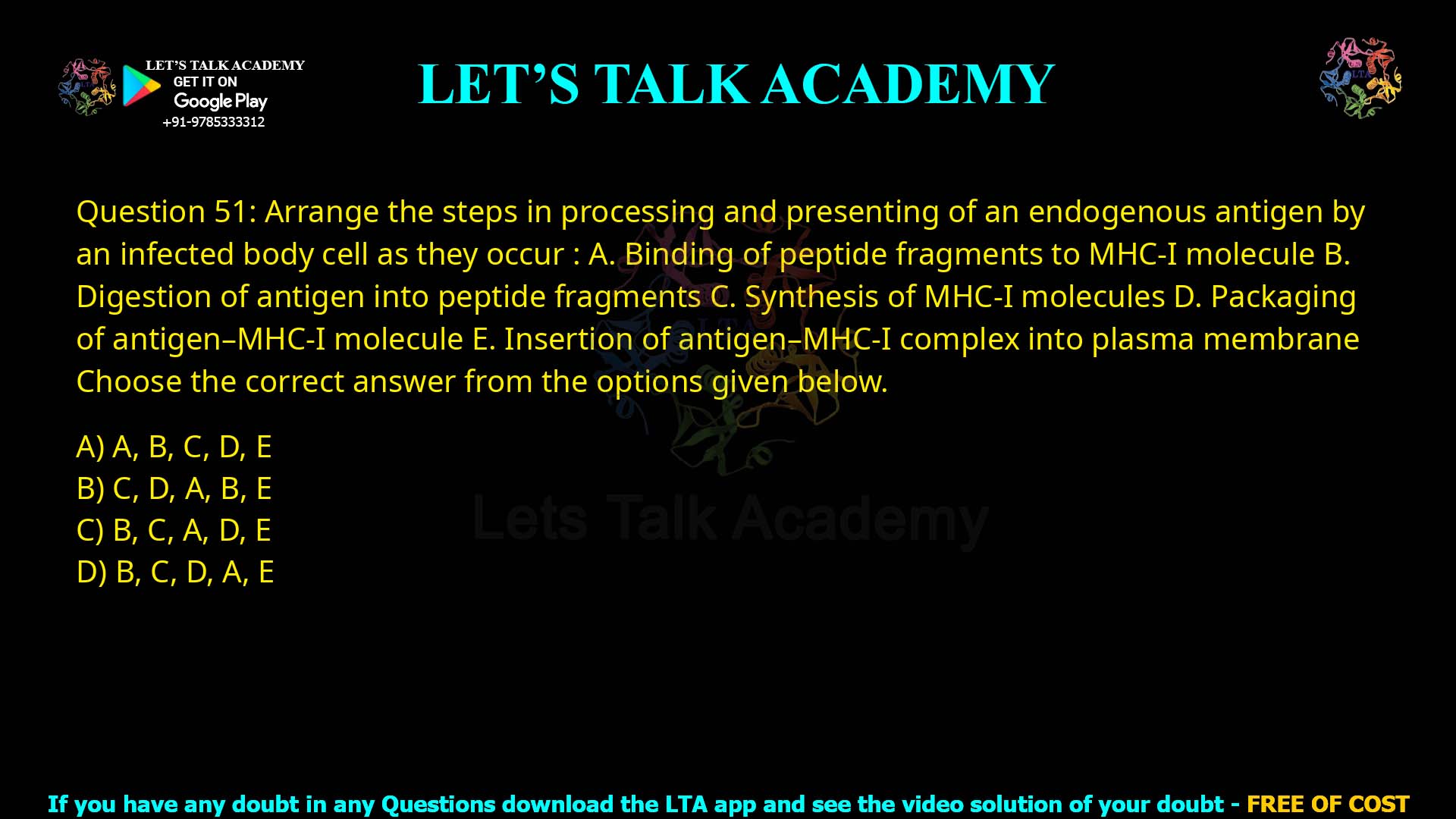
The correct sequence for processing and presenting an endogenous antigen by MHC class I on an infected cell is B, C, A, D, E. Endogenous antigens (e.g., viral proteins) are first degraded into peptides (B), followed by MHC-I synthesis (C), peptide binding to MHC-I (A), complex packaging/transport (D), and final membrane insertion (E).
Endogenous antigen processing occurs via the cytosolic pathway in all nucleated cells:
-
B: Digestion into peptide fragments – Viral/cytosolic proteins are ubiquitinated and degraded by the proteasome into 8-10 aa peptides.
-
C: Synthesis of MHC-I molecules – MHC-I (heavy chain + β2-microglobulin) is continuously synthesized in the rough ER.
-
A: Binding of peptide fragments to MHC-I – Peptides are transported into ER via TAP, binding MHC-I with chaperone help (calnexin, tapasin, ERp57).
-
D: Packaging of antigen–MHC-I complex – Stable peptide-MHC-I dissociates from PLC (peptide loading complex), enters Golgi vesicles.
-
E: Insertion into plasma membrane – Complex traffics via secretory pathway to cell surface for CD8+ T cell recognition.
-
A, B, C, D, E: Wrong. Binding (A) can’t precede digestion (B); peptides must exist first.
-
C, D, A, B, E: Wrong. MHC synthesis (C) before digestion (B) possible, but packaging (D) before binding (A) impossible.
-
B, C, A, D, E: Correct. Matches chronological order: degradation → synthesis → loading → packaging → presentation.
-
B, C, D, A, E: Wrong. Packaging (D) before binding (A) reverses ER loading logic.
Endogenous antigen processing MHC I pathway presents viral proteins to CD8+ T cells via cytosolic steps: proteasome digestion, ER loading, surface presentation. Crucial for GATE/CSIR immunology.
This follows canonical cytosolic pathway chronology. Other options violate logic (e.g., binding without peptides). Master for exam questions on antigen processing MHC I presentation.