Which of the following is NOT an assumption of the Hardy-Weinberg model? (1) Population mates at random with respect to the locus in question (2) Selection is not acting on […]

Which of the following is NOT an assumption of the Hardy-Weinberg model? (1) Population mates at random with respect to the locus in question (2) Selection is not acting on […]
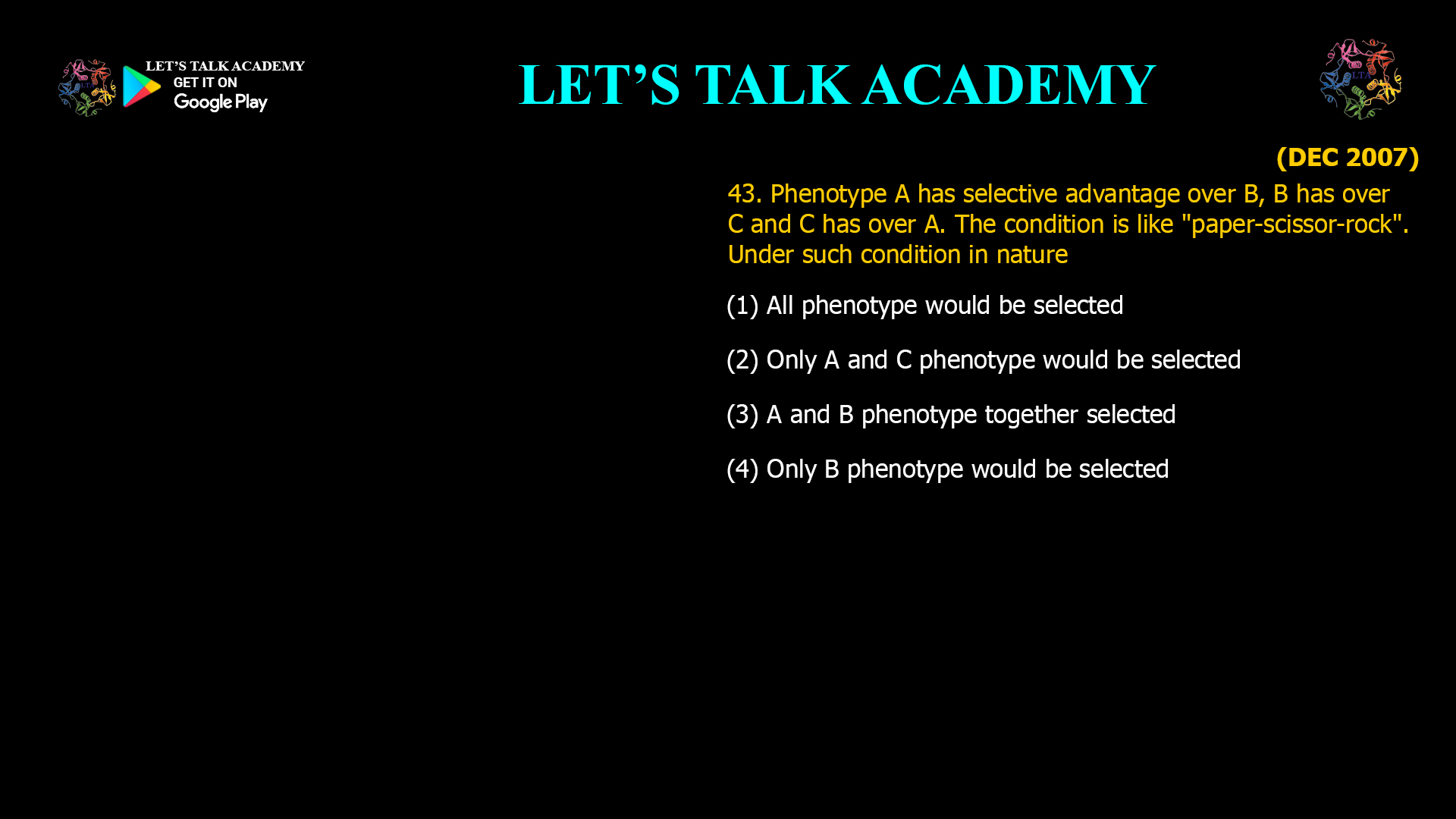
Phenotype A has selective advantage over B, B has over C and C has over A. The condition is like “paper-scissor-rock”. Under such condition in nature (1) All phenotype would […]

Under which condition Hardy-Weinberg law will NOT operate? (1) 3 alleles are involved (2) Alleles are X-linked (3) Skewed sex ratio (4) Population is tetraploid When Does the Hardy-Weinberg […]

Natural selection against extreme phenotype is termed as (1) Directional selection (2) Diversifying selection (3) Disruptive selection (4) Stabilizing selection Introduction Natural selection shapes the diversity of life by favoring […]

Among the following which is not an assumption of Hardy-Weinberg rule (1) Small population size (2) Random mating (3) No natural selection (4) No mutation Which Is NOT an […]

A population of 200 is in Hardy-Weinberg equilibrium with allele frequency of ‘A’ = 0.7 and ‘a’ 0.3. The number of carriers in population will be (1) 18 (2) 42 […]

If the two extreme morphological forms are favored against heterozygotes, such a selection is termed as (1) Disruptive (2) Directional (3) Stabilizing (4) Cyclic Introduction Evolution shapes populations in remarkable […]
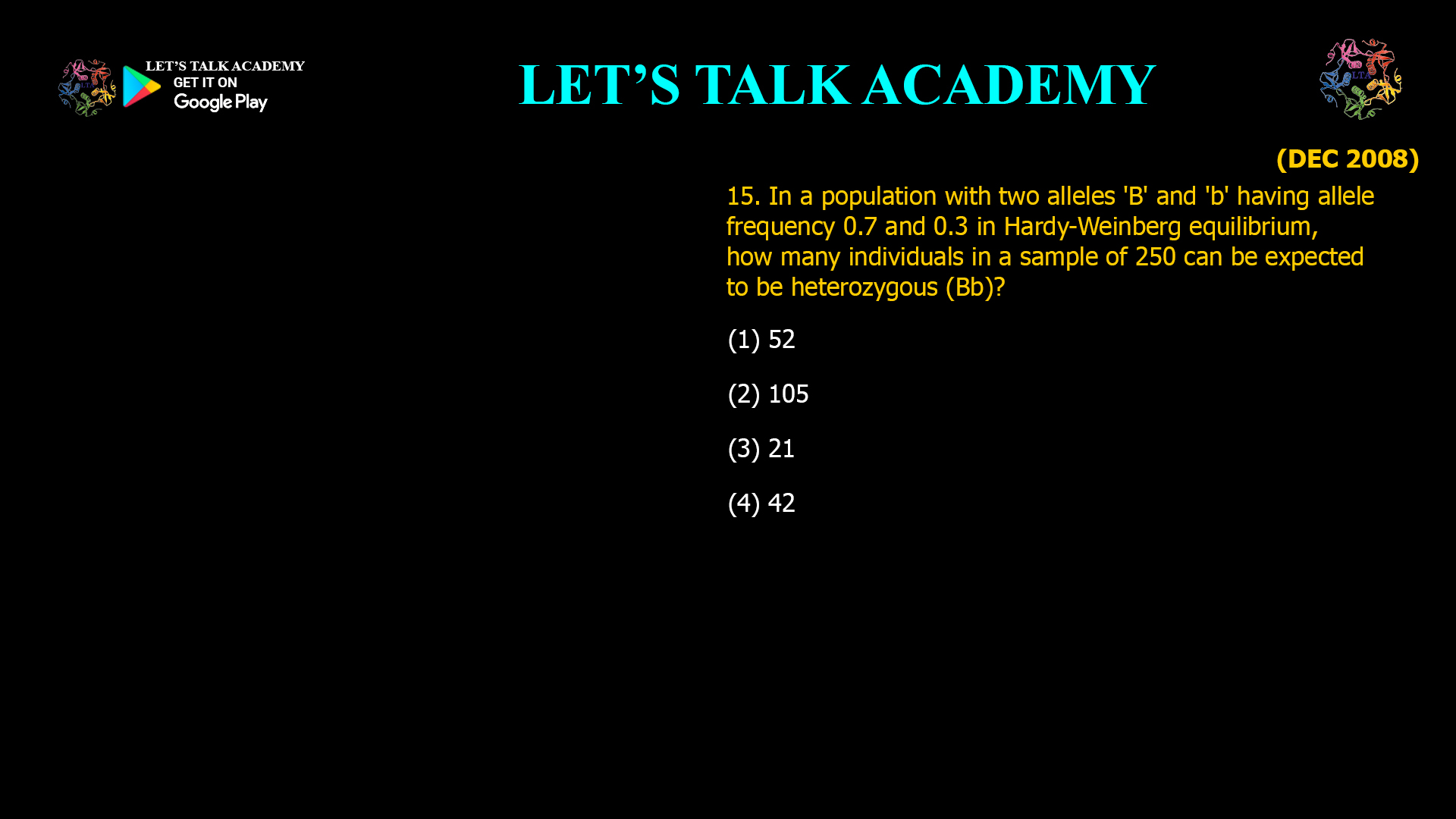
In a population with two alleles ‘B’ and ‘b’ having allele frequency 0.7 and 0.3 in Hardy-Weinberg equilibrium, how many individuals in a sample of 250 can be expected to […]
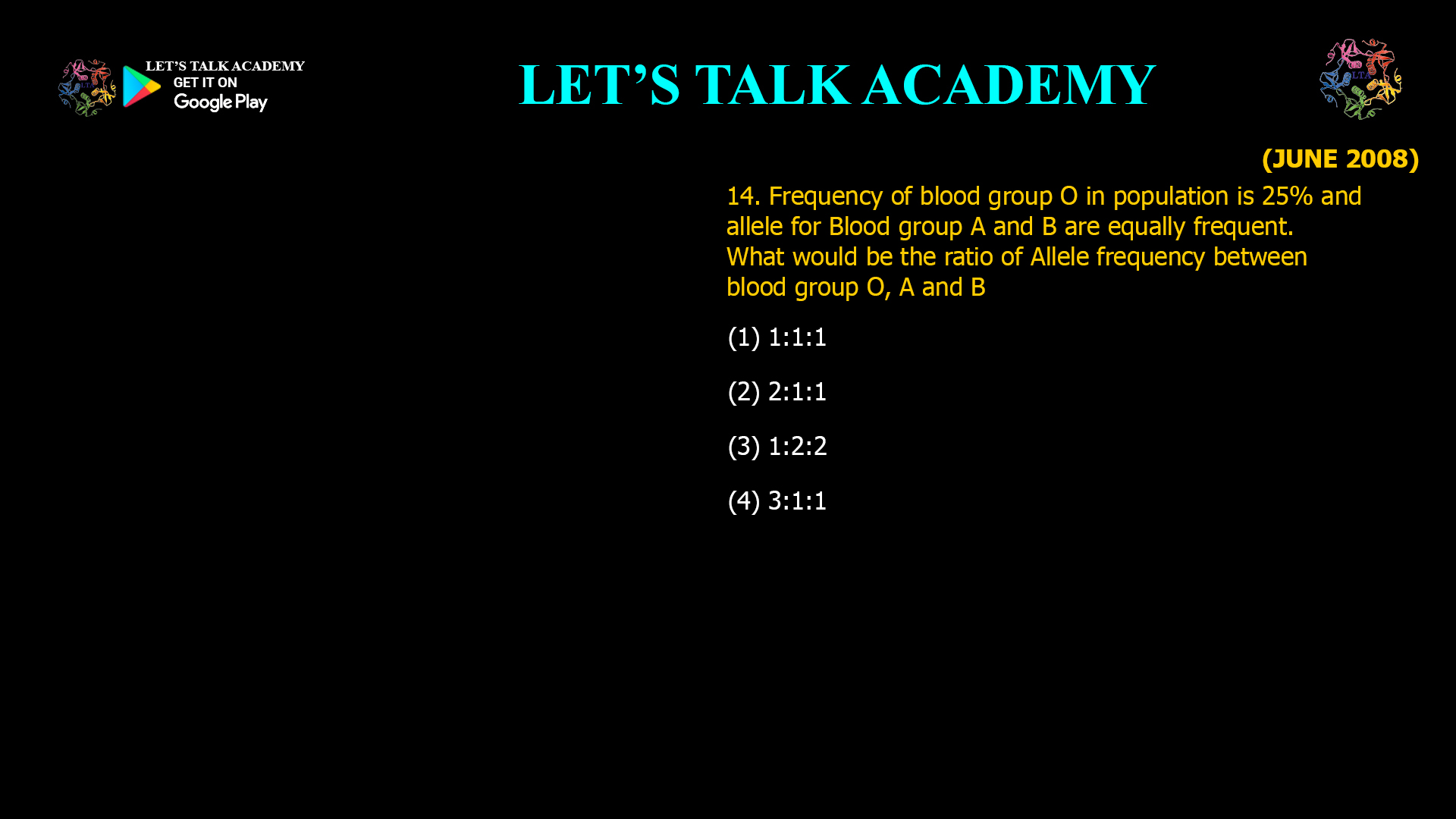
Frequency of blood group O in population is 25% and allele for Blood group A and B are equally frequent. What would be the ratio of Allele frequency between blood […]
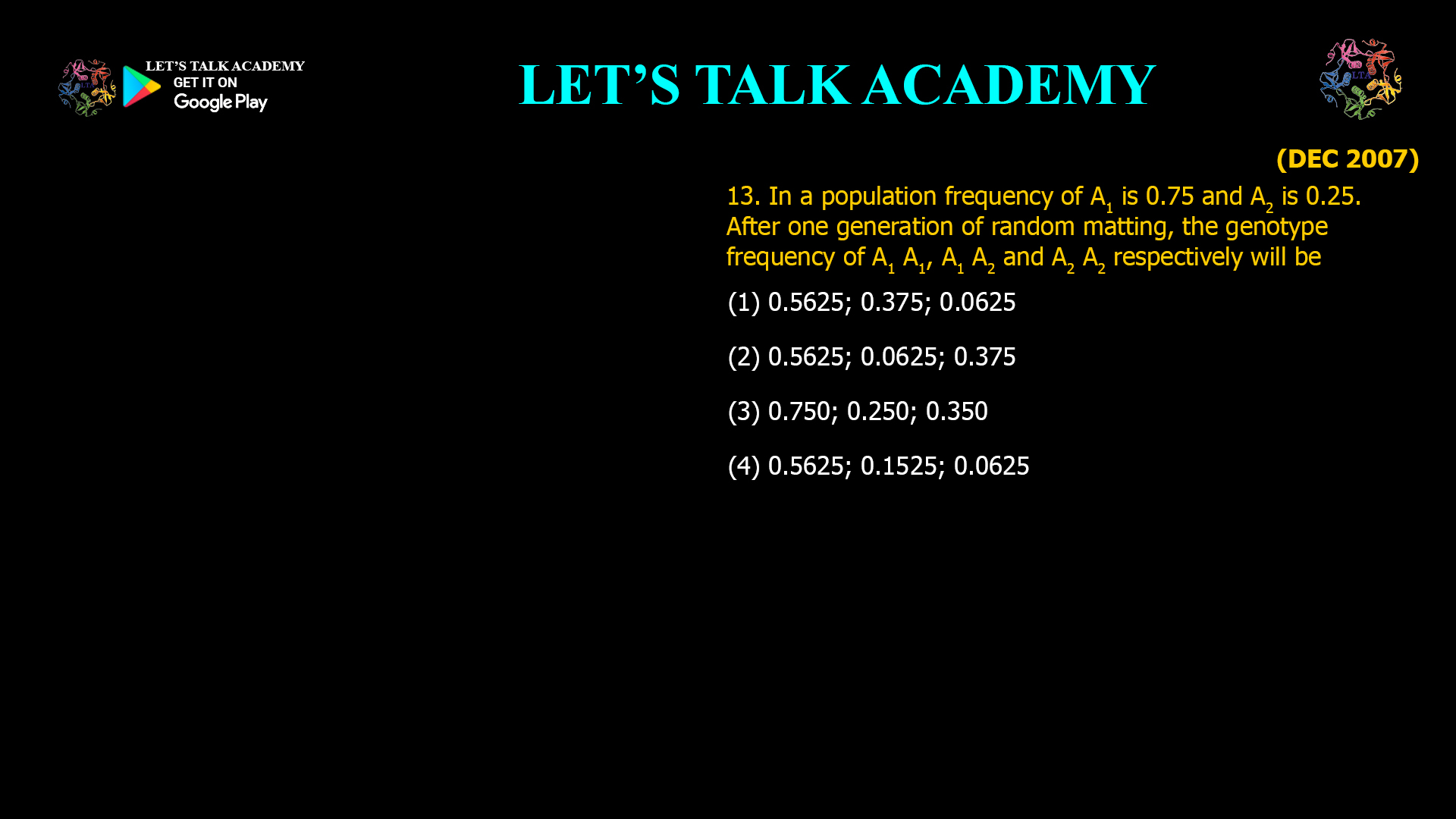
13. In a population frequency of A1 is 0.75 and A2 is 0.25. After one generation of random matting, the genotype frequency of A1 A1, A1 A2 and A2 A2 […]


