Reduction in the frequency of heterozygous genotype with a concomitant increase in the frequency of homozygous genotype, in context of random mating is due to (1) Genetic drift (2) Intense […]
Reduction in the frequency of heterozygous genotype with a concomitant increase in the frequency of homozygous genotype, in context of random mating is due to (1) Genetic drift (2) Intense […]
How is genetic variation in a population related to inbreeding and finite population size? (1) Both finite population size and inbreeding lead to decrease in genetic variation. (2) Only inbreeding […]
In spite of its two-fold cost, sexual reproduction is the most dominant mode of reproduction among the living organisms. Which of the following reasons might account for this? (A) Sexual […]
The Galapagos finches were an important clue to Darwin’s thinking about the origin of species. These finches are believed to have descended from a single ancestral species that colonized the […]
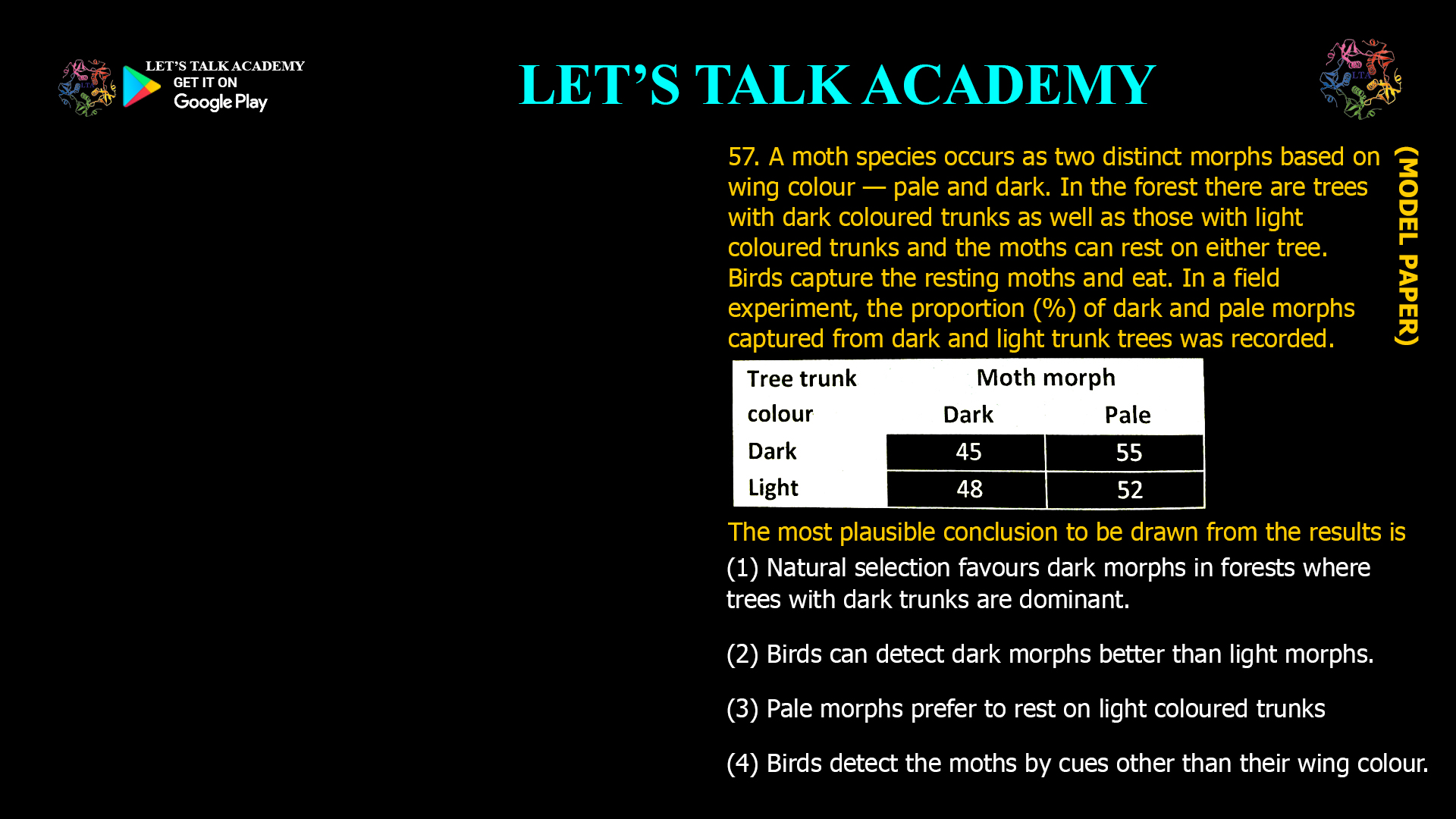
A moth species occurs as two distinct morphs based on wing colour — pale and dark. In the forest there are trees with dark coloured trunks as well as those […]
In pre-industrial period in England, peppered moths had light coloration which effectively camouflaged’ them against light coloured trees and lichens. During industrial revolution, many lichens died out and trees became […]
In Africa “AS” represent a carrier of sickle cell anemia, where A is the allele for normal haemoglobin and S for sickle cell haemoglobin. If the allele S is maintained […]
It is found that people with the genetic disease called sickle cell anemia are resistant to malaria. Which of the following best describes the underlying mechanism? (1) Frequency-dependent selection (2) […]
Directional Selection for a particular trait will lead to the frequency of the trait: (1) being normally distributed in the population. (2) always showing a left-skewed distribution in the population. […]

Which of the following evolutionary processes played an important role in the evolution of immune system? (1) Reproductive isolation (2) Adaptive radiation (3) Neutral evolution (4) Co-evolution What Is […]


