In an experiment that has continued for more than 50 years, corn has been propagated by breeding only from plants with the height amount of oil in the seeds. The […]
In an experiment that has continued for more than 50 years, corn has been propagated by breeding only from plants with the height amount of oil in the seeds. The […]

The rate of mutation in E. coli from lac– to lac+ are determined using medium containing lactose, as the only sole source of energy. The principle of spontaneity can be […]
Which of the following statements about evolution is NOT true? (1) Evolution is the product of natural selection. (2) Evolution is goal-oriented. (3) Prokaryotes evolve faster than eukaryotes. (4) Evolution […]

Change in allele frequency at species or below species level is termed as (1) Microevolution (2) Macroevolution (3) Mega evolution (4) Silent evolution What Is Microevolution? Microevolution refers to the […]
If E. coli is grown on lactose free medium for 20 generations under presence of constant mutagen which produces the lac– mutants as well as lac– revertants in equal amount. […]

Which is essential for bringing variation and evolution? (1) Mutation (2) Reproduction (3) Mitosis (4) Genetic drift What Is Mutation? A mutation is a change in the DNA sequence of an […]

Smallest unit which can evolve is- (1) Individual (2) Species (3) population (4) Gene What Is a Population? A population is a group of individuals of the same species living in […]

The primary cause of variation among different individual in population is presence of (1) Recombination (2) Mutation (3) Multiple alleles (4) Hybridization What is Genetic Variation? Genetic variation refers […]
Examples of antibiotic resistance highlight important features of natural selection. Which of the following statements is NOT true? (1) Evolution by natural selection is progressive, it makes individuals ‘better’. (2) […]
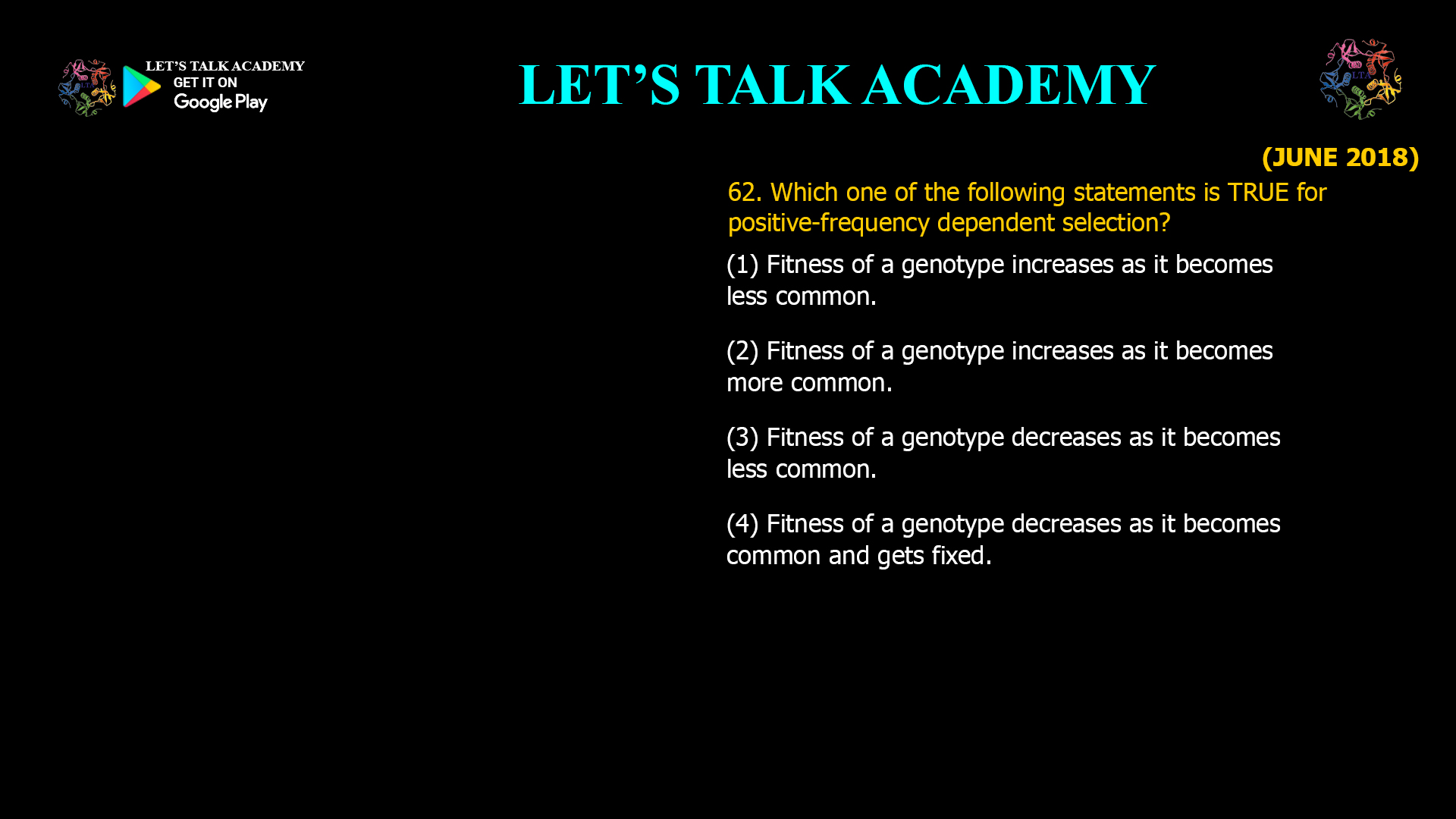
Which one of the following statements is TRUE for positive-frequency dependent selection? (1) Fitness of a genotype increases as it becomes less common. (2) Fitness of a genotype increases as […]


