During vulva development in C. elegans, the anchor cell produces Lin-3 protein which interacts with the Let-23 protein present on the six vulval precursor cells (VPCs) that form an equivalence […]

During vulva development in C. elegans, the anchor cell produces Lin-3 protein which interacts with the Let-23 protein present on the six vulval precursor cells (VPCs) that form an equivalence […]

Development of vulva in C. elegans is initiated by the induction of a small number of cells by short range signals from a single inducing cell. With reference to this, […]

Generally the number of cells present in gametophyte of angiosperm are- (1) 7 (2) 8 (3) 3 (4) 5 Introduction Angiosperms, or flowering plants, have highly reduced and specialized gametophytes […]

In C. elegans during embryogenesis, an anchor cell and 6 hypodermal vulval precursor cells (VPCs) get involved in forming the vulva. If 3 of the hypodermal VPCs are killed by […]

1. Apomixis is reproduction in which (1) Fusion of gametes but no fusion of central cell (2) Egg form complete plant (3) Pollen forms seeds (4) Seeds are formed without […]

The following experiments related to vulva development in C. elegans were performed: • When the anchor cell was killed by laser beam at early embryonic development and embryo was allowed […]

In C. elegans, an anchor cell and a few hypodermal cells take part in the formation of vulva. The experiment performed to understand the role of these cells in vulva […]

A group of six cells called ‘equivalence group cells’ divide to form the vulval structure in Caenorhabditis elegans. They are called so because (1) they have similar fates during development […]
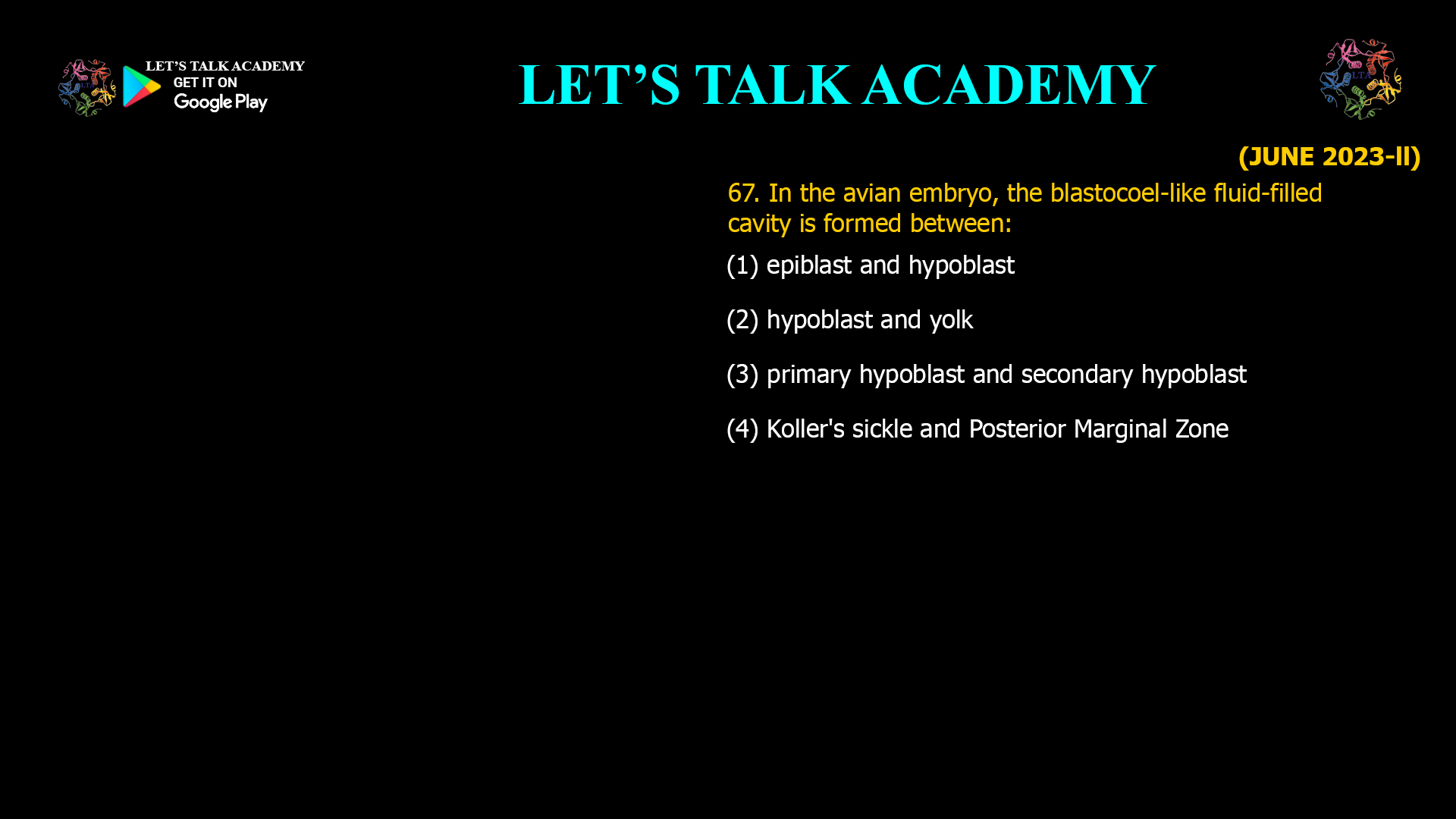
67. In the avian embryo, the blastocoel-like fluid-filled cavity is formed between: (1) epiblast and hypoblast (2) hypoblast and yolk (3) primary hypoblast and secondary hypoblast (4) Koller’s sickle and […]

The model organism to study cell lineage is (1) Xenopus (2) Yeast (3) Caenorhabditis elegans (4) Drosophila Understanding how cells divide, differentiate, and form complex tissues is a central question […]


