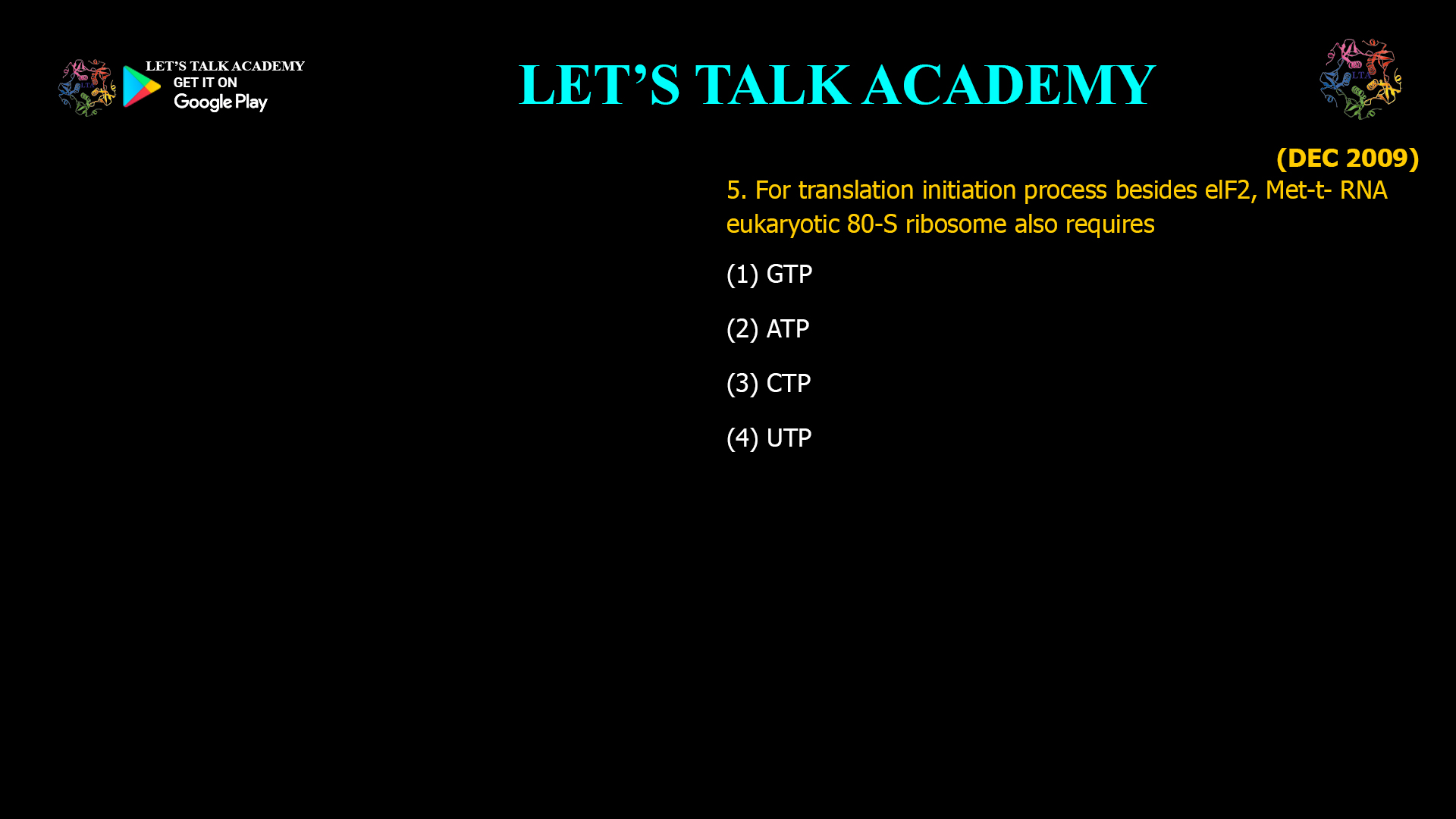
For translation initiation process besides elF2, Met-t- RNA eukaryotic 80-S ribosome also requires
(1) GTP (2) ATP
(3) CTP (4) UTP
Introduction
Translation initiation in eukaryotes is a highly regulated and complex process that ensures the accurate and efficient synthesis of proteins. This process involves the assembly of the ribosome at the start codon of messenger RNA (mRNA), a step that requires several initiation factors, including eIF2, and the initiator transfer RNA (Met-tRNA). However, the process also critically depends on the presence of specific nucleotide triphosphates to provide the necessary energy for correct initiation.
The Players in Translation Initiation
Key Components:
-
eIF2: A multi-subunit initiation factor that delivers the initiator Met-tRNA to the small ribosomal subunit.
-
Met-tRNA: The initiator tRNA charged with methionine, which pairs with the AUG start codon.
-
80S Ribosome: The functional ribosome in eukaryotes, formed by the joining of the 40S and 60S subunits.
-
Initiation Factors: Besides eIF2, a host of other initiation factors (eIF1, eIF1A, eIF3, eIF4, eIF5, eIF5B, etc.) are involved in the process.
The Role of Nucleotide Triphosphates in Initiation
Nucleotide triphosphates (NTPs) are essential for various steps in translation initiation, providing energy and enabling conformational changes. The main NTPs considered are:
-
GTP (Guanosine Triphosphate)
-
ATP (Adenosine Triphosphate)
-
CTP (Cytidine Triphosphate)
-
UTP (Uridine Triphosphate)
Each of these molecules can be hydrolyzed to release energy, but only specific NTPs are used at defined stages of translation initiation.
The Central Role of GTP in Translation Initiation
eIF2-GTP-Met-tRNA Ternary Complex
One of the earliest and most critical steps in translation initiation is the formation of the ternary complex, which consists of eIF2 bound to GTP and Met-tRNA. This complex is essential for recruiting the initiator tRNA to the small ribosomal subunit.
GTP Hydrolysis and Ribosomal Joining
After the ternary complex is assembled and the small ribosomal subunit is positioned at the start codon, GTP bound to eIF2 is hydrolyzed to GDP. This event, promoted by the initiation factor eIF5, triggers the release of eIF2-GDP and other factors, allowing the large ribosomal subunit to join and form the functional 80S ribosome.
eIF5B and GTP
Another GTP-binding factor, eIF5B, is required for the final joining of the large ribosomal subunit. eIF5B is a ribosome-dependent GTPase that mediates the joining of the 60S subunit to the 48S preinitiation complex, forming the 80S ribosome. The GTP bound to eIF5B is hydrolyzed during this process, releasing eIF5B and completing the initiation phase.
The Role of ATP in Translation Initiation
While ATP is not directly involved in the core process of eIF2-GTP-Met-tRNA ternary complex formation or ribosomal joining, it plays a key role in earlier and auxiliary steps:
-
mRNA Activation: The 5′ cap structure of eukaryotic mRNA must be recognized and unwound before the initiation complex can assemble. This process is mediated by the eIF4F complex, which includes eIF4A, an ATP-dependent RNA helicase. ATP is hydrolyzed to provide the energy needed for unwinding the mRNA secondary structure, facilitating scanning and start codon recognition.
-
Auxiliary Functions: Some other initiation factors, such as eIF4B and eIF4H, enhance the helicase activity of eIF4A, but the actual energy for unwinding comes from ATP hydrolysis.
CTP and UTP in Translation Initiation
CTP and UTP are not directly involved in the canonical translation initiation process in eukaryotes. While these nucleotides are important for other cellular processes (such as RNA synthesis), they are not required for the assembly of the initiation complex or the joining of ribosomal subunits.
Step-by-Step Overview of Translation Initiation
-
Formation of the Ternary Complex:
eIF2 binds GTP and Met-tRNA to form the ternary complex. -
Assembly of the 43S Preinitiation Complex:
The ternary complex binds to the small ribosomal subunit along with other initiation factors. -
mRNA Activation:
The mRNA is unwound and activated by the eIF4F complex, using ATP. -
Attachment and Scanning:
The 43S complex attaches to the mRNA and scans for the start codon. -
Start Codon Recognition and 48S Complex Formation:
The initiator tRNA recognizes the AUG codon, forming the 48S preinitiation complex. -
GTP Hydrolysis and Factor Release:
GTP bound to eIF2 is hydrolyzed, releasing eIF2-GDP and other factors. -
Large Subunit Joining:
eIF5B mediates the joining of the large ribosomal subunit, using GTP. -
Formation of the 80S Ribosome:
The functional ribosome is assembled, ready for translation elongation.
Summary Table
| NTP | Role in Translation Initiation |
|---|---|
| GTP | Required for eIF2 ternary complex formation and ribosomal joining |
| ATP | Used for mRNA unwinding and activation by eIF4A |
| CTP | Not required for initiation |
| UTP | Not required for initiation |
Why GTP Is the Answer
When considering what is required besides eIF2 and Met-tRNA for the initiation of translation on eukaryotic 80S ribosomes, the immediate and direct requirement is GTP. GTP is essential for both the formation of the eIF2-GTP-Met-tRNA ternary complex and the joining of ribosomal subunits. ATP is important for mRNA activation but is not directly involved in the core initiation complex formation or ribosomal joining.
Conclusion
For the translation initiation process in eukaryotes, besides eIF2 and Met-tRNA, the eukaryotic 80S ribosome also requires GTP. GTP is crucial for the formation of the initiation complex and for the joining of ribosomal subunits. ATP is used for mRNA activation, but not for the direct assembly of the initiation complex. CTP and UTP are not involved in this process.
Correct answer: (1) GTP


8 Comments
Prami Masih
June 11, 2025👍👍
Santosh Saini
November 3, 2025For the translation initiation process in eukaryotes besides eIF2 and met t RNA, the eukaryotic 80s ribosome also requires GTP
Divya rani
November 3, 2025In translation initiation GTP is required for eIF2 ternary complex formation and ribosomal joining.
anjani sharma
November 3, 2025Answer 1
In translation initiation GTP is required for eIF2 ternary complex formation and ribosomal joining.
Priya khandal
November 3, 2025Gtp
Pooja
November 4, 2025GTP
Heena Mahlawat
November 5, 2025Gtp
Sakshi Kanwar
November 8, 2025Gtp