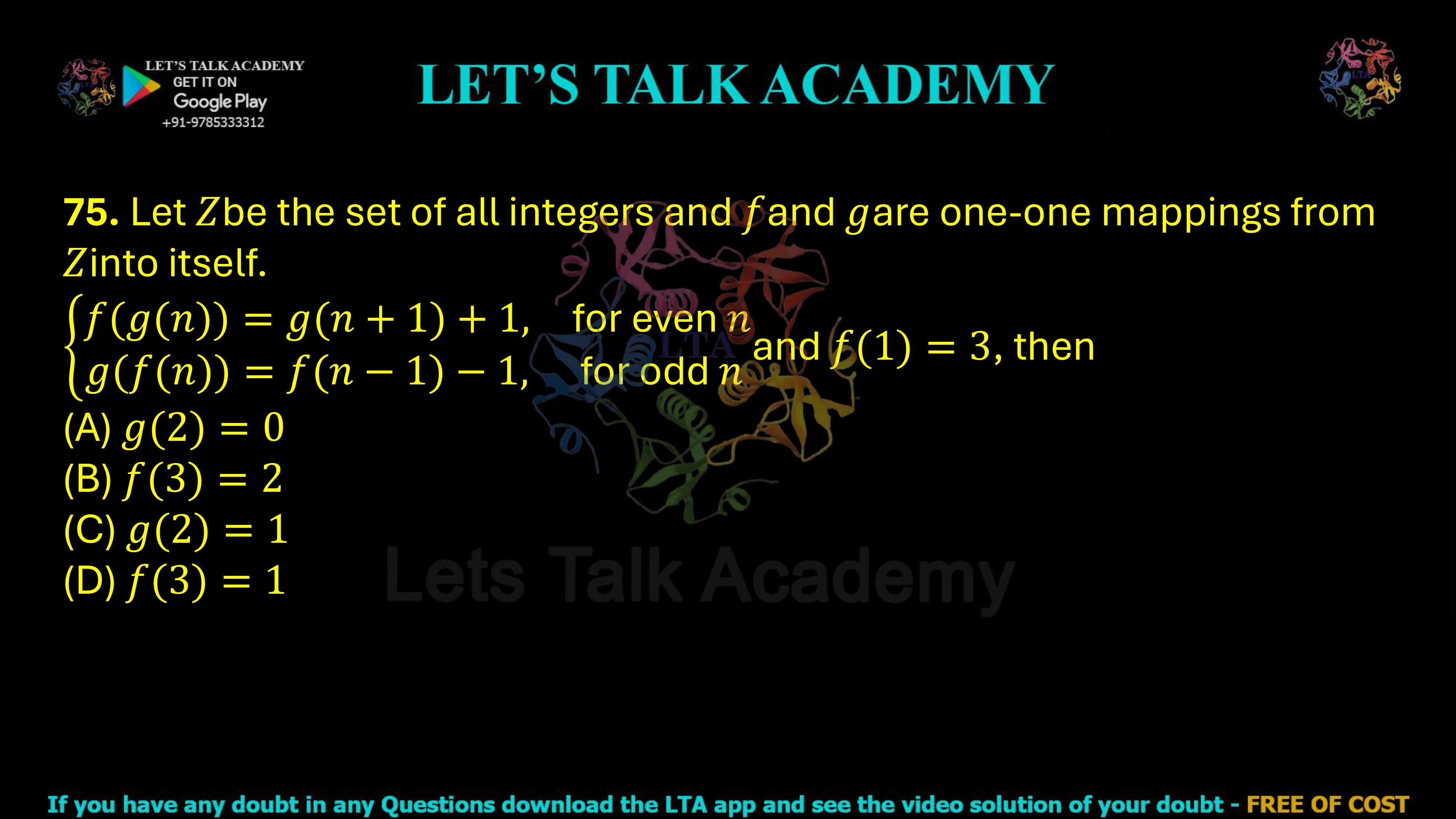
75. Let Z be the set of all integers and let f and g be one-one mappings from Z into itself such that
For even n,
f(g(n)) = g(n + 1) + 1
For odd n,
g(f(n)) = f(n − 1) − 1
and
f(1)=3.
Then
(A) g(2)=0
(B) f(3)=2
(C) g(2)=1
(D) f(3)=1
Functional Equation Involving One-One Mappings
The present question involves two one-one mappings defined on the set of all integers. The key observation is that both functions are injective. Many students try to determine the explicit formulas for the functions, but that is unnecessary. Instead, we use the given relations, substitute suitable values of n, and exploit the injective property to obtain the required answer.
Correct Answer
Option (A): g(2)=0
Understanding the Given Conditions
Two different functional relations are provided depending upon whether the integer n is even or odd. Therefore, the first step is to substitute the smallest convenient values of n and connect the two equations.
The most important property given in the question is that both f and g are one-one (injective). This means that whenever
f(a)=f(b)
we must conclude
a=b.
This property will be the key to solving the problem.
Step 1: Use the Relation for Odd n
Take
n=1,
which is an odd integer.
The second relation becomes
g(f(1))=f(0)-1.
Since
f(1)=3,
we obtain
g(3)=f(0)-1.
Step 2: Use the Relation for Even n
Now choose
n=2,
which is an even integer.
The first relation gives
f(g(2))=g(3)+1.
From Step 1,
g(3)=f(0)-1.
Substituting this value,
f(g(2))=(f(0)-1)+1.
Therefore,
f(g(2))=f(0).
Step 3: Use the One-One Property
Since f is one-one (injective), equal outputs imply equal inputs.
Thus, from
f(g(2))=f(0),
we conclude
g(2)=0.
This immediately determines the correct answer.
Mathematical Verification
From the odd relation,
g(3)=f(0)-1.
Substituting into the even relation gives
f(g(2))=f(0).
Because f is injective,
g(2)=0.
The result follows directly from the defining property of one-one functions.
Explanation of Every Option
Option (A): g(2)=0
This option is correct. It follows directly from substituting n = 1 and n = 2 into the given functional equations and then applying the injective property of the function f.
Option (B): f(3)=2
This statement cannot be deduced from the given information. None of the functional equations uniquely determines the value of f(3).
Option (C): g(2)=1
This contradicts the injectivity argument, which proves that g(2)=0. Therefore, this option is incorrect.
Option (D): f(3)=1
Like Option (B), this value cannot be established from the given conditions. Hence, it is incorrect.
Related Practice Example
Suppose a function f is one-one and satisfies
f(a)=f(b).
Then the injective property immediately implies
a=b.
This simple observation is one of the most frequently used tools in solving functional equation problems in competitive examinations.
Key Takeaways
Whenever a question states that a function is one-one, always look for opportunities to equate two function values. Once the outputs are equal, injectivity allows you to conclude that the corresponding inputs must also be equal. This principle greatly simplifies many functional equation problems.
Final Answer
Using the given functional equations for n=1 and n=2, and applying the one-one property of the function f, we obtain
g(2)=0.
Correct Option: (A)


