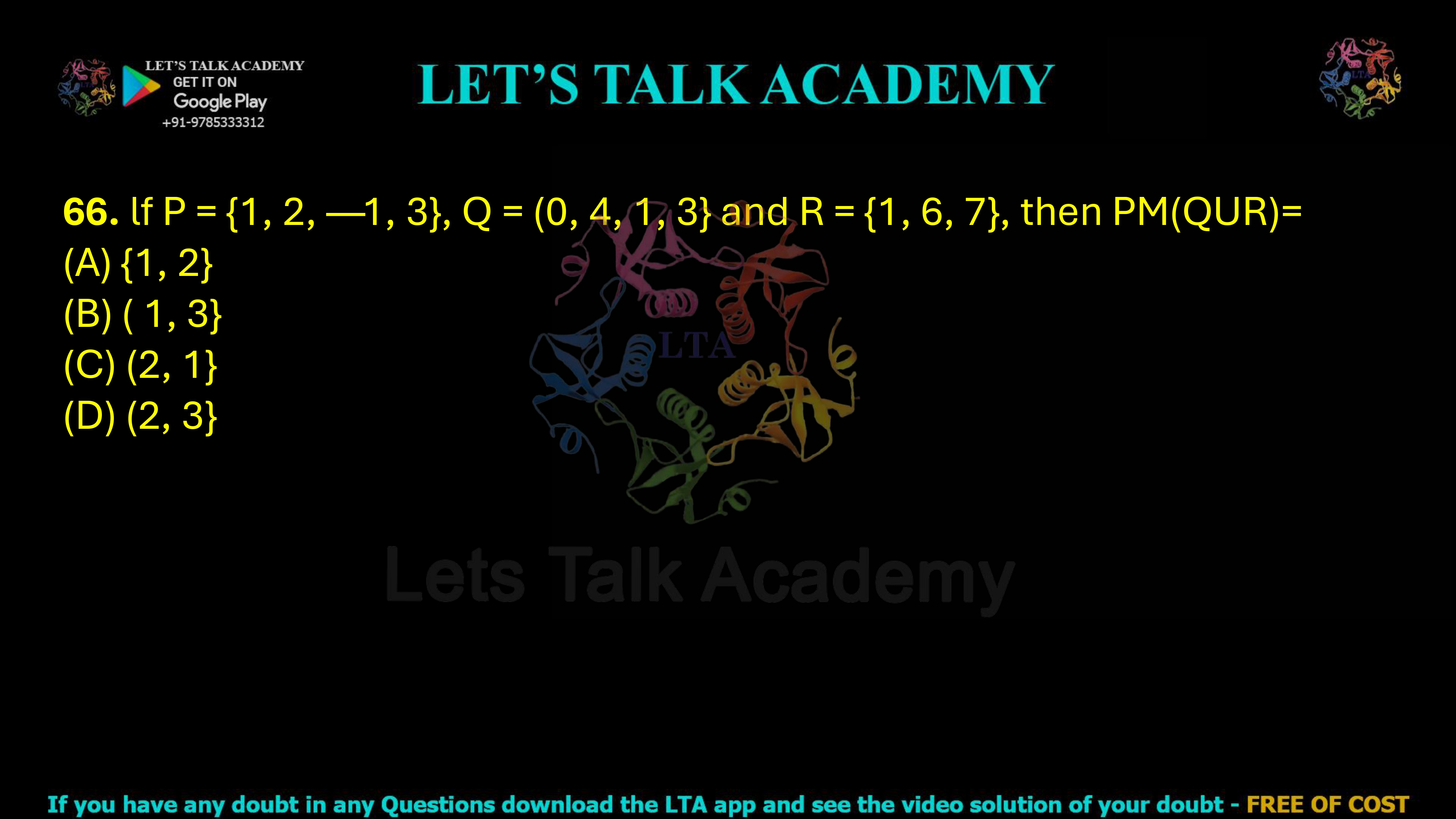
66. lf P = {1, 2, —1, 3}, Q = (0, 4, 1, 3} and R = {1, 6, 7}, then PM(QUR)=
(A) {1, 2}
(B) ( 1, 3}
(C) (2, 1}
(D) (2, 3}
Finding P ∩ (Q ∪ R) – Complete Concept and Detailed Solution
The present question requires us to perform two set operations sequentially. First, we need to determine the union of two sets, namely Q and R. After obtaining the union, we must find its intersection with the set P. Solving the operations in the correct order is essential because changing the order may produce an entirely different result. Therefore, before solving the question, let us briefly understand the concepts involved.
Correct Answer
Option (B): {1, 3}
Understanding the Concepts of Union and Intersection
Before solving the problem, it is important to understand the meaning of the two operations involved.
What is the Union of Two Sets?
The union of two sets contains every distinct element that belongs to either of the sets. Duplicate elements are written only once because a set never contains repeated elements.
Symbolically,
A ∪ B represents all elements that are in A, in B, or in both.
What is the Intersection of Two Sets?
The intersection of two sets contains only those elements that are common to both sets.
Symbolically,
A ∩ B represents the elements that belong to both A and B simultaneously.
These two operations are among the most frequently tested concepts in elementary set theory and form the basis for solving advanced problems involving Venn diagrams, probability, and Boolean algebra.
Step 1: Find the Union of Q and R
The given sets are
Q = {0, 4, 1, 3}
R = {1, 6, 7}
To find the union, we combine all distinct elements from both sets.
Notice that the element 1 appears in both sets, but it is written only once in the union.
Therefore,
Q ∪ R = {0, 1, 3, 4, 6, 7}
This set contains every unique element that belongs to either Q or R.
Step 2: Find the Intersection with P
The set P is
P = {1, 2, −1, 3}
Now we compare every element of P with the elements of Q ∪ R.
| Element of P | Present in Q ∪ R? |
|---|---|
| 1 | Yes ✔ |
| 2 | No ✘ |
| −1 | No ✘ |
| 3 | Yes ✔ |
The common elements are therefore
{1, 3}
Hence,
P ∩ (Q ∪ R) = {1, 3}.
Mathematical Verification
Let us verify the result carefully.
Union:
{0,4,1,3} ∪ {1,6,7}
= {0,1,3,4,6,7}
Intersection with P:
{1,2,−1,3} ∩ {0,1,3,4,6,7}
= {1,3}
The calculation confirms that our answer is correct.
Explanation of Every Option
Option (A): {1, 2}
This option is incorrect because the element 2 is not present in the union of Q and R. Therefore, it cannot appear in the intersection.
Option (B): {1, 3}
This option is correct because both 1 and 3 belong to P as well as to Q ∪ R. These are exactly the common elements.
Option (C): {2, 1}
This option is incorrect because although the order of elements in a set does not matter, the inclusion of 2 makes the set incorrect. Since 2 does not belong to Q ∪ R, it cannot appear in the intersection.
Option (D): {2, 3}
This option is incorrect because 2 is absent from Q ∪ R. Only the element 3 is common to both sets.
Alternative Method Using a Venn Diagram
Another effective way to solve this problem is by imagining a Venn diagram. First, combine the regions corresponding to sets Q and R to form their union. Then identify only those elements that also lie inside set P. The common region contains exactly the elements 1 and 3.
This graphical approach is particularly useful for solving more complex questions involving three or more sets.
Related Practice Example
Let
A = {2,4,6,8}
B = {1,2,3,4}
C = {4,5,6}
Find A ∩ (B ∪ C).
First,
B ∪ C = {1,2,3,4,5,6}
Now intersect with A:
{2,4,6,8} ∩ {1,2,3,4,5,6}
= {2,4,6}
This example follows exactly the same procedure as the present question.
Key Takeaways
Whenever an expression contains more than one set operation, solve it systematically according to the brackets. First compute the union or intersection inside the parentheses, and then perform the remaining operation. Remember that union includes every distinct element, whereas intersection contains only the common elements. Following this approach minimizes mistakes and improves speed during competitive examinations.
Final Answer
The union of the sets Q and R is
{0,1,3,4,6,7}.
The elements common to this set and P are
{1,3}.
Therefore,
P ∩ (Q ∪ R) = {1,3}.
Correct Option: (B) {1,3}


