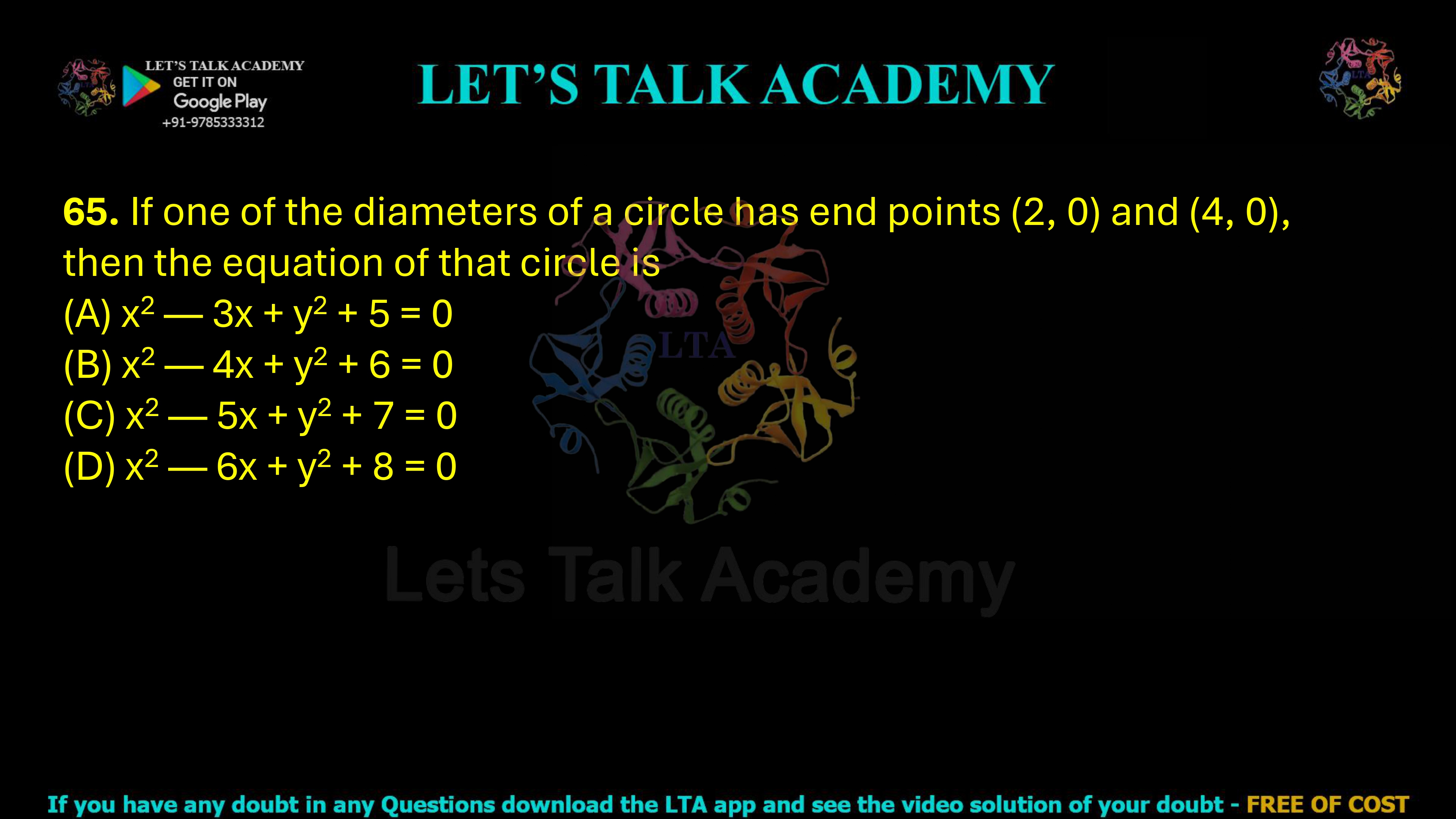
65. If one of the diameters of a circle has end points (2, 0) and (4, 0), then the equation of that circle is
(A) x2 — 3x + y2 + 5 = 0
(B) x2 — 4x + y2 + 6 = 0
(C) x2 — 5x + y2 + 7 = 0
(D) x2 — 6x + y2 + 8 = 0
Equation of a Circle When the Endpoints of Its Diameter Are Given
Although the question appears simple, solving it correctly requires following a logical sequence of steps. First, we determine the centre of the circle by finding the midpoint of the diameter. Next, we calculate the radius using the distance between the centre and either endpoint. Finally, we substitute these values into the standard equation of a circle and simplify the expression. Understanding this systematic approach allows students to solve similar problems quickly and accurately during competitive examinations.
Correct Answer
None of the given options is correct.
The correct equation of the circle is:
x² − 6x + y² + 8 = 0
This corresponds mathematically to Option (D).
Step 1: Identify the Endpoints of the Diameter
The given endpoints are
A(2,0) and B(4,0).
These two points lie on the x-axis and form the diameter of the circle.
The most important property of a circle states that the centre of the circle always lies at the midpoint of its diameter.
Step 2: Find the Centre of the Circle
To determine the centre, we use the midpoint formula.
::contentReference[oaicite:0]{index=0}
Applying the midpoint formula to the given points,
Centre = ((2 + 4)/2, (0 + 0)/2)
= (6/2, 0)
= (3,0)
Thus, the centre of the required circle is (3,0).
Step 3: Calculate the Radius
The radius is the distance between the centre and either endpoint of the diameter.
The centre is (3,0) and one endpoint is (2,0).
The distance between these two points is
|3 − 2| = 1
Therefore,
Radius = 1
Consequently,
Radius² = 1
Step 4: Write the Standard Equation of the Circle
The standard equation of a circle with centre (h,k) and radius r is given by
::contentReference[oaicite:1]{index=1}
Substituting
h = 3
k = 0
r = 1
we obtain
(x − 3)² + y² = 1
Step 5: Expand the Equation
Expanding the square,
(x − 3)² = x² − 6x + 9
Therefore,
x² − 6x + 9 + y² = 1
Bringing all terms to one side,
x² − 6x + y² + 8 = 0
This is the required equation of the circle.
Verification of the Result
A good practice in competitive examinations is to verify the obtained equation by substituting the given endpoints.
Substituting the point (2,0):
2² − 6(2) + 0 + 8 = 4 − 12 + 8 = 0 ✔
Substituting the point (4,0):
4² − 6(4) + 0 + 8 = 16 − 24 + 8 = 0 ✔
Both endpoints satisfy the equation, confirming that the solution is correct.
Explanation of Every Option
Option (A): x² − 3x + y² + 5 = 0
This option is incorrect because the coefficient of x indicates a centre at (3/2,0), which is not the midpoint of the given diameter. Moreover, substituting either endpoint into the equation does not satisfy it.
Option (B): x² − 4x + y² + 6 = 0
This option is also incorrect. Here the centre would be (2,0), which coincides with one endpoint of the diameter. A circle cannot have its centre located at one endpoint of its diameter.
Option (C): x² − 5x + y² + 7 = 0
This option is incorrect because its centre becomes (5/2,0), which is not the midpoint of the given diameter. Hence, it does not represent the required circle.
Option (D): x² − 6x + y² + 8 = 0
This option is mathematically correct because it has centre (3,0), radius 1, and both endpoints of the diameter satisfy the equation.
Alternative Method Using Diameter Formula
There is another elegant method for solving such questions without separately calculating the centre and radius.
If the endpoints of the diameter are (x₁,y₁) and (x₂,y₂), then the equation of the circle is
(x − x₁)(x − x₂) + (y − y₁)(y − y₂) = 0
Substituting the given endpoints,
(x − 2)(x − 4) + (y − 0)(y − 0) = 0
x² − 6x + 8 + y² = 0
Thus,
x² − 6x + y² + 8 = 0
This method is particularly useful in objective examinations because it avoids calculating the midpoint and radius separately.
Related Practice Example
Suppose the endpoints of a diameter are (1,2) and (5,6).
The centre is
((1+5)/2, (2+6)/2) = (3,4).
The radius is the distance from (3,4) to (1,2), which equals √8.
Hence, the equation becomes
(x−3)² + (y−4)² = 8.
Practising similar examples strengthens conceptual understanding and improves speed in examinations.
Key Takeaways
Whenever the endpoints of a diameter are given, the first step is to find the midpoint, which becomes the centre of the circle. Next, calculate the radius using the distance formula, substitute these values into the standard equation of the circle, and simplify. Alternatively, the direct diameter formula provides a faster method for solving objective-type questions.
Final Answer
The centre of the circle is (3,0), the radius is 1, and the required equation is
x² − 6x + y² + 8 = 0
Correct Option: (D)


