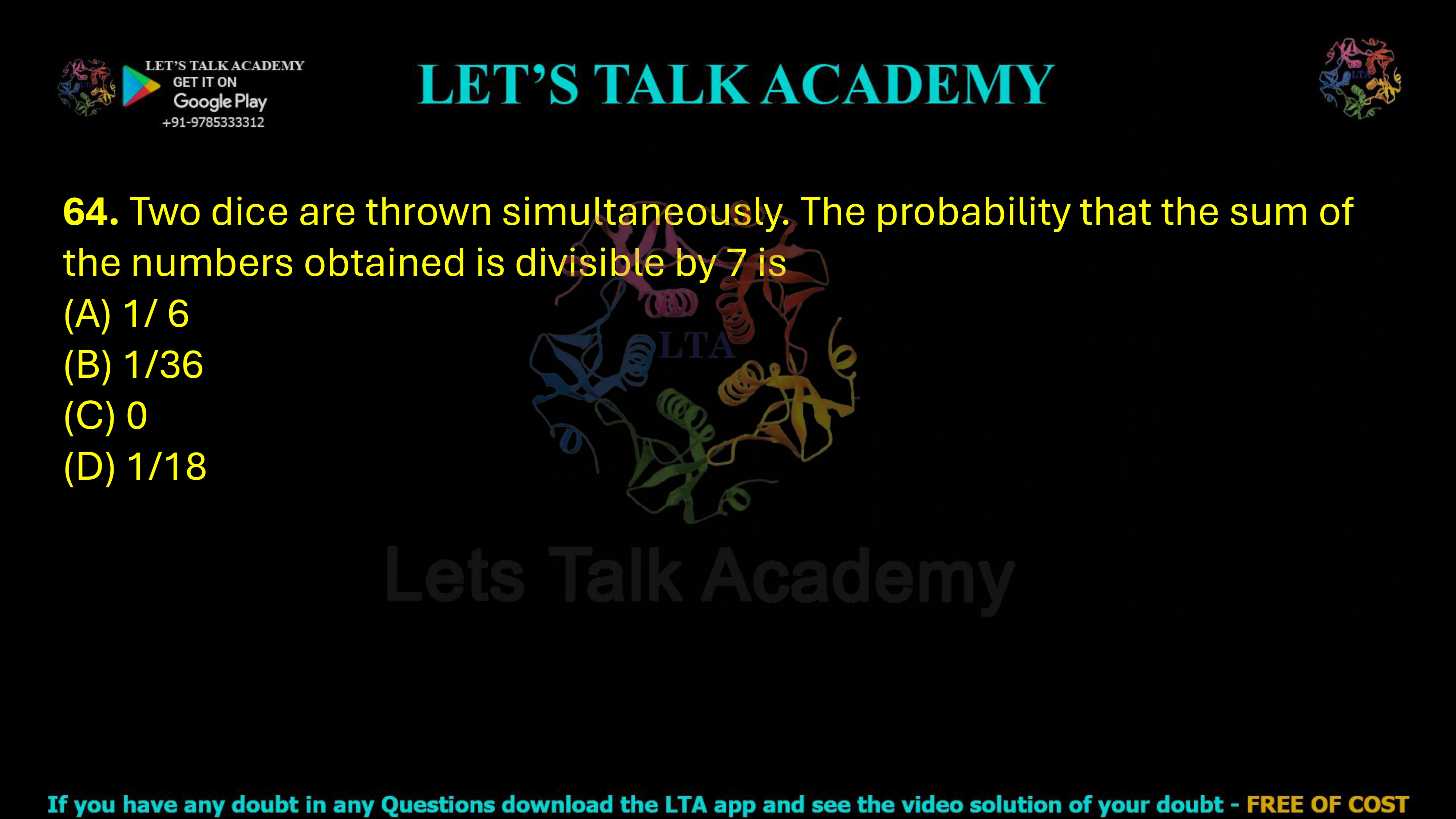
64. Two dice are thrown simultaneously. The probability that the sum of the numbers obtained is divisible by 7 is
(A) 1/ 6 (B) 1/36
(C) 0 (D) 1/18
Probability That the Sum of Two Dice Is Divisible by 7
The present question is based on the classical definition of probability. Although it appears straightforward, many students make mistakes by counting favorable outcomes incorrectly or by forgetting that each ordered pair obtained from two dice is equally likely. Therefore, before solving the problem, it is essential to understand how the sample space of two dice is constructed and how favorable outcomes are identified.
Correct Answer
Option (A): 1/6
Understanding the Concept of Classical Probability
Whenever two fair dice are thrown, each die can show any one of the numbers from 1 to 6. Since the result of the first die is independent of the second die, every possible ordered pair has an equal chance of occurring.
The classical definition of probability states that
Probability = (Number of Favorable Outcomes) ÷ (Total Number of Possible Outcomes)
Therefore, solving any probability problem involving dice requires two steps:
- Determine the total number of equally likely outcomes.
- Count the outcomes that satisfy the given condition.
Total Number of Possible Outcomes
The first die has 6 possible outcomes.
The second die also has 6 possible outcomes.
Since each outcome of the first die can occur with every outcome of the second die, the total number of possible outcomes is
6 × 6 = 36.
Thus, the sample space contains 36 equally likely ordered pairs.
Finding the Favorable Outcomes
The question asks for the probability that the sum of the numbers obtained is divisible by 7.
The smallest possible sum when two dice are thrown is
1 + 1 = 2
and the largest possible sum is
6 + 6 = 12.
The numbers between 2 and 12 that are divisible by 7 are:
7
Only the sum 7 is possible because the next multiple of 7 is 14, which cannot be obtained using two standard dice.
List All Favorable Outcomes
The ordered pairs whose sum is 7 are:
(1, 6)
(2, 5)
(3, 4)
(4, 3)
(5, 2)
(6, 1)
Hence, the total number of favorable outcomes is
6.
Calculating the Probability
Using the probability formula,
Probability = Favorable Outcomes / Total Outcomes
= 6 / 36
= 1 / 6
Therefore, the required probability is
1/6.
Mathematical Verification
Total outcomes = 36
Favorable outcomes = 6
Probability = 6/36
Dividing both numerator and denominator by 6 gives
1/6.
This confirms that the answer is mathematically correct.
Explanation of Every Option
Option (A): 1/6
This option is correct. There are exactly six ordered pairs whose sum equals 7, and since the total number of equally likely outcomes is 36, the probability becomes 6/36 = 1/6.
Option (B): 1/36
This option is incorrect because it assumes that only one favorable outcome exists. In reality, there are six different ordered pairs that produce a sum of 7.
Option (C): 0
This option is incorrect because obtaining a sum of 7 is clearly possible. In fact, it is one of the most common outcomes when two dice are thrown.
Option (D): 1/18
This option is incorrect because 1/18 equals 2/36, implying only two favorable outcomes. However, there are actually six favorable ordered pairs.
Alternative Method
Instead of writing all 36 outcomes, remember that only the sum 7 satisfies the divisibility condition. The number of ways to obtain a sum of 7 with two dice is a well-known result:
1+6, 2+5, 3+4, 4+3, 5+2, and 6+1.
Since there are six such outcomes, the probability can immediately be written as
6/36 = 1/6.
This shortcut is particularly useful during time-bound competitive examinations.
Related Practice Example
Suppose two fair dice are rolled. What is the probability that the sum is equal to 8?
The favorable outcomes are:
(2,6), (3,5), (4,4), (5,3), and (6,2).
Thus, the number of favorable outcomes is 5.
Therefore, the probability is
5/36.
Practising similar questions strengthens the ability to solve probability problems quickly and accurately in examinations.
Key Takeaways
Whenever two fair dice are thrown, the total number of equally likely outcomes is always 36. To solve probability questions efficiently, first determine the total sample space, then count the favorable outcomes satisfying the given condition. Finally, apply the classical probability formula and simplify the fraction to its lowest terms.
Final Answer
The sum of two dice is divisible by 7 only when the sum equals 7. There are exactly 6 favorable ordered pairs out of 36 total outcomes.
Probability = 6/36 = 1/6
Correct Option: (A) 1/6


