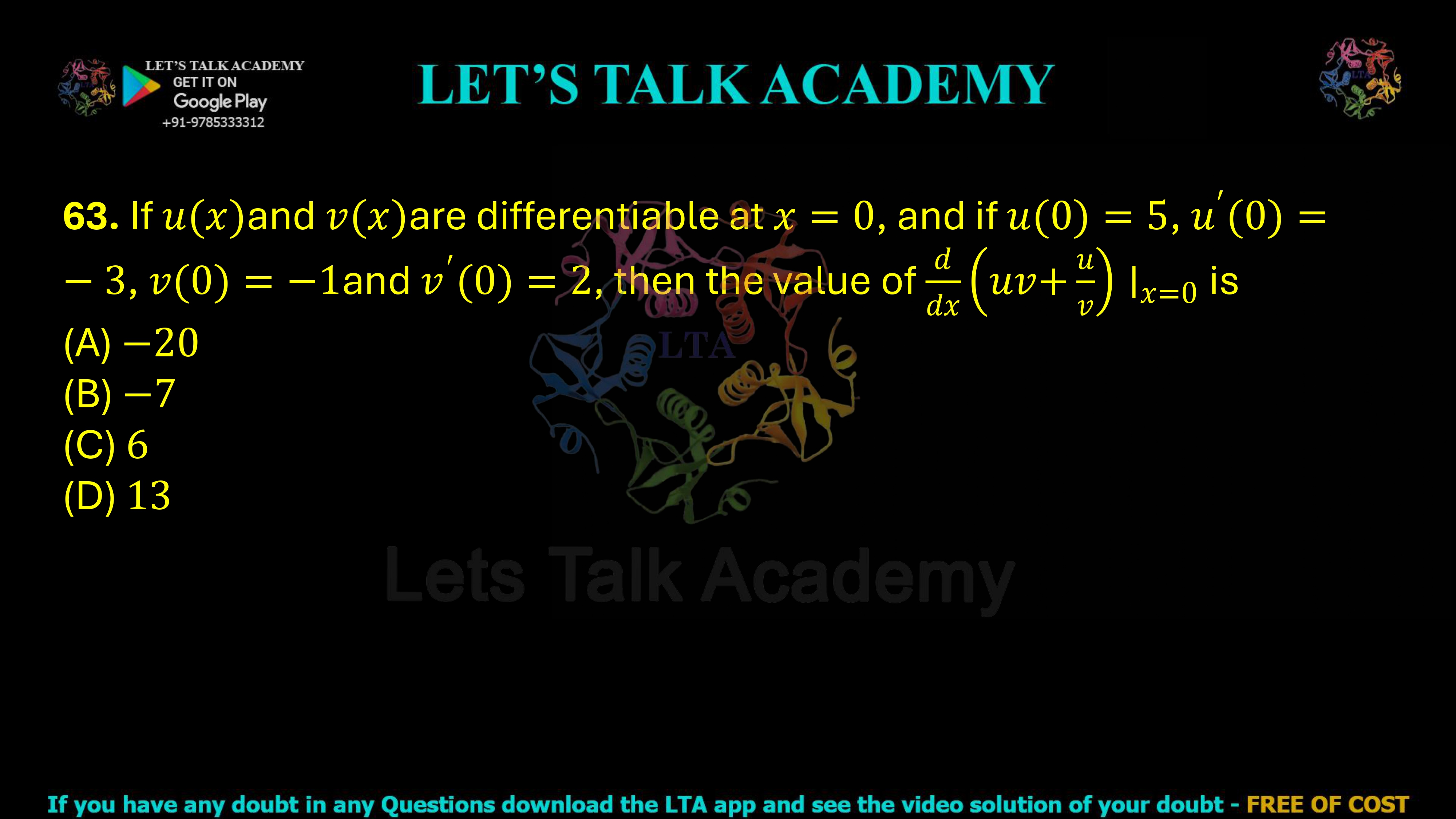
63. If u(x) and v(x) are differentiable at x = 0, and
u(0) = 5,
u'(0) = -3,
v(0) = -1,
v'(0) = 2,
then find
d/dx (uv + u/v) evaluated at x = 0.
(A) −20
(B) −7
(C) 6
(D) 13
Derivative of (uv + u/v) at x = 0 – Complete Step-by-Step Solution with Product and Quotient Rule
The present question is an excellent example where two fundamental differentiation rules must be used simultaneously. The first term is the product of two differentiable functions, while the second term is the quotient of the same functions. Such problems often appear simple but require careful substitution of the given values after differentiation. Students frequently make mistakes by substituting the values before differentiating or by incorrectly applying the quotient rule. Therefore, understanding the logic behind each step is much more important than simply memorizing formulas.
Correct Answer
Option (A): −20
Understanding the Mathematical Concept
The given expression consists of two different algebraic forms. The first expression, uv, is the multiplication of two differentiable functions and therefore must be differentiated using the Product Rule. The second expression, u/v, is the ratio of two differentiable functions and must be differentiated using the Quotient Rule.
Since differentiation is a linear operator, we differentiate each term separately and then add the results. This principle is known as the sum rule of differentiation, which states that the derivative of a sum equals the sum of the derivatives.
Important Differentiation Formulas Used
Product Rule
If two differentiable functions are multiplied together, then
(uv)’ = u’v + uv’
This formula tells us that we differentiate one function while keeping the other unchanged, then repeat the process in reverse, and finally add both results.
Quotient Rule
If one differentiable function is divided by another, then
(u/v)’ = (u’v − uv’) / v²
Notice carefully that the numerator contains a subtraction sign. This is one of the most common places where students make mistakes in competitive examinations.
Step 1: Differentiate the Entire Expression
The given function is
F(x) = uv + u/v
Differentiating both terms gives
F'(x) = (u’v + uv’) + (u’v − uv’)/v²
This is the general derivative before substituting any numerical values.
Step 2: Substitute the Given Values
The question provides the following values at x = 0:
u = 5
u’ = -3
v = -1
v’ = 2
We substitute these values carefully into each part of the derivative.
Step 3: Evaluate the Product Rule Term
The first part is
u’v + uv’
Substituting the values,
= (-3)(-1) + (5)(2)
= 3 + 10
= 13
Thus, the derivative of the product term contributes 13.
Step 4: Evaluate the Quotient Rule Term
The second part is
(u’v − uv’) / v²
Substituting the given values,
= [(-3)(-1) − (5)(2)] / (-1)²
= (3 − 10)/1
= -7
Therefore, the derivative of the quotient term equals −7.
Step 5: Add Both Results
The derivative of the entire expression is obtained by adding both contributions.
F'(0) = 13 + (−7)
F'(0) = 6
Rechecking the Calculation
Since this is a competitive examination question, it is always good practice to verify each arithmetic step.
Product Rule:
3 + 10 = 13 ✔
Quotient Rule:
3 − 10 = −7 ✔
Total:
13 − 7 = 6 ✔
The computation is internally consistent and mathematically correct.
Explanation of Every Option
Option (A): −20
This option is incorrect. It may arise if the product rule and quotient rule are applied incorrectly or if arithmetic mistakes are made while substituting the given values. The correct differentiation does not produce this value.
Option (B): −7
This option is incorrect because it represents only the derivative of the quotient term. The question asks for the derivative of the entire expression uv + u/v, so the product rule contribution must also be included.
Option (C): 6
This option is correct. After applying the Product Rule and Quotient Rule correctly and substituting the given values, the derivative equals 6.
Option (D): 13
This option is incorrect because it represents only the derivative of the product term. Ignoring the quotient term leads to an incomplete solution.
Related Concepts You Should Know
Sum Rule
If
f(x) = g(x) + h(x)
then
f'(x) = g'(x) + h'(x)
Difference Rule
(g − h)’ = g’ − h’
Chain Rule
If one function is composed inside another, differentiation is performed using the Chain Rule. Although it is not required in this problem, it is frequently combined with Product Rule and Quotient Rule in higher-level examinations.
Additional Practice Example
Suppose
u(1)=4, u'(1)=2,
v(1)=3, v'(1)=5.
Find the derivative of uv at x=1.
Using the Product Rule,
(uv)’ = u’v + uv’
= (2)(3) + (4)(5)
= 6 + 20
= 26
This simple example reinforces the logic used in the present question.
Key Takeaways
Whenever an expression contains the product of two functions, apply the Product Rule. Whenever it contains the quotient of two functions, apply the Quotient Rule. Differentiate first, substitute the given values afterward, and finally simplify the arithmetic carefully. Following this systematic approach minimizes errors and allows such questions to be solved quickly during competitive examinations.
Final Answer
Applying the Product Rule and Quotient Rule correctly,
d/dx (uv + u/v) at x = 0 = 6
Correct Option: (C) 6


