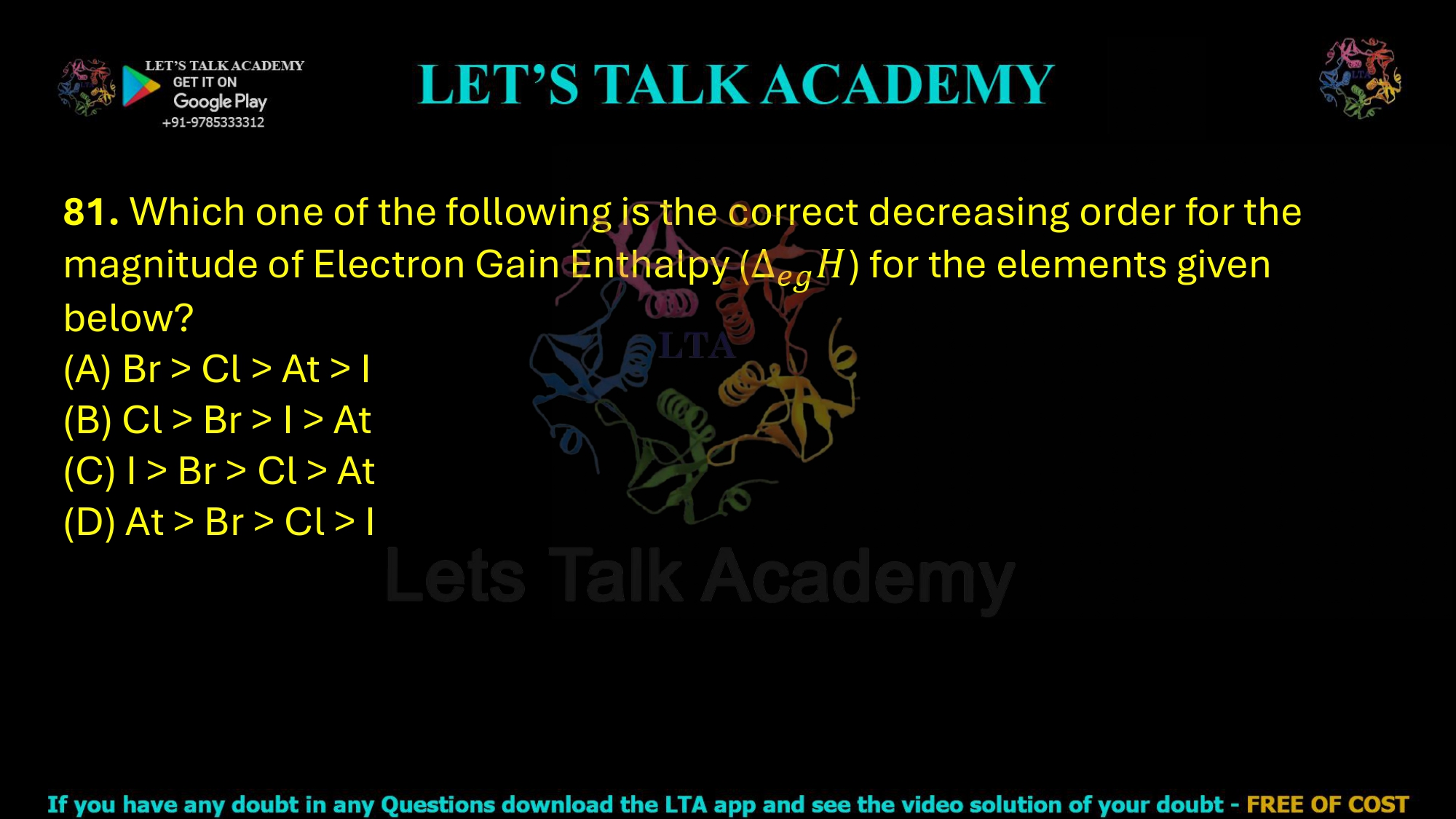
81. Which one of the following is the correct decreasing order for the magnitude of Electron Gain Enthalpy () for the elements given below?
(A) Br > Cl > At > I
(B) Cl > Br > I > At
(C) I > Br > Cl > At
(D) At > Br > Cl > I
Correct Decreasing Order of Electron Gain Enthalpy for Halogens
Although students often memorize periodic trends, competitive examinations usually test the exceptions to these trends. One of the most famous exceptions involves the halogens, where chlorine possesses a more negative electron gain enthalpy than fluorine despite fluorine being above chlorine in the periodic table. Similarly, understanding the trend among chlorine, bromine, iodine, and astatine requires conceptual knowledge of atomic size, shielding effect, and effective nuclear charge.
This question asks us to determine the correct decreasing order of the magnitude of electron gain enthalpy for four Group 17 elements.
Understanding Electron Gain Enthalpy
Electron gain enthalpy is defined as the enthalpy change that occurs when an isolated gaseous atom gains an electron to form a gaseous anion.
X(g) + e− → X−(g)
If energy is released during this process, the electron gain enthalpy is negative. The more negative the value, the greater is the tendency of the atom to accept an electron.
In many competitive examinations, the term magnitude of electron gain enthalpy is used. This refers to the absolute value of the electron gain enthalpy. Therefore, the element with the most negative electron gain enthalpy has the greatest magnitude.
Periodic Trend in Halogens
The halogens belong to Group 17 of the periodic table and have the outer electronic configuration ns2 np5. They require only one additional electron to complete their octet, making them highly favorable electron acceptors.
As we move down the group:
- Atomic size increases.
- Shielding effect increases.
- The added electron experiences weaker attraction from the nucleus.
- The magnitude of electron gain enthalpy decreases.
Thus, the general trend is
Cl > Br > I > At
It is important to remember that fluorine is an exception because of its extremely small size and greater electron-electron repulsion in the compact 2p orbital. Since fluorine is not included in this question, the trend follows the normal decrease down the group.
Approximate Electron Gain Enthalpy Values
The approximate values are:
- Chlorine (Cl): −349 kJ mol−1
- Bromine (Br): −325 kJ mol−1
- Iodine (I): −295 kJ mol−1
- Astatine (At): approximately −270 kJ mol−1
Considering the magnitude (absolute value), the decreasing order becomes:
Cl > Br > I > At
Explanation of Every Option
Option (A): Br > Cl > At > I
This option is incorrect because chlorine has a greater magnitude of electron gain enthalpy than bromine. The order incorrectly places bromine ahead of chlorine. It also incorrectly places astatine before iodine.
Option (B): Cl > Br > I > At
This is the correct answer. Chlorine possesses the highest magnitude of electron gain enthalpy among the given elements because of its relatively small atomic size and strong effective nuclear attraction. As atomic size increases down the group, the attraction for the incoming electron decreases, resulting in the order Cl > Br > I > At.
Option (C): I > Br > Cl > At
This option is incorrect because iodine is much larger than chlorine and bromine. Consequently, its electron gain enthalpy is significantly less negative. Therefore, iodine cannot have the greatest magnitude.
Option (D): At > Br > Cl > I
This option is incorrect because astatine is the largest atom among the given elements. Due to extensive shielding and a large atomic radius, it has the smallest magnitude of electron gain enthalpy, not the largest.
Why Chlorine Has a Higher Electron Gain Enthalpy than Bromine
Chlorine has a smaller atomic radius than bromine, allowing the nucleus to attract the incoming electron more effectively. Although bromine also requires one electron to complete its valence shell, the increased shielding by inner electrons reduces the nuclear attraction experienced by the incoming electron.
Consequently, the energy released when chlorine gains an electron is greater than that released by bromine, giving chlorine a larger magnitude of electron gain enthalpy.
Why Astatine Has the Smallest Electron Gain Enthalpy
Astatine is the heaviest naturally occurring halogen and possesses the largest atomic radius among the elements listed. The incoming electron is added far from the nucleus and experiences strong shielding from many inner electron shells. As a result, the attraction between the nucleus and the incoming electron is relatively weak, making the electron gain enthalpy least negative.
Final Answer
Correct Option: (B)
Correct decreasing order of the magnitude of electron gain enthalpy:
Cl > Br > I > At


