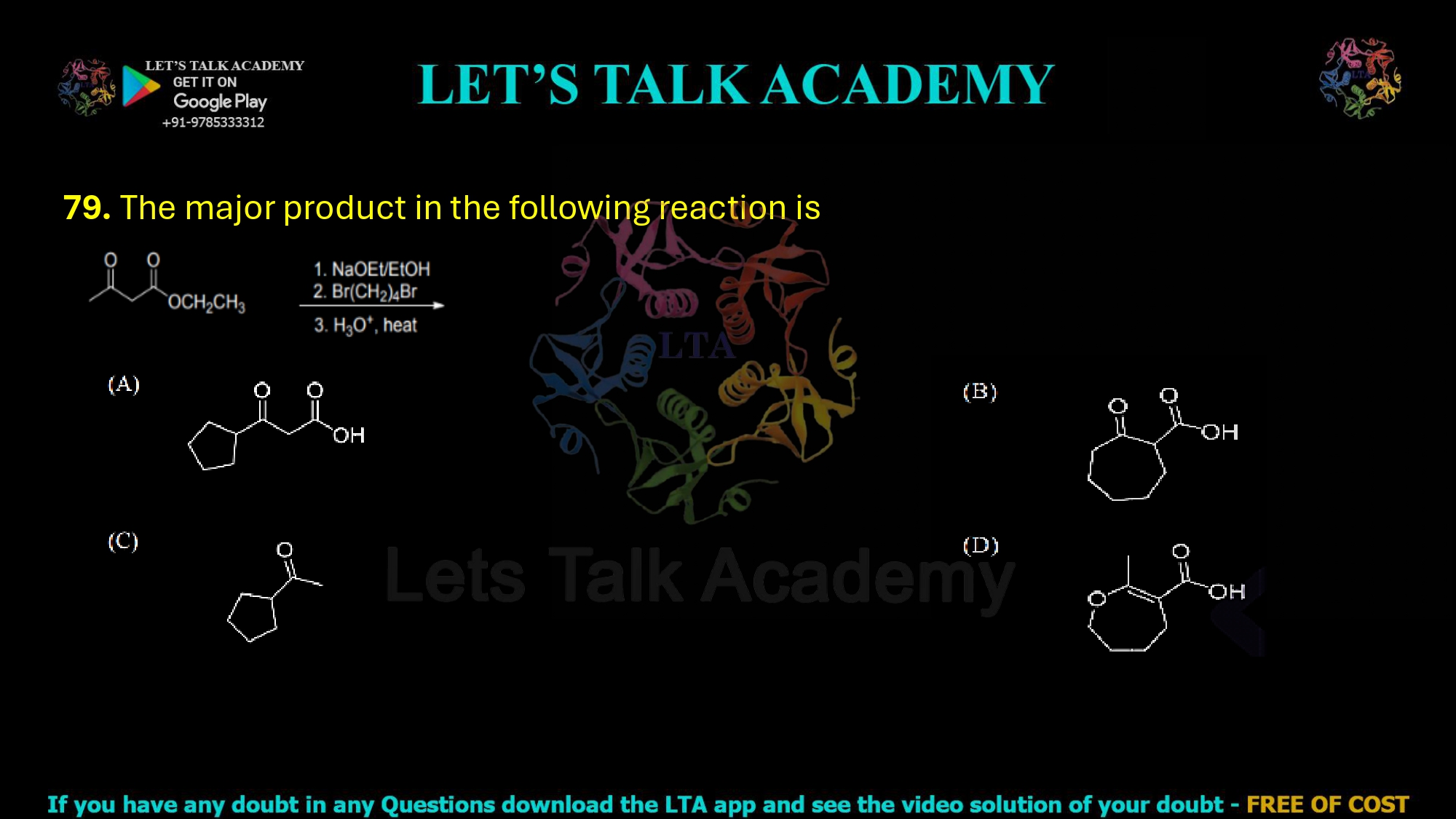
79. The major product in the following reaction is
Major Product Formed from Ethyl Acetoacetate and 1,4-Dibromobutane (Acetoacetic Ester Synthesis)
Correct Answer
✅ Correct Option: (C)
Understanding the Reaction
Ethyl acetoacetate is a β-keto ester that contains an acidic methylene group between the ketone and ester functionalities. Treatment with sodium ethoxide removes one of these acidic α-hydrogens to generate a resonance-stabilized enolate ion. This enolate acts as a strong nucleophile and undergoes nucleophilic substitution with alkyl halides.
When 1,4-dibromobutane is used as the alkylating agent, one bromine atom is displaced during the first alkylation step. The remaining bromide atom is positioned four carbon atoms away, allowing intramolecular cyclization to occur. Intramolecular reactions are generally favored because they lead to the formation of stable five-membered rings.
Reaction Mechanism
Step 1: Formation of the Enolate
Sodium ethoxide removes the acidic α-hydrogen from ethyl acetoacetate to produce a resonance-stabilized enolate ion. This enolate serves as the nucleophile throughout the reaction.
Step 2: Alkylation with 1,4-Dibromobutane
The enolate attacks one end of 1,4-dibromobutane through an SN2 reaction, forming a bromobutyl-substituted β-keto ester.
Step 3: Intramolecular Cyclization
The remaining bromide undergoes an intramolecular SN2 displacement, producing a five-membered cyclopentane ring. Ring closure is highly favorable because five-membered rings possess minimal angle strain.
Step 4: Hydrolysis and Decarboxylation
Acidic hydrolysis converts the ester group into a carboxylic acid. Upon heating, β-keto acids readily undergo decarboxylation, releasing carbon dioxide and producing the corresponding methyl ketone.
The final product obtained is cyclopentyl methyl ketone.
Why Option (C) is Correct
Option (C) represents cyclopentyl methyl ketone, the expected product of acetoacetic ester synthesis after alkylation, intramolecular cyclization, hydrolysis, and decarboxylation. The sequence follows the classical behavior of β-keto esters and is the most stable outcome of the reaction.
Explanation of Each Option
Option (A)
This structure still contains a carboxylic acid group. Because the final reaction step involves heating after acidic hydrolysis, the intermediate β-keto acid undergoes decarboxylation. Therefore, this compound cannot be the final product.
Option (B)
This option represents a cyclic β-keto acid. Although such an intermediate may exist before decarboxylation, it is unstable under the given reaction conditions and readily loses carbon dioxide. Hence, it is not the final product.
Option (C)
This option correctly represents cyclopentyl methyl ketone formed after complete hydrolysis and decarboxylation of the cyclized β-keto ester. It is the expected product of the acetoacetic ester synthesis and is therefore the correct answer.
Option (D)
This structure contains an oxygen atom incorporated into the ring, suggesting formation of a cyclic ether. No such ring closure occurs during this reaction because the cyclization proceeds through carbon–carbon bond formation rather than oxygen incorporation. Therefore, this option is incorrect.
Concept Behind the Question
This problem tests the application of the acetoacetic ester synthesis. Students should recognize that β-keto esters form stabilized enolates, which undergo alkylation with alkyl halides. When a dihalide is used, intramolecular cyclization becomes possible, especially when a stable five-membered ring can form. Finally, hydrolysis followed by heating converts the β-keto ester into a methyl ketone through decarboxylation.
Final Answer
Ethyl acetoacetate first undergoes enolate formation and alkylation with 1,4-dibromobutane, followed by intramolecular cyclization. Acidic hydrolysis and decarboxylation finally produce cyclopentyl methyl ketone.
✅ Correct Answer: Option (C)


