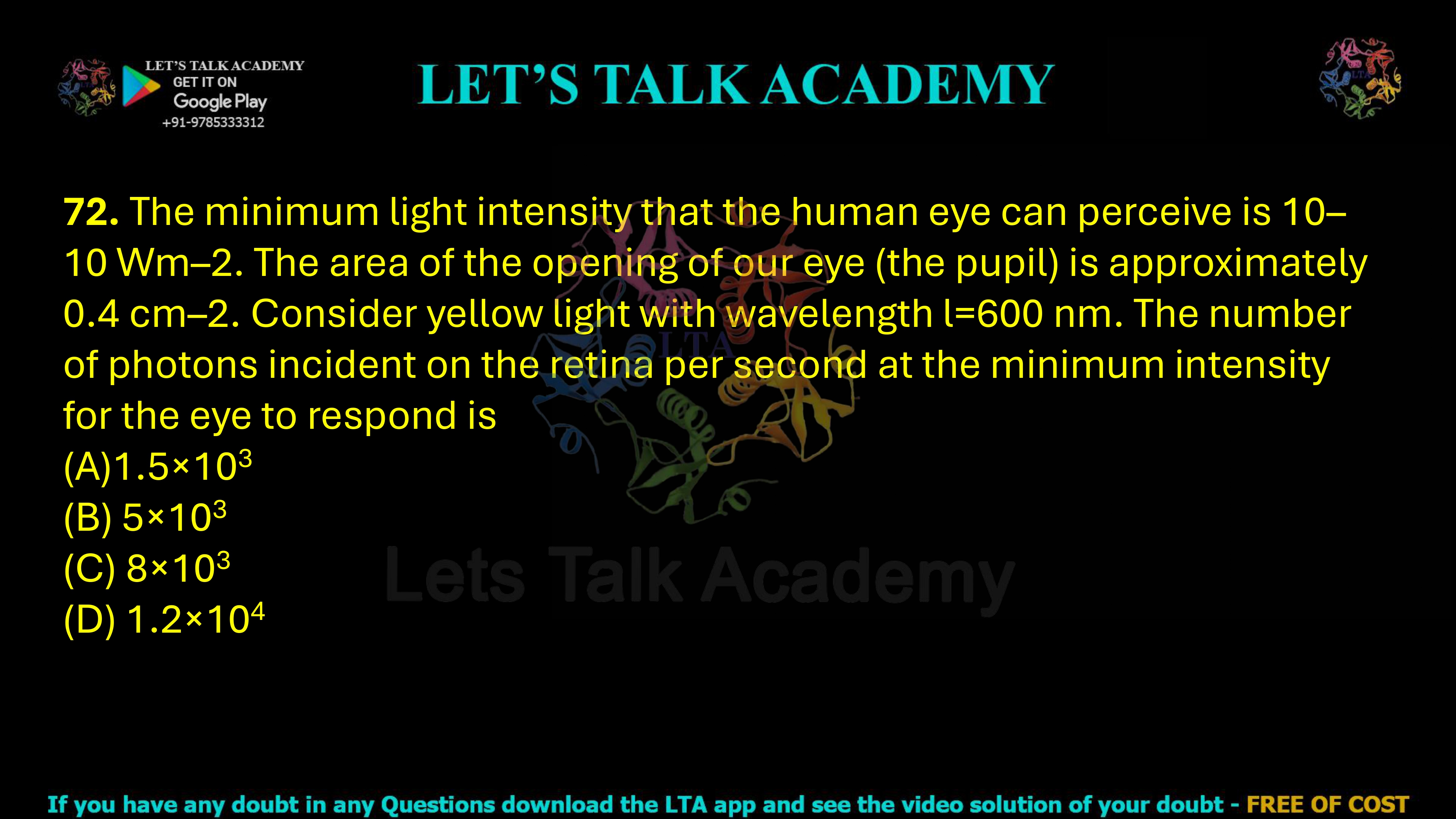
72. The minimum light intensity that the human eye can perceive is 10–10 Wm–2. The area of the opening of our eye (the pupil) is approximately 0.4 cm–2. Consider yellow light with wavelength l=600 nm. The number of photons incident on the retina per second at the minimum intensity for the eye to respond is
(A)1.5×10³
(B) 5×10³
(C) 8×10³
(D) 1.2×10⁴
Number of Photons Incident on the Human Eye at Minimum Light Intensity – Complete Theory and Detailed Solution
Correct Answer
Option (D) – 1.2 × 10⁴ photons per second
Understanding the Concept
Light consists of tiny packets of energy called photons. Each photon carries an energy that depends only on its wavelength. The shorter the wavelength, the greater is the energy carried by each photon.
When light falls on the eye, the total power entering the pupil depends upon the intensity of light and the area of the pupil. Dividing this power by the energy of one photon gives the number of photons entering the eye every second.
Step 1: Calculate the Power Entering the Eye
Power is given by
P = IA
where
- I = Light intensity
- A = Area of the pupil
Given,
- Intensity, I = 10−10 W m−2
- Area = 0.4 cm²
Convert the area into SI units.
0.4 cm² = 0.4 × 10⁻⁴ m² = 4 × 10⁻⁵ m²
Therefore,
P = (10−10) × (4 × 10−5)
P = 4 × 10⁻¹⁵ W
This means the eye receives 4 × 10⁻¹⁵ joule of energy every second.
Step 2: Calculate the Energy of One Photon
The energy of a photon is given by
::contentReference[oaicite:0]{index=0}
E = hc/λ
where
- Planck’s constant, h = 6.63 × 10⁻³⁴ J s
- Speed of light, c = 3 × 10⁸ m/s
- Wavelength, λ = 600 × 10−9 m
Substituting the values,
E = (6.63 × 10−34 × 3 × 108)/(600 × 10−9)
E ≈ 3.31 × 10⁻¹⁹ J
Thus, each photon of yellow light carries approximately 3.31 × 10⁻¹⁹ joule of energy.
Step 3: Calculate the Number of Photons Per Second
The number of photons entering the eye each second is
Number of photons = Total power / Energy of one photon
N = (4 × 10⁻¹⁵)/(3.31 × 10−19)
N ≈ 1.21 × 10⁴
Therefore, approximately 1.2 × 10⁴ photons strike the retina every second.
Why Does the Eye Need Thousands of Photons?
Although individual photons carry very small amounts of energy, the retina requires a minimum number of photons to stimulate the photoreceptor cells effectively. If the number of incident photons falls below this threshold, the human eye cannot perceive light. This demonstrates the remarkable sensitivity of the human visual system, which can respond to only a few thousand photons each second under ideal dark conditions.
Detailed Explanation of Every Option
Option (A): 1.5 × 10³
This value is much smaller than the calculated result. It usually arises from an incorrect conversion of the pupil area from square centimetres to square metres.
Option (B): 5 × 10³
This value is approximately half the correct answer and generally results from an error in calculating the photon energy or the incident power.
Option (C): 8 × 10³
This value is close but still smaller than the correct calculation. It may result from using rounded values incorrectly during intermediate steps.
Option (D): 1.2 × 10⁴
This is the correct answer. It is obtained by accurately calculating the power entering the pupil and dividing it by the energy of one photon using Planck’s equation.
Important Formulae
Light Intensity
I = P/A
Power Received
P = IA
Energy of One Photon
E = hc/λ
Number of Photons
N = P/E
Key Points to Remember
Always convert the area into square metres before using SI units. Remember that the energy of a photon is inversely proportional to its wavelength. Longer wavelengths correspond to lower-energy photons, while shorter wavelengths correspond to higher-energy photons. In numerical problems, carefully perform unit conversions before substituting values into the equations.
Final Answer
The number of photons incident on the retina every second at the minimum detectable intensity is
1.2 × 10⁴
Correct Option: (D)


