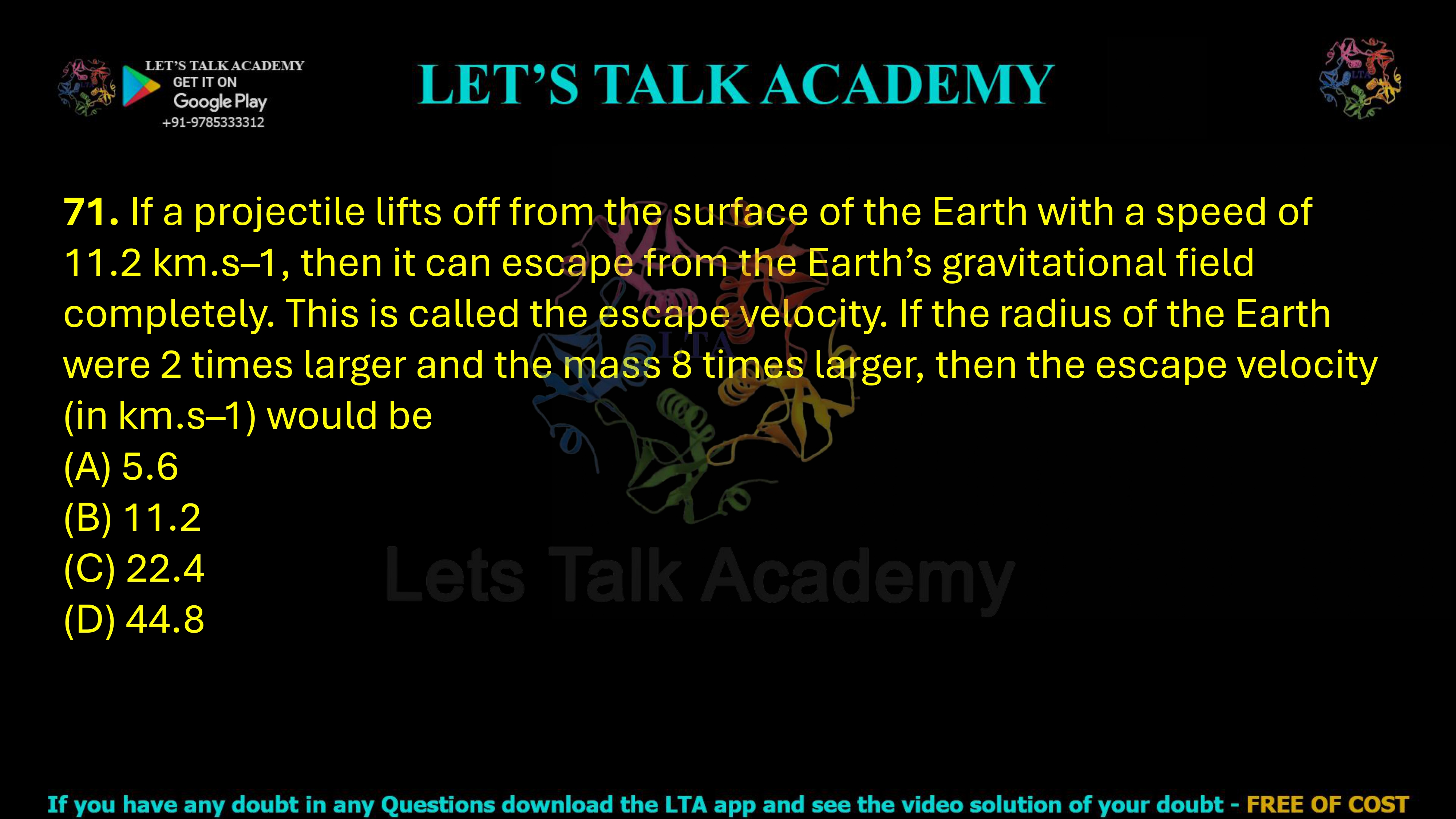
71. If a projectile lifts off from the surface of the Earth with a speed of 11.2 km.s–1, then it can escape from the Earth’s gravitational field completely. This is called the escape velocity. If the radius of the Earth were 2 times larger and the mass 8 times larger, then the escape velocity (in km.s–1) would be
(A) 5.6
(B) 11.2
(C) 22.4
(D) 44.8
Escape Velocity When Earth’s Mass and Radius Change – Complete Theory and Detailed Solution
Correct Answer
Option (C) – 22.4 km s−1
Understanding Escape Velocity
Escape velocity is the minimum speed that an object must possess so that it can escape completely from the gravitational attraction of a planet without requiring any further propulsion. Once the object is launched with this speed, it can move infinitely far away from the planet while its final speed becomes zero.
It is important to note that escape velocity does not depend on the mass of the object being launched. Whether the object is a small stone or a large spacecraft, the required escape velocity from the same planet remains the same.
Formula for Escape Velocity
The escape velocity is given by
ve = √(2GM/R)
where
- G = Universal gravitational constant
- M = Mass of the planet
- R = Radius of the planet
From this equation, we observe that
ve ∝ √(M/R)
This proportionality is the key to solving the problem.
Step 1: Write the Given Changes
The original escape velocity of Earth is
v = 11.2 km s−1
The modified planet has
- New mass = 8M
- New radius = 2R
Step 2: Apply the Escape Velocity Relation
Using the proportionality
v ∝ √(M/R)
The new escape velocity is
v’ = v √[(8M/2R)/(M/R)]
Simplifying the expression,
v’ = v √4
v’ = 2v
Step 3: Calculate the New Escape Velocity
Substituting the given value,
v’ = 2 × 11.2
v’ = 22.4 km s−1
Hence, the escape velocity of the new planet is 22.4 km s−1.
Why Does the Escape Velocity Increase?
The escape velocity depends on both the mass and the radius of the planet. Increasing the mass strengthens the gravitational pull, making it more difficult for an object to escape. Increasing the radius has the opposite effect because the object starts farther away from the planet’s centre.
In this problem, the mass increases by a factor of eight, while the radius increases by only a factor of two. The increase in mass has the greater influence, causing the ratio M/R to become four times larger. Since escape velocity depends on the square root of this ratio, the escape velocity doubles.
Detailed Explanation of Every Option
Option (A): 5.6 km s−1
This value is half of the Earth’s escape velocity. It would imply that the gravitational attraction became weaker, which is not the case. Since the mass increases significantly, the escape velocity must increase rather than decrease. Therefore, this option is incorrect.
Option (B): 11.2 km s−1
This is the escape velocity of the present Earth. Because both the mass and radius have changed, the escape velocity cannot remain the same. Hence, this option is incorrect.
Option (C): 22.4 km s−1
This is the correct answer. The ratio M/R becomes four times larger, so the escape velocity becomes √4 = 2 times larger. Multiplying the original escape velocity by two gives 22.4 km s−1.
Option (D): 44.8 km s−1
This value is four times the original escape velocity. Students may obtain this answer by assuming that escape velocity is directly proportional to M/R instead of the square root of M/R. Since the formula contains a square root, this option is incorrect.
Important Formulae
Escape Velocity
ve = √(2GM/R)
Orbital Velocity
vo = √(GM/R)
Relation Between Escape Velocity and Orbital Velocity
ve = √2 × vo
Key Points to Remember
Escape velocity depends only on the mass and radius of the planet. It is independent of the mass, shape, or size of the object being launched. Whenever the mass or radius changes, use the proportional relation v ∝ √(M/R) to solve such questions quickly without substituting the gravitational constant.
Final Answer
The new escape velocity is
22.4 km s−1
Correct Option: (C)


