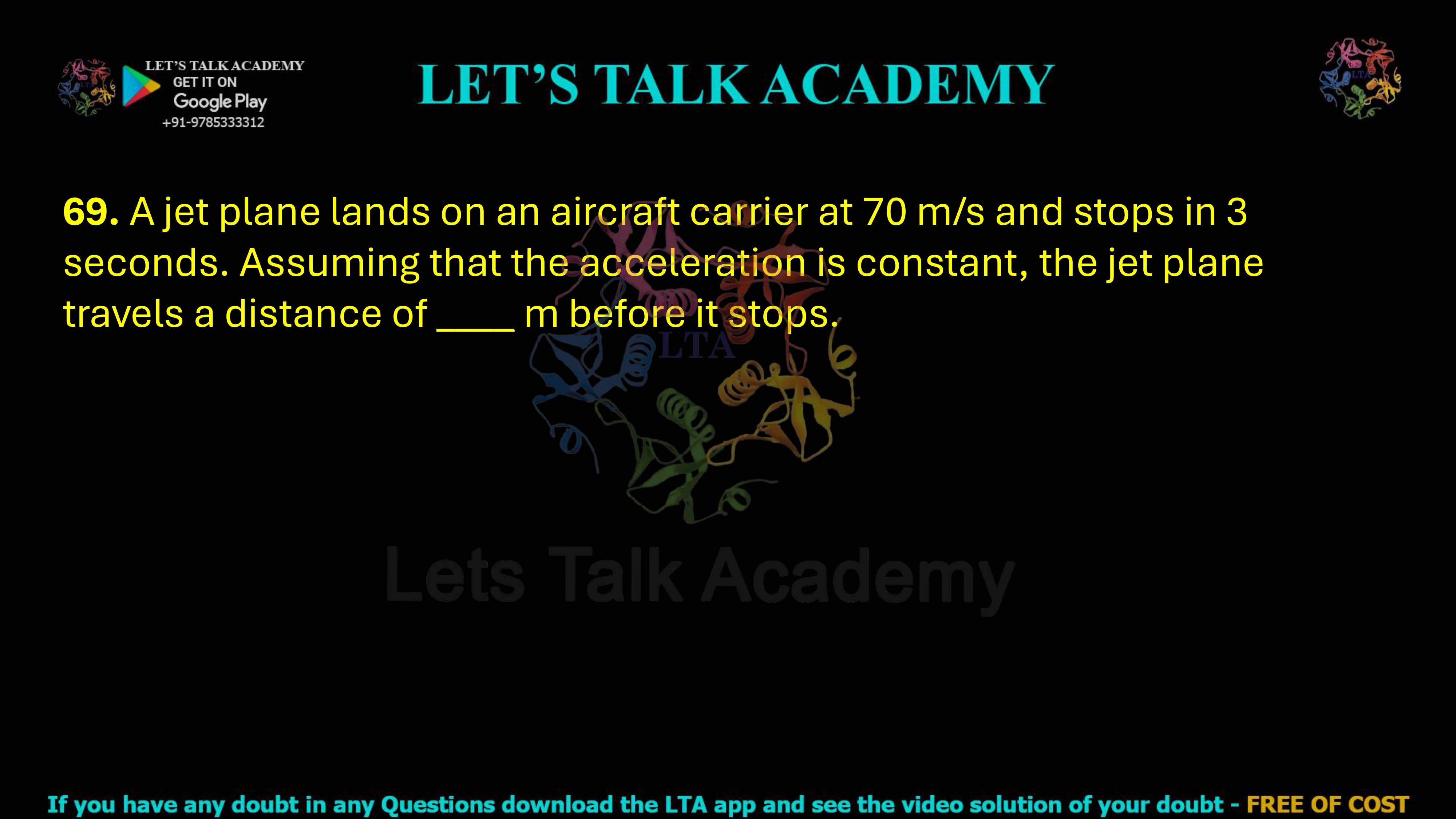
69. A jet plane lands on an aircraft carrier at 70 m/s and stops in 3 seconds. Assuming that the acceleration is constant, the jet plane travels a distance of ____ m before it stops.
Distance Travelled by a Jet Plane Before Stopping – Complete Theory and Detailed Solution
Concept Used
For motion with constant acceleration, the equations of motion (also called SUVAT equations) are used. Since the initial velocity, final velocity, and time are known, the most convenient equation for finding displacement is:
::contentReference[oaicite:0]{index=0}
First, calculate the acceleration using the first equation of motion:
v = u + at
Step 1: Calculate the Acceleration
Substituting the given values,
0 = 70 + a × 3
3a = -70
a = -70/3 m/s²
a ≈ -23.33 m/s²
The negative sign indicates that the plane is decelerating.
Step 2: Calculate the Distance Travelled
Now use the second equation of motion:
s = ut + ½at²
Substituting the values,
s = (70 × 3) + ½ × (-70/3) × (3)²
s = 210 – 105
s = 105 m
Therefore, the jet plane travels a distance of 105 metres before coming to rest.
Alternative Short Method
We can also use the average velocity because the acceleration is constant.
Average velocity
= (u + v)/2
= (70 + 0)/2
= 35 m/s
Distance travelled
= Average velocity × Time
= 35 × 3
= 105 m
This method is much faster and is highly useful in objective-type examinations.
Why Does the Plane Stop Uniformly?
The question states that the acceleration is constant. This means the braking force acting on the aircraft remains approximately constant during the stopping interval. As a result, the velocity decreases uniformly with time, allowing the equations of uniformly accelerated motion to be applied directly.
Real-Life Applications
The concept of stopping distance is extremely important in aviation, automobile engineering, and transportation safety. Aircraft carriers use arresting cables to stop fighter jets within a very short distance. Engineers calculate the required stopping distance to ensure that the aircraft comes to rest safely without overshooting the runway.
The same principles are also used to determine the braking distance of cars, trains, and high-speed vehicles.
Important Formulae
First Equation of Motion
v = u + at
Second Equation of Motion
s = ut + ½at²
Third Equation of Motion
v² = u² + 2as
Average Velocity
Average Velocity = (u + v)/2
Distance Using Average Velocity
s = Average Velocity × Time
Key Points to Remember
Whenever a body moves with constant acceleration or deceleration, the equations of motion provide the simplest way to calculate displacement, velocity, acceleration, or time. If the initial and final velocities are known, using the average velocity method often saves time during competitive examinations.
Final Answer
The jet plane travels a distance of
105 m


