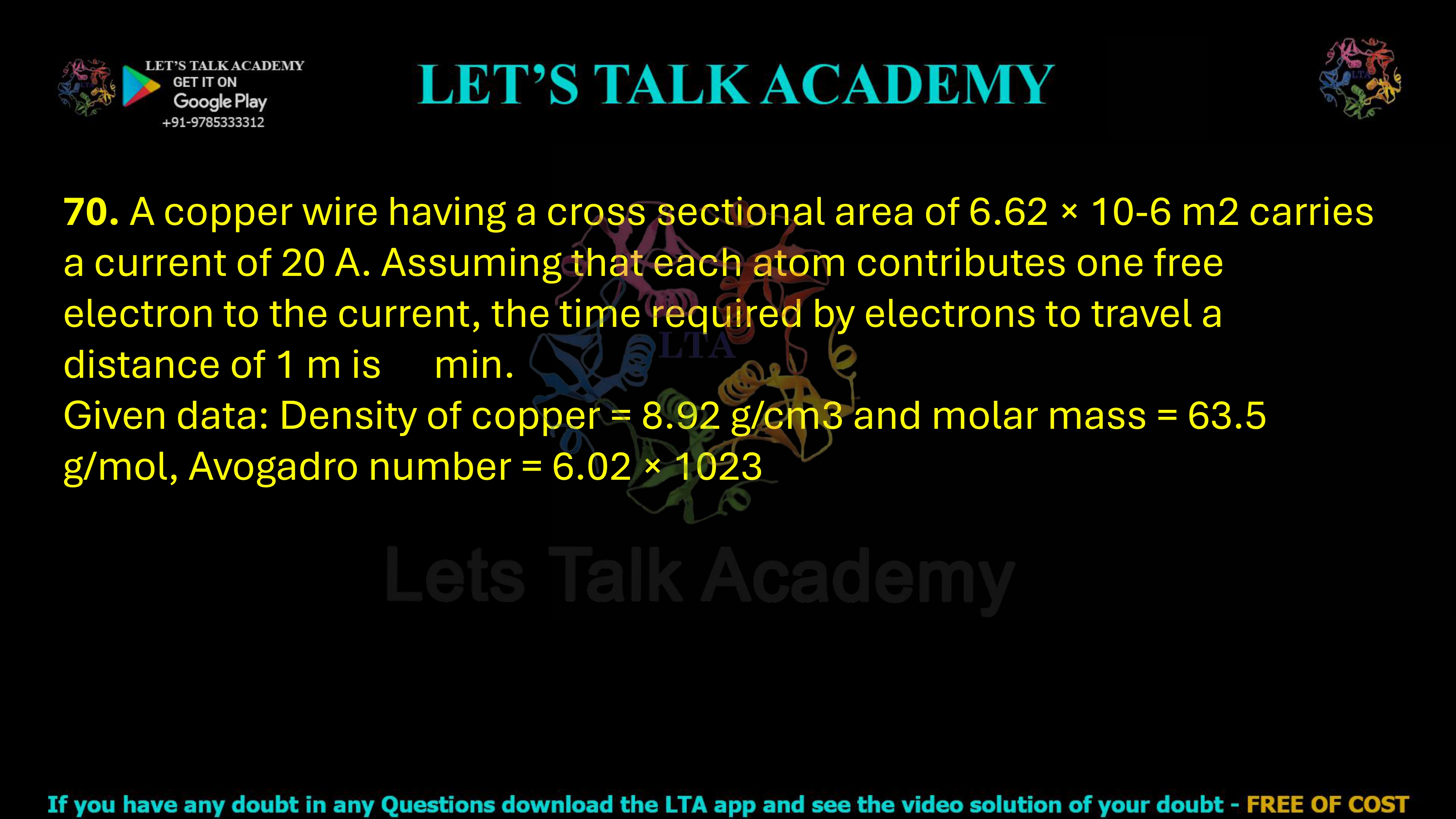
70. A copper wire having a cross sectional area of 6.62 × 10⁻⁶ m2 carries a current of 20 A. Assuming that each atom contributes one free electron to the current, the time required by electrons to travel a distance of 1 m is min.
Given data: Density of copper = 8.92 g/cm3 and molar mass = 63.5 g/mol, Avogadro number = 6.02 × 10²³
Drift Velocity of Electrons in a Copper Wire – Complete Theory and Detailed Numerical Solution
Concept Used
The current flowing through a conductor is related to the drift velocity by
I = neAvd
where
- I = Current
- n = Number of free electrons per unit volume
- e = Charge of an electron (1.6 × 10⁻¹⁹ C)
- A = Cross-sectional area
- vd = Drift velocity
Once the drift velocity is known, the time taken to travel a distance of 1 m is simply
t = Distance / Drift Velocity
Step 1: Convert Density into SI Units
Density of copper is given as
8.92 g/cm³
Converting into SI units,
ρ = 8920 kg/m³
Step 2: Calculate the Number Density of Free Electrons
The number of copper atoms per unit volume is
n = (ρ/M) × NA
Substituting the values,
n = (8920 / 0.0635) × (6.02 × 1023)
n ≈ 8.46 × 1028 electrons/m³
Since each copper atom contributes one free electron, this is also the free electron density.
Step 3: Calculate the Drift Velocity
Using
I = neAvd
Therefore,
vd = I/(neA)
Substituting the values,
vd = 20 / [(8.46 × 1028) × (1.6 × 10−19) × (6.62 × 10−6)]
vd ≈ 2.23 × 10⁻⁴ m/s
Step 4: Calculate the Time Required to Travel 1 m
Using
t = Distance / Drift Velocity
t = 1 / (2.23 × 10⁻⁴)
t ≈ 4477 s
Converting seconds into minutes,
t = 4477 / 60 ≈ 74.6 min
Why Is the Drift Velocity So Small?
Many students are surprised that electrons take more than an hour to travel just one metre. This happens because electrons move randomly in all directions due to thermal motion. The applied electric field produces only a very small average drift in one direction. Although the drift velocity is small, the electric signal travels through the conductor almost instantaneously because the electric field propagates nearly at the speed of light.
Important Formulae
Current: I = neAvd
Number Density: n = (ρ/M)NA
Drift Velocity: vd = I/(neA)
Time: t = Distance/vd
Final Answer
The time required for the electrons to travel a distance of 1 m is
74.6 minutes (approximately)


