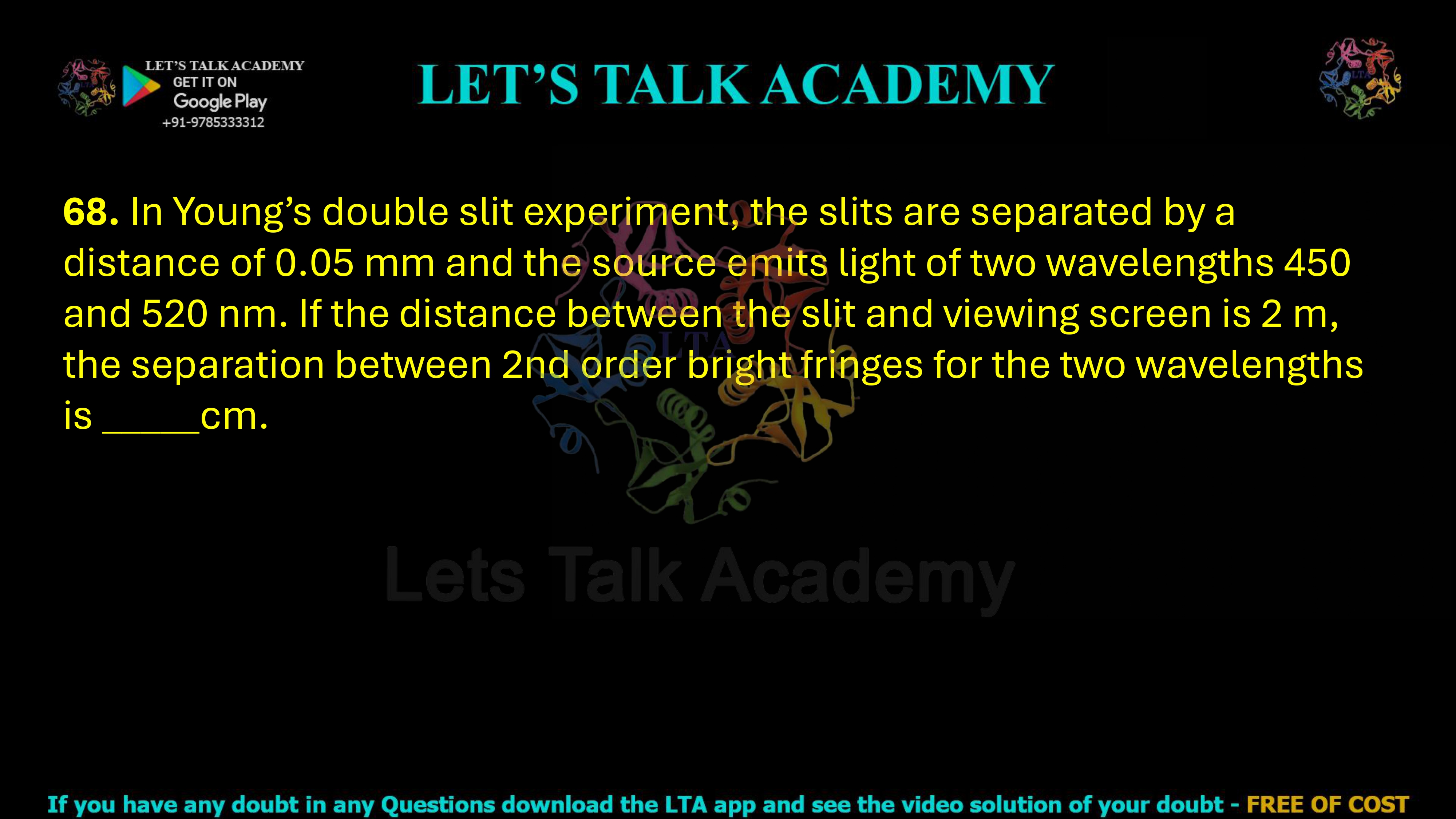
68. In Young’s double slit experiment, the slits are separated by a distance of 0.05 mm and the source emits light of two wavelengths 450 and 520 nm. If the distance between the slit and viewing screen is 2 m, the separation between 2nd order bright fringes for the two wavelengths is _____cm.
Separation Between Second Order Bright Fringes in Young’s Double Slit Experiment – Complete Theory and Detailed Solution
Concept Used
In Young’s Double Slit Experiment, the position of the nth bright fringe is given by
y = nλD/d
Since two different wavelengths are used, each wavelength produces its own interference pattern. Therefore, the position of the second-order bright fringe will be different for each wavelength.
The required separation is simply the difference between these two positions.
Step 1: Write the Position of the Second Bright Fringe
For wavelength λ₁,
y₁ = 2λ₁D/d
For wavelength λ₂,
y₂ = 2λ₂D/d
Therefore, the separation between the two second-order bright fringes is
Δy = y₂ − y₁
= 2D(λ₂ − λ₁)/d
Step 2: Calculate the Difference in Wavelength
λ₂ − λ₁ = (520 − 450) nm
= 70 nm
= 70 × 10−9 m
Step 3: Substitute the Values
Δy = [2 × 2 × 70 × 10−9]/(5 × 10−5)
= (280 × 10−9)/(5 × 10−5)
= 56 × 10−5 m
= 5.6 × 10⁻⁴ m
Step 4: Convert into Centimetres
Since
1 m = 100 cm
Therefore,
Δy = 5.6 × 10−4 × 100
= 5.6 × 10⁻² cm
= 0.056 cm
Why Do Different Wavelengths Produce Different Fringe Positions?
The position of a bright fringe is directly proportional to the wavelength of light. This means that light with a larger wavelength forms fringes farther from the central bright fringe, while light with a smaller wavelength forms fringes closer to the center.
In this problem, the wavelength of 520 nm is greater than that of 450 nm. Therefore, its second-order bright fringe appears farther from the central maximum. The difference between these positions gives the required separation.
Detailed Conceptual Explanation
Imagine projecting two sets of interference patterns on the same screen using blue and green light. Since green light has a longer wavelength than blue light, its bright fringes spread out more. As the order number increases, the separation between corresponding fringes also increases because the position of a bright fringe is directly proportional to both the wavelength and the order number.
This principle is widely used in optical instruments to distinguish different wavelengths of light and forms the basis of several interference-based measurement techniques.
Important Formulae
Position of nth Bright Fringe
y = nλD/d
Fringe Width
β = λD/d
Separation Between Bright Fringes for Two Wavelengths
Δy = nD(λ₂ − λ₁)/d
Key Points to Remember
The fringe position increases with wavelength, distance between the slits and screen, and order of the fringe. It decreases as the slit separation increases. When two wavelengths are used simultaneously, each produces its own interference pattern, and the distance between corresponding fringes depends only on the difference in their wavelengths.
Final Answer
The separation between the second-order bright fringes for wavelengths 450 nm and 520 nm is
0.056 cm


