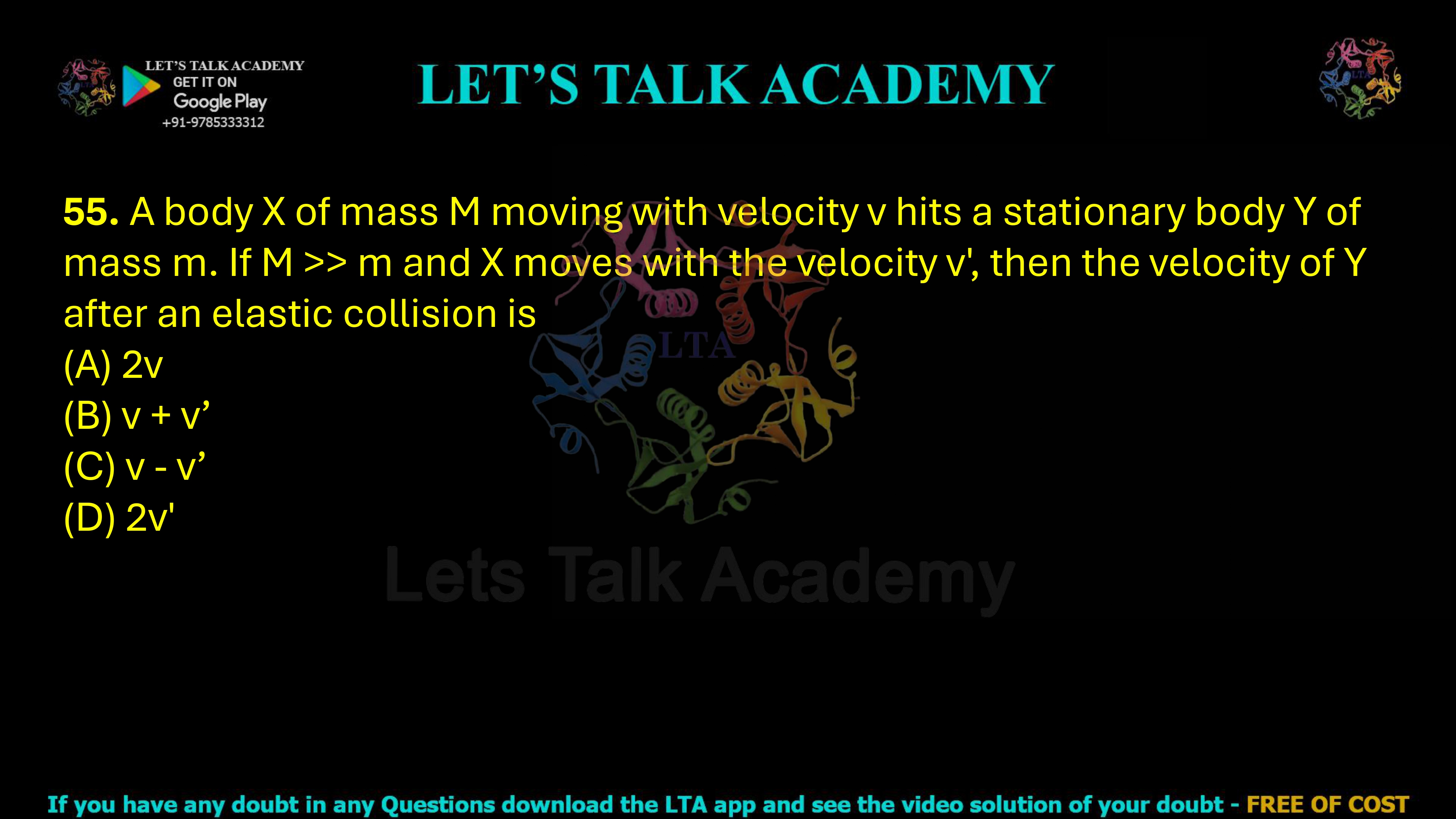
55. A body X of mass M moving with velocity v hits a stationary body Y of mass m. If M >> m and X moves with the velocity v’, then the velocity of Y after an elastic collision is
(A) 2v
(B) v + v’
(C) v – v’
(D) 2v’
Velocity of a Body After Elastic Collision – Complete Explanation with Formula and Derivation
Correct Answer
Option (B) – v + v’
Concept Used
For a one-dimensional elastic collision, two physical quantities are always conserved:
- Linear Momentum
- Kinetic Energy
A very useful relation obtained from these conservation laws is the relative velocity equation.
Relative speed of approach = Relative speed of separation
Mathematical Derivation
Initially,
- Velocity of body X = v
- Velocity of body Y = 0
After collision,
- Velocity of body X = v’
- Velocity of body Y = V
Using the relative velocity equation for an elastic collision,
v − 0 = V − v’
Therefore,
V = v + v’
Hence, the velocity of body Y immediately after the collision is
v + v’.
Why Option (B) is Correct
Option (B) satisfies the fundamental property of an elastic collision that the relative speed of separation equals the relative speed of approach. By directly applying this principle, the velocity of the lighter body becomes v + v’. This result is independent of the condition M >> m; the given condition simply indicates that the heavier body experiences only a small change in its velocity after collision.
Why Option (A) is Incorrect
The expression 2v is obtained only in a special case where the heavier body continues with nearly the same speed after collision, such as when it strikes an extremely light body without significant loss of speed. Since the problem explicitly states that the heavier body moves with velocity v’ after collision, this option ignores the given information and is therefore incorrect.
Why Option (C) is Incorrect
The quantity v − v’ represents the decrease in the velocity of the heavier body, not the final velocity of the lighter body. It does not satisfy the relative velocity relation for elastic collisions and therefore cannot be the required answer.
Why Option (D) is Incorrect
The expression 2v’ has no basis in the conservation equations for this situation. It neither satisfies the momentum equation nor the relative velocity condition. Hence, this option is incorrect.
Important Formula for Elastic Collisions
Relative Velocity Equation
Relative speed of approach = Relative speed of separation
Mathematically,
u₁ − u₂ = v₂ − v₁
where
- u₁ and u₂ are the initial velocities.
- v₁ and v₂ are the final velocities.
This equation is one of the fastest methods to solve one-dimensional elastic collision problems in competitive examinations.
Special Case When M >> m
When the mass of one body is much greater than the other, the heavier body undergoes only a slight change in velocity, whereas the lighter body acquires a comparatively large velocity. Such approximations are frequently used in entrance examinations because they simplify collision calculations.
Final Answer
Velocity of body Y after the elastic collision = v + v’
Correct Option: (B)


