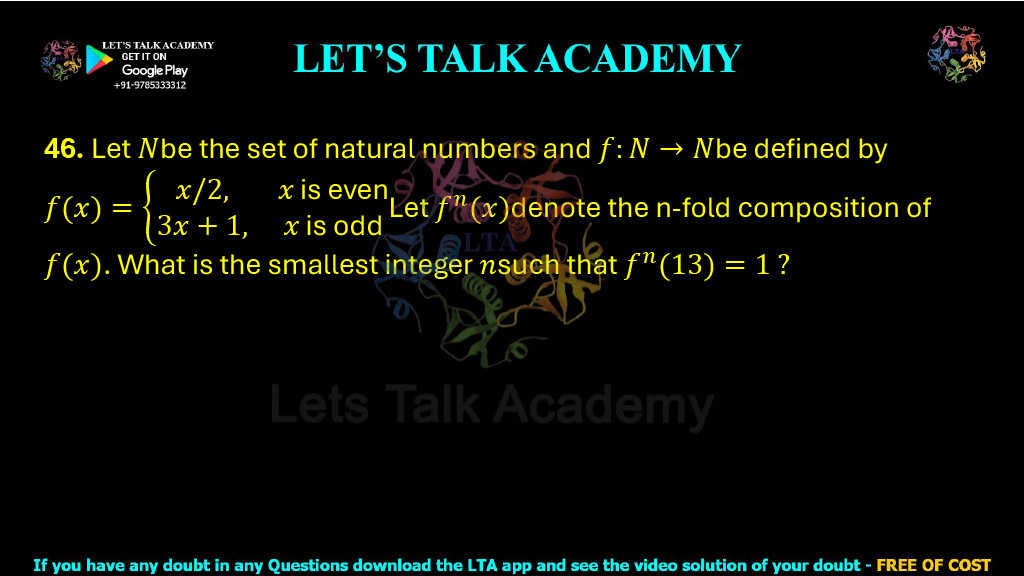
46. Let N be the set of natural numbers and f : N → N be defined by:
f(x) = x/2, if x is even
f(x) = 3x + 1, if x is odd
Let fn(x) denote the n-fold composition of f(x). What is the smallest integer n such that:
fn(13) = 1?
Find the Smallest Integer n Such That fⁿ(13) = 1
Understanding the Given Piecewise Function
This question is based on the repeated application, or iteration, of a piecewise-defined function. The function behaves differently depending on whether the input is even or odd.
The function is defined as:
f(x) = x/2, when x is even
and:
f(x) = 3x + 1, when x is odd
Therefore, at every step, we must first determine whether the current number is even or odd. If it is even, we divide it by 2. If it is odd, we multiply it by 3 and then add 1.
The starting value is:
x = 13
We need to apply the function repeatedly until the result becomes 1. The number of function applications required will give the value of n.
Meaning of n-Fold Composition of a Function
The notation fn(x) in this question does not mean that the numerical value f(x) is raised to the power n. Instead, it represents repeated composition of the function with itself.
For example:
f1(x) = f(x)
f2(x) = f(f(x))
f3(x) = f(f(f(x)))
Similarly, fn(13) means that the function f is applied to 13 exactly n times.
Therefore, we must carefully count every application of the function while generating the sequence starting from 13.
Starting the Iteration From x = 13
The initial number is:
13
Since 13 is odd, we use the odd-number rule:
f(x) = 3x + 1
We now apply the function repeatedly and count each step.
First Iteration: Finding f(13)
Since 13 is odd, we use:
f(x) = 3x + 1
Therefore:
f(13) = 3(13) + 1
f(13) = 39 + 1 = 40
Hence:
f1(13) = 40
Second Iteration: Finding f²(13)
The current value is 40. Since 40 is even, we use the even-number rule:
f(x) = x/2
Therefore:
f(40) = 40/2 = 20
Hence:
f2(13) = 20
Third Iteration: Finding f³(13)
The current value is 20, which is even. Therefore:
f(20) = 20/2 = 10
Hence:
f3(13) = 10
Fourth Iteration: Finding f⁴(13)
The current value is 10, which is also even. Therefore:
f(10) = 10/2 = 5
Hence:
f4(13) = 5
Fifth Iteration: Finding f⁵(13)
The current value is 5. Since 5 is odd, we apply the odd-number rule:
f(5) = 3(5) + 1
f(5) = 15 + 1 = 16
Hence:
f5(13) = 16
Sixth Iteration: Finding f⁶(13)
The current value is 16, which is even. Therefore:
f(16) = 16/2 = 8
Hence:
f6(13) = 8
Seventh Iteration: Finding f⁷(13)
The current value is 8, which is even. Therefore:
f(8) = 8/2 = 4
Hence:
f7(13) = 4
Eighth Iteration: Finding f⁸(13)
The current value is 4, which is even. Therefore:
f(4) = 4/2 = 2
Hence:
f8(13) = 2
Ninth Iteration: Finding f⁹(13)
The current value is 2, which is even. Therefore:
f(2) = 2/2 = 1
Hence:
f9(13) = 1
Writing the Complete Iteration Sequence
The entire sequence generated by repeatedly applying the function is:
13 → 40 → 20 → 10 → 5 → 16 → 8 → 4 → 2 → 1
Now, it is important to count the number of function applications, not the number of values written in the sequence.
The transitions are:
13 → 40 : 1st application
40 → 20 : 2nd application
20 → 10 : 3rd application
10 → 5 : 4th application
5 → 16 : 5th application
16 → 8 : 6th application
8 → 4 : 7th application
4 → 2 : 8th application
2 → 1 : 9th application
Therefore, the value 1 is reached after exactly 9 applications of the function.
Verifying That n = 9 Is the Smallest Integer
The question specifically asks for the smallest integer n such that fn(13) = 1. Therefore, we must confirm that the value 1 is not reached at any earlier iteration.
The successive values are:
f1(13) = 40
f2(13) = 20
f3(13) = 10
f4(13) = 5
f5(13) = 16
f6(13) = 8
f7(13) = 4
f8(13) = 2
f9(13) = 1
None of the values from f1(13) to f8(13) is equal to 1. The value 1 appears for the first time at the ninth iteration.
Therefore, 9 is the smallest possible value of n.
Why the Even and Odd Rules Must Be Applied at Every Step
The function is piecewise-defined, which means the same formula cannot be used at every stage. After each iteration, the newly obtained value must be checked again to determine whether it is even or odd.
For example, the starting value 13 is odd, so the rule 3x + 1 produces 40. The number 40 is even, so the next step uses division by 2. After repeated division, the sequence reaches 5, which is odd, so the rule changes again to 3x + 1.
Thus, the calculation follows the pattern:
13 → 3(13) + 1 = 40
40 → 40/2 = 20
20 → 20/2 = 10
10 → 10/2 = 5
5 → 3(5) + 1 = 16
16 → 16/2 = 8
8 → 8/2 = 4
4 → 4/2 = 2
2 → 2/2 = 1
This systematic application of the correct rule at each step leads to the required answer.
Final Answer
The repeated function composition gives:
13 → 40 → 20 → 10 → 5 → 16 → 8 → 4 → 2 → 1
The function must be applied 9 times to reach 1.
Therefore:
f9(13) = 1
Hence, the smallest integer n is:
9
Correct Answer: 9


