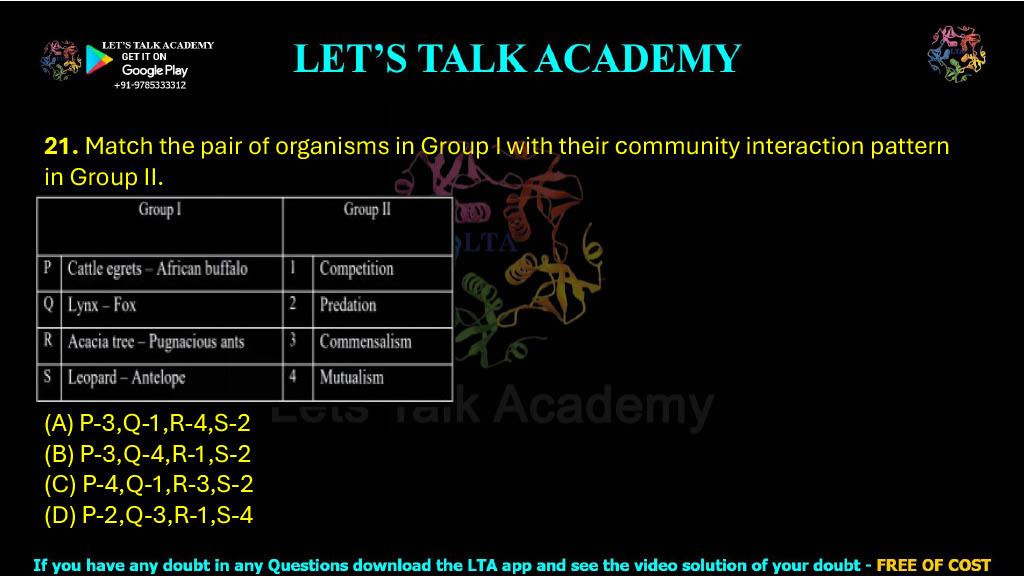
21. Match the pair of organisms in Group I with their community interaction pattern in Group II.
| Group I | Group II |
|---|---|
| P. Cattle egrets – African buffalo | 1. Competition |
| Q. Lynx – Fox | 2. Predation |
| R. Acacia tree – Pugnacious ants | 3. Commensalism |
| S. Leopard – Antelope | 4. Mutualism |
(A) P-3, Q-1, R-4, S-2
(B) P-3, Q-4, R-1, S-2
(C) P-4, Q-1, R-3, S-2
(D) P-2, Q-3, R-1, S-4
Community Interaction Patterns: Matching Organism Pairs with Competition, Predation, Commensalism and Mutualism
Explanation of the Correct Answer
The correct answer is (A) P-3, Q-1, R-4, S-2. This matching question tests the ability to identify four major types of ecological interactions: commensalism, competition, mutualism, and predation. Each pair of organisms represents a characteristic example of one of these interactions.
Cattle egrets and African buffalo represent commensalism because the egrets benefit by feeding on insects disturbed by the movement of the buffalo, while the buffalo is generally considered neither significantly benefited nor harmed. Lynx and fox represent competition because their ecological requirements may overlap and they can compete for similar prey resources. Acacia trees and pugnacious ants represent mutualism because both partners receive benefits from the association. Leopards and antelopes represent predation because the leopard benefits by capturing and consuming the antelope, while the antelope is harmed.
The complete matching is therefore:
P. Cattle egrets – African buffalo → 3. Commensalism
Q. Lynx – Fox → 1. Competition
R. Acacia tree – Pugnacious ants → 4. Mutualism
S. Leopard – Antelope → 2. Predation
Thus, the correct sequence is P-3, Q-1, R-4, S-2, which corresponds to option (A).
Understanding Community Interactions in Ecology
A biological community consists of populations of different species living in the same area and interacting with one another. These interactions can influence the survival, growth, reproduction, abundance, and distribution of the participating species.
Ecologists often classify species interactions according to the effects they have on each participant. A positive sign (+) indicates that a species benefits, a negative sign (–) indicates that it is harmed, and zero (0) indicates that it experiences no significant effect.
Mutualism is represented as (+/+) because both species benefit. Competition is represented as (–/–) because both species experience a cost. Predation is represented as (+/–) because the predator benefits while the prey is harmed. Commensalism is represented as (+/0) because one species benefits while the other is neither significantly helped nor harmed.
The four organism pairs given in this question provide clear examples of these four interaction patterns.
P. Cattle Egrets and African Buffalo: Commensalism
The interaction between cattle egrets and African buffalo is matched with commensalism. Commensalism is an ecological interaction in which one species benefits while the other species experiences no significant benefit or harm.
Cattle egrets are birds that often follow large grazing mammals such as buffalo and cattle. As the large mammals move through grass and vegetation, their movement disturbs insects and other small animals that would otherwise remain hidden.
The egrets take advantage of this disturbance by capturing and eating the exposed insects. Therefore, the cattle egret obtains a feeding benefit from the presence and movement of the buffalo.
The African buffalo, however, is generally considered unaffected in this standard ecological example. The bird does not significantly reduce the buffalo’s fitness, nor does the buffalo necessarily depend on the egret for survival.
Therefore, the interaction is represented as:
Cattle egret (+) / African buffalo (0) = Commensalism (+/0)
Thus, P matches with 3.
Why the Cattle Egret Benefits
The benefit to the cattle egret is primarily increased access to food. Insects may fly, jump, or move out of the vegetation when disturbed by the feet and movement of a large grazing animal.
Instead of searching for all prey independently, the egret can follow the buffalo and capture organisms that become exposed. This improves the bird’s feeding opportunity.
Why the African Buffalo Is Considered Unaffected
In the simplified ecological classification used in this question, the buffalo does not receive a major direct benefit from the egret and is not significantly harmed by it.
The buffalo continues its normal movement and feeding activities, while the egret uses the opportunity created by those activities. Therefore, the relationship is classified as commensalism rather than mutualism.
Q. Lynx and Fox: Competition
The interaction between lynx and fox is matched with competition. Competition occurs when two species require the same limited ecological resource and the use of that resource by one reduces its availability to the other.
Lynx and fox are carnivorous mammals whose diets and ecological requirements can overlap. When both predators depend on similar prey species in the same habitat, each may reduce the amount of prey available to the other.
As a result, both species may experience reduced access to food compared with a situation in which the competitor is absent. This makes competition a negative-negative interaction.
The relationship is represented as:
Lynx (–) / Fox (–) = Competition (–/–)
Thus, Q matches with 1.
Why Lynx and Fox Can Compete
Competition becomes possible when the ecological niches of species overlap. If lynx and fox hunt similar prey, use overlapping hunting areas, or depend on related food resources, the activity of one predator can reduce resource availability for the other.
For example, if one predator captures more of a limited prey population, fewer prey individuals remain available to the competing predator. This indirect reduction in resource availability is a form of exploitative competition.
Why Competition Is Negative for Both Species
Neither competitor benefits from the presence of the other. Each would potentially have access to more prey if the competing predator were absent.
Therefore, competition imposes an ecological cost on both species and is represented as a (–/–) interaction.
R. Acacia Tree and Pugnacious Ants: Mutualism
The relationship between the Acacia tree and pugnacious ants is matched with mutualism. Mutualism is an interaction in which both participating species receive a benefit.
Acacia trees can provide ants with food and shelter. The plant may produce food resources such as nectar or specialized nutrient-rich structures, while hollow thorns or other plant structures can provide protected living spaces for ant colonies.
In return, the pugnacious ants defend the Acacia tree against herbivores and other threats. The ants may aggressively attack animals that attempt to feed on the plant and may help protect the plant from damage.
Therefore, both organisms benefit:
Acacia tree (+) / Pugnacious ants (+) = Mutualism (+/+)
Thus, R matches with 4.
Benefits Received by the Pugnacious Ants
The ants receive important resources from the Acacia tree. These resources may include food and protected nesting spaces.
By living on or within the plant, the ants gain access to a relatively stable habitat and nutritional resources that support the colony.
Benefits Received by the Acacia Tree
The Acacia tree receives protection from the ants. The aggressive behaviour of the ants can discourage herbivores from feeding on leaves and other plant tissues.
This defensive service can reduce damage to the plant and improve its chances of survival and reproduction. Since both the plant and the ants receive benefits, the interaction is classified as mutualism.
S. Leopard and Antelope: Predation
The relationship between a leopard and an antelope is a classic example of predation. Predation occurs when one organism, the predator, captures, kills, and consumes another organism, the prey.
The leopard acts as the predator and gains energy and nutrients by consuming the antelope. The antelope acts as the prey and experiences a negative effect because it is killed.
The interaction is represented as:
Leopard (+) / Antelope (–) = Predation (+/–)
Thus, S matches with 2.
Benefit to the Leopard
The leopard benefits by obtaining food. The nutrients and energy gained from prey support survival, growth, maintenance, and reproduction.
Therefore, the effect of the interaction on the leopard is positive.
Negative Effect on the Antelope
The antelope is harmed because it is captured and consumed by the predator. The effect on the prey is therefore negative.
This positive-negative relationship is the defining pattern of predation.
Complete Matching of Group I with Group II
The ecological relationships can now be matched clearly.
P. Cattle egrets – African buffalo → 3. Commensalism (+/0)
Q. Lynx – Fox → 1. Competition (–/–)
R. Acacia tree – Pugnacious ants → 4. Mutualism (+/+)
S. Leopard – Antelope → 2. Predation (+/–)
Therefore, the correct matching sequence is:
P-3, Q-1, R-4, S-2
This corresponds to option (A).
Detailed Explanation of Every Option
Option (A): P-3, Q-1, R-4, S-2 — Correct
This option correctly matches all four organism pairs with their ecological interactions.
Cattle egrets benefit from insects disturbed by African buffalo, while the buffalo is considered unaffected, making the relationship commensalism. Lynx and fox can compete for overlapping prey resources, making their relationship competition.
Acacia trees and pugnacious ants both receive benefits, making their association mutualism. Leopards capture and consume antelopes, making their relationship predation.
Therefore, option (A) is correct.
Option (B): P-3, Q-4, R-1, S-2 — Incorrect
This option correctly identifies the cattle egret-African buffalo relationship as commensalism and the leopard-antelope relationship as predation. However, it incorrectly classifies the lynx-fox and Acacia-ant relationships.
Lynx and fox are not a standard example of mutualism because both predators do not provide reciprocal benefits to each other. Instead, their overlapping resource requirements can produce competition.
Similarly, the relationship between Acacia trees and pugnacious ants is not competition. The plant provides food or shelter, while the ants provide protection. Since both benefit, the relationship is mutualism.
Therefore, option (B) is incorrect.
Option (C): P-4, Q-1, R-3, S-2 — Incorrect
This option correctly matches lynx and fox with competition and leopard and antelope with predation. However, it incorrectly exchanges the relationships of the cattle egret-buffalo pair and the Acacia-ant pair.
Cattle egrets and African buffalo are used as an example of commensalism rather than mutualism because the egret benefits while the buffalo is considered unaffected.
The Acacia-ant relationship is mutualism rather than commensalism because both organisms benefit. The ants receive resources from the plant, and the plant receives protection from herbivores.
Therefore, option (C) is incorrect.
Option (D): P-2, Q-3, R-1, S-4 — Incorrect
This option incorrectly matches all four organism pairs.
Cattle egrets do not prey on African buffalo, so their relationship is not predation. Lynx and fox are not a standard example of commensalism because they can compete for overlapping food resources.
Acacia trees and pugnacious ants do not primarily compete with each other; instead, both partners benefit from their association. Finally, the leopard-antelope relationship is not mutualism because the leopard benefits by killing and consuming the antelope.
Therefore, option (D) is incorrect.
Difference Between the Four Ecological Interactions
Understanding the effect of an interaction on each participant provides the simplest way to distinguish the four relationships in this question.
Competition (–/–) occurs when both species experience a cost because they depend on the same limited resource. The lynx-fox relationship represents this pattern.
Predation (+/–) occurs when the predator benefits and the prey is harmed. The leopard-antelope relationship represents this pattern.
Commensalism (+/0) occurs when one species benefits while the other experiences no significant effect. The cattle egret-African buffalo relationship represents this pattern.
Mutualism (+/+) occurs when both species benefit. The Acacia tree-pugnacious ant relationship represents this pattern.
Why Species Interactions Are Important in Community Ecology
Species do not exist independently within natural ecosystems. Their survival and abundance are influenced by interactions with predators, prey, competitors, mutualistic partners, and other organisms.
Competition can influence resource use and species coexistence. Predation can regulate prey populations and alter community structure. Mutualism can improve the survival and reproduction of both partners. Commensalism allows one species to benefit from the activities of another without producing a major effect on that partner.
These interactions create ecological networks that influence population dynamics, biodiversity, species distribution, and the overall functioning of ecosystems.
Final Answer
Cattle egrets and African buffalo represent commensalism because the egret benefits while the buffalo is considered unaffected. Lynx and fox represent competition because they can depend on overlapping prey resources.
Acacia trees and pugnacious ants represent mutualism because the tree provides resources to the ants while the ants protect the tree. Leopards and antelopes represent predation because the leopard benefits by capturing and consuming the antelope.
The correct matching is:
P-3, Q-1, R-4, S-2
Therefore, the correct answer is (A) P-3, Q-1, R-4, S-2.


