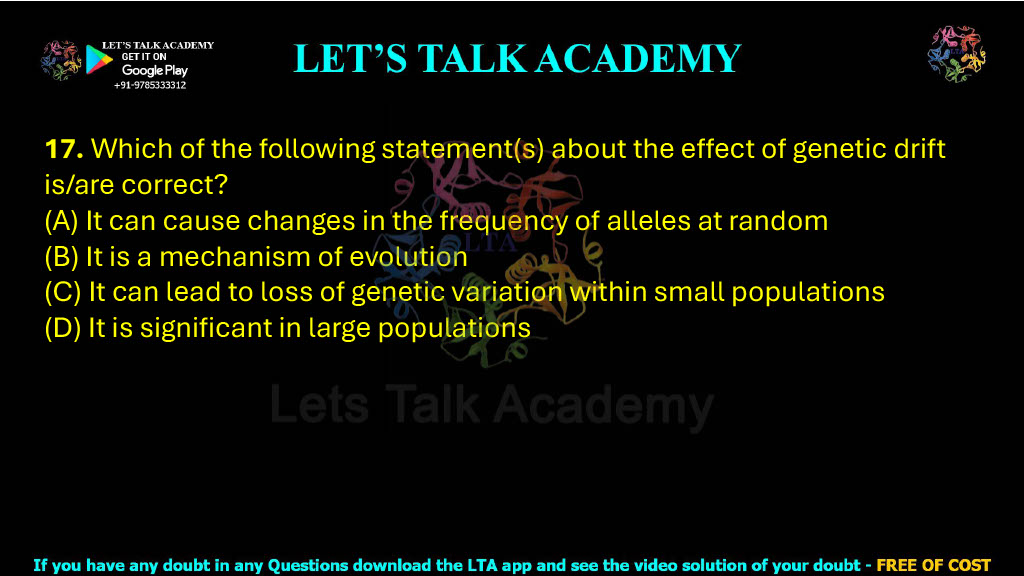
17. Which of the following statement(s) about the effect of genetic drift is/are correct?
(A) It can cause changes in the frequency of alleles at random
(B) It is a mechanism of evolution
(C) It can lead to loss of genetic variation within small populations
(D) It is significant in large populations
Effects of Genetic Drift: Which Statements About Genetic Drift Are Correct?
Explanation of the Correct Answer
The correct statements are (A), (B), and (C). Genetic drift is the random change in allele frequencies from one generation to the next due to chance events. Unlike natural selection, genetic drift does not consistently favour alleles because they improve survival or reproductive success. Instead, alleles may increase, decrease, become fixed, or disappear simply because of random sampling during reproduction.
Genetic drift is recognized as an important mechanism of evolution because evolution can be defined as a change in allele frequencies within a population across generations. Since genetic drift directly changes allele frequencies, it contributes to evolutionary change.
The effects of genetic drift are especially strong in small populations. When only a limited number of individuals contribute genes to the next generation, random differences in survival and reproduction can produce large changes in allele frequencies. Over time, some alleles may be completely lost while others may become fixed, causing a reduction in genetic variation within the population.
Statement (D) is incorrect because genetic drift is not most significant in large populations. Although random sampling occurs in every finite population, its effects are much weaker in large populations because chance deviations tend to average out across many individuals. Therefore, genetic drift has its greatest evolutionary influence in small populations.
What Is Genetic Drift?
Genetic drift is an evolutionary process in which allele frequencies change randomly from one generation to the next. The word random is essential because the direction of change is not determined by whether an allele is beneficial, harmful, or neutral.
Suppose a population contains two alleles, A and a. If some individuals carrying allele A happen to reproduce more successfully purely by chance, the frequency of allele A may increase in the next generation. In another generation, individuals carrying the same allele may leave fewer offspring, causing its frequency to decrease.
These fluctuations are not necessarily associated with adaptation. They result from random sampling of alleles during survival and reproduction. For this reason, genetic drift is often described as a stochastic evolutionary process.
Why Genetic Drift Changes Allele Frequencies at Random
Every generation is formed from only a sample of the alleles present in the previous generation. Not every individual survives to reproduce, and individuals do not always contribute equal numbers of offspring. Some may reproduce many times, while others may leave no offspring at all.
When these differences occur because of chance rather than differences in biological fitness, allele frequencies may change randomly. The smaller the population, the more strongly these chance events can influence the genetic composition of the next generation.
For example, imagine a small population containing ten individuals. If two individuals die before reproducing, the alleles they carry may be completely removed from the next generation. In contrast, the random loss of two individuals from a population containing thousands of individuals is unlikely to cause a major change in overall allele frequencies.
This relationship between population size and random sampling explains why genetic drift is especially powerful in small populations.
Genetic Drift as a Mechanism of Evolution
Evolution at the population level involves changes in allele frequencies over generations. Several processes can cause these changes, including natural selection, mutation, gene flow, and genetic drift.
Genetic drift qualifies as a mechanism of evolution because it directly changes the genetic composition of populations. Even if no allele provides a selective advantage, chance alone can cause one allele to become more common and another to become less common.
Over many generations, random fluctuations may produce substantial evolutionary changes. An allele may eventually reach a frequency of 1, meaning that it has become fixed, or reach a frequency of 0, meaning that it has been lost from the population.
Therefore, evolutionary change does not always result from adaptation. Genetic drift demonstrates that chance can also shape the genetic structure and evolutionary history of populations.
How Genetic Drift Causes Loss of Genetic Variation
One of the most important effects of genetic drift is the reduction of genetic variation within populations. When an allele is randomly lost, the population permanently loses that component of genetic diversity unless the allele is reintroduced through mutation or gene flow.
Similarly, when one allele becomes fixed, alternative alleles at that genetic locus disappear from the population. As more loci become fixed over time, overall genetic variation declines.
This loss of variation is especially rapid in small populations because random fluctuations in allele frequencies are larger. A rare allele may disappear after only a few generations, while another allele may rapidly increase toward fixation.
Reduced genetic variation can influence the long-term evolutionary potential of a population because genetic diversity provides the raw material on which natural selection acts. A population with lower genetic diversity may have fewer genetic alternatives available when environmental conditions change.
Why Population Size Determines the Strength of Genetic Drift
The strength of genetic drift is inversely related to population size. This means that as population size decreases, the effect of genetic drift becomes stronger. As population size increases, the effect becomes weaker.
In a small population, each individual represents a relatively large proportion of the total gene pool. Therefore, the accidental survival, death, or reproductive success of a few individuals can substantially change allele frequencies.
In a large population, each individual represents only a tiny fraction of the total gene pool. Random events affecting a few individuals generally have little influence on the overall allele frequencies of the population.
This principle can be summarized as:
Small population → Strong genetic drift → Large random allele frequency changes → Rapid allele loss or fixation
Large population → Weak genetic drift → Small random allele frequency changes → Greater stability of allele frequencies
Detailed Explanation of Every Option
Option (A): It Can Cause Changes in the Frequency of Alleles at Random — Correct
This statement is correct because random changes in allele frequency are the defining feature of genetic drift. The frequency of an allele may increase or decrease from one generation to the next because of chance events.
Unlike natural selection, genetic drift does not necessarily favour alleles that increase fitness. A beneficial allele may be lost by chance, while a neutral or even mildly harmful allele may increase in frequency, particularly in a small population.
For example, if individuals carrying a particular allele accidentally fail to reproduce, the frequency of that allele may decline even if the allele itself has no negative effect on survival or reproduction. Conversely, an allele may become more common simply because its carriers happen to leave more offspring.
Therefore, statement (A) is correct.
Option (B): It Is a Mechanism of Evolution — Correct
This statement is correct because genetic drift changes allele frequencies across generations. Any process that produces heritable changes in the genetic composition of a population can contribute to evolution.
The major mechanisms that influence evolutionary change include mutation, natural selection, gene flow, and genetic drift. Mutation creates new genetic variation, natural selection produces non-random differences in reproductive success, gene flow transfers alleles between populations, and genetic drift changes allele frequencies through chance.
Genetic drift can alter the evolutionary direction of a population even when environmental conditions remain unchanged. It can cause populations to diverge genetically and may contribute to evolutionary differentiation among isolated populations.
Therefore, statement (B) is correct.
Option (C): It Can Lead to Loss of Genetic Variation Within Small Populations — Correct
This statement is correct because genetic drift can randomly eliminate alleles from a population. The effect is especially strong in small populations, where each allele copy represents a relatively large proportion of the total gene pool.
When rare alleles are lost, genetic diversity decreases. Over time, continued genetic drift can cause additional alleles to disappear and can eventually lead to the fixation of one allele at a genetic locus.
The loss of genetic variation can be particularly important for small and isolated populations because reduced genetic diversity may limit their capacity to respond to environmental changes.
Therefore, statement (C) is correct.
Option (D): It Is Significant in Large Populations — Incorrect
This statement is incorrect because the evolutionary effects of genetic drift are strongest in small populations and relatively weak in large populations.
In a large population, random differences in survival and reproduction tend to average out because many individuals contribute alleles to the next generation. The allele frequency changes caused by chance are therefore generally small.
In contrast, random events affecting only a few individuals can dramatically alter the genetic composition of a small population. For this reason, population genetics predicts that genetic drift becomes stronger as population size decreases.
It is important to understand that genetic drift can technically occur in any finite population. However, the statement asks where its effects are significant. Its evolutionary impact is most pronounced in small populations, not large populations.
Therefore, statement (D) is incorrect.
Genetic Drift and Allele Fixation
Allele fixation occurs when one allele reaches a frequency of 1 in a population. At this point, every copy of the gene in the population carries the same allele, and alternative alleles have been lost.
Genetic drift can lead to fixation purely by chance. An allele does not necessarily need to provide an adaptive advantage to become fixed. In small populations, random fluctuations can rapidly increase the frequency of an allele until it becomes the only allele remaining at that locus.
At the same time, other alleles may reach a frequency of 0 and disappear completely. This process explains why repeated genetic drift tends to reduce genetic diversity within populations.
Genetic Drift and Allele Loss
Allele loss is the opposite outcome of fixation. When the frequency of an allele falls to zero, the allele disappears from the population.
Rare alleles are particularly vulnerable to random loss because they are represented by only a small number of copies. If the individuals carrying those copies fail to reproduce, the allele may not be transmitted to the next generation.
Once an allele has been lost, genetic drift alone cannot restore it. The allele can return only through processes such as mutation or gene flow from another population.
Therefore, repeated allele loss is a major reason why genetic drift reduces genetic variation within small populations.
The Founder Effect as an Example of Genetic Drift
The founder effect occurs when a new population is established by a small number of individuals from a larger ancestral population. Because the founders carry only a sample of the genetic variation present in the original population, the new population may have very different allele frequencies.
Some alleles present in the original population may be absent from the founders, while other alleles may be unusually common simply by chance. These differences are not necessarily caused by natural selection.
Because the newly founded population is often small, continued genetic drift can further alter allele frequencies and reduce genetic variation over subsequent generations.
The founder effect therefore demonstrates how random sampling and small population size can produce rapid evolutionary change.
The Bottleneck Effect as an Example of Genetic Drift
A population bottleneck occurs when the size of a population is suddenly and drastically reduced. Events such as natural disasters, disease outbreaks, habitat destruction, or other environmental disturbances may leave only a small number of survivors.
The surviving individuals may not represent the complete genetic diversity of the original population. Some alleles may be lost entirely, while the frequencies of remaining alleles may differ substantially from their original values.
Even if the population later increases in size, the genetic variation lost during the bottleneck may remain absent. Therefore, a temporary reduction in population size can have long-lasting effects on genetic diversity.
Genetic Drift Versus Natural Selection
Genetic drift and natural selection both change allele frequencies, but they operate through fundamentally different mechanisms.
Natural selection is non-random with respect to fitness. Individuals carrying traits that improve survival or reproductive success tend to contribute more offspring to future generations. As a result, advantageous alleles may increase in frequency.
Genetic drift, in contrast, changes allele frequencies because of chance. The evolutionary fate of an allele under drift is not necessarily related to whether the allele is beneficial, harmful, or neutral.
In small populations, genetic drift can sometimes overpower weak natural selection. A beneficial allele may disappear by chance before it becomes common, while a slightly disadvantageous allele may increase in frequency.
Therefore, understanding the difference between random genetic drift and non-random natural selection is essential for understanding population genetics.
Genetic Drift and Genetic Differences Between Populations
Although genetic drift reduces genetic variation within individual populations, it can increase genetic differences between separate populations.
If two isolated populations experience genetic drift independently, different alleles may increase, become fixed, or disappear in each population. As a result, the populations may gradually become genetically different from one another.
This divergence is especially likely when gene flow between the populations is absent or limited. Over long periods, genetic drift may contribute to substantial evolutionary differentiation.
Thus, genetic drift has two important effects: it tends to reduce variation within populations while increasing differences among isolated populations.
Final Answer
Genetic drift is the random change in allele frequencies from one generation to the next. It is a genuine mechanism of evolution because it changes the genetic composition of populations over time.
Its effects are especially strong in small populations, where random sampling can rapidly cause allele loss, allele fixation, and a reduction in genetic variation. In large populations, random fluctuations tend to have a much smaller effect.
Therefore, statements (A), (B), and (C) are correct, while statement (D) is incorrect.
Correct Answer: (A), (B), and (C)


