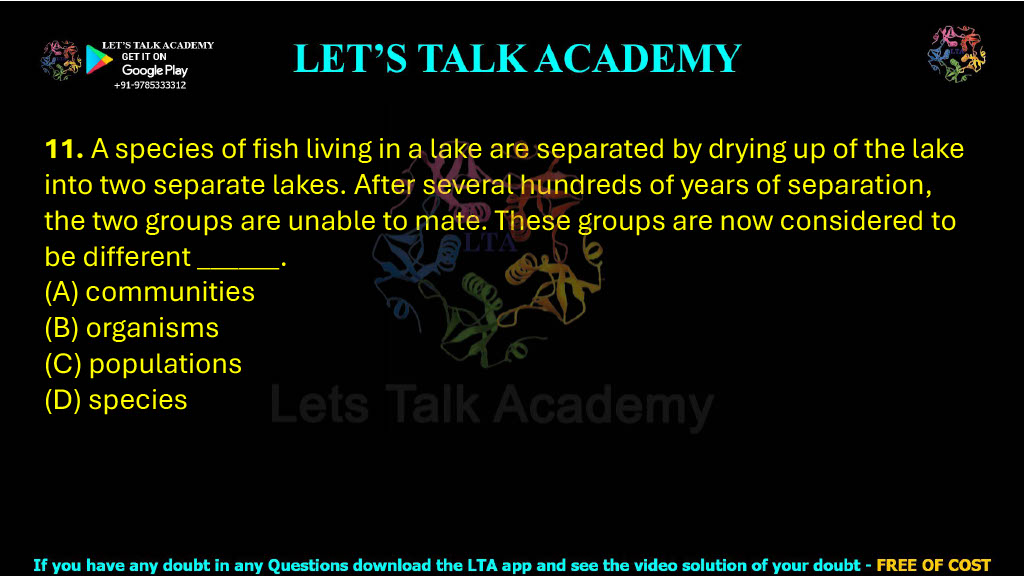
11. A species of fish living in a lake are separated by drying up of the lake into two separate lakes. After several hundreds of years of separation, the two groups are unable to mate. These groups are now considered to be different ______.
(A) communities
(B) organisms
(C) populations
(D) species
Fish Population Separation and Speciation: Why the Correct Answer Is Species
Explanation of the Correct Answer
The correct answer is (D) species because the two groups of fish have become reproductively isolated. Initially, all the fish lived together in a single lake and belonged to the same species. When the lake dried up and was divided into two separate lakes, the original fish population was physically separated into two isolated groups. This geographical barrier prevented gene flow between them.
Over several hundreds of years, the two isolated fish groups experienced independent evolutionary changes. Mutations, natural selection, genetic drift, and adaptation to the environmental conditions of their respective lakes gradually increased the genetic differences between them. Because the two groups could no longer exchange genes, these differences continued to accumulate over generations.
Eventually, the genetic and reproductive differences became so great that the two groups were unable to mate with each other. According to the biological species concept, groups of organisms that can interbreed naturally and produce fertile offspring belong to the same species. If two groups are reproductively isolated and cannot successfully interbreed, they are considered different species.
Therefore, once the two fish groups became unable to mate, they were no longer simply two separated populations of the same species. They had evolved into two different species.
How Geographic Isolation Leads to the Formation of New Species
The process described in this question is a classic example of allopatric speciation. Allopatric speciation occurs when a population is divided by a geographical barrier, causing the separated groups to evolve independently.
In this example, the drying of the original lake acts as the geographical event that divides one continuous fish population into two isolated populations living in separate lakes. Since fish cannot move between the two lakes, gene flow between the populations stops.
Step 1: One Original Fish Population
At the beginning, all the fish live in the same lake. They can encounter one another, mate freely, and exchange genes. Because gene flow occurs throughout the population, the fish belong to the same species.
Step 2: Formation of a Geographic Barrier
The lake dries up in such a way that it becomes divided into two separate lakes. Some fish remain in one lake, while the remaining fish survive in the other lake. The two groups are now geographically isolated.
Geographic isolation is important because it prevents individuals from one population from mating with individuals of the other population. As a result, gene flow between the two fish populations stops.
Step 3: Independent Evolution
After separation, each fish population evolves independently. New mutations arise separately in each population. Natural selection may favor different characteristics because the two lakes may differ in food availability, water temperature, predators, parasites, oxygen levels, or other ecological conditions.
Genetic drift can also change allele frequencies randomly, especially if either isolated population is relatively small. Over hundreds of generations, these independent evolutionary forces cause the two fish populations to become increasingly different.
Step 4: Development of Reproductive Isolation
As genetic differences accumulate, the two groups may develop differences in mating behaviour, reproductive timing, body structure, courtship signals, gamete compatibility, or other reproductive characteristics.
Eventually, the differences become large enough to prevent successful mating. At this stage, reproductive isolation has evolved.
Step 5: Formation of Different Species
Once the two groups can no longer interbreed successfully, speciation is considered complete under the biological species concept. The original single species has now given rise to two different species.
One population → Geographic isolation → No gene flow → Independent evolution → Genetic divergence → Reproductive isolation → Formation of new species
Why Reproductive Isolation Is the Key Concept
The most important clue in the question is the statement that the two groups are “unable to mate.” Physical separation alone does not always mean that two populations are different species. Two populations of the same species can live in different geographical areas and still retain the ability to interbreed if they come into contact again.
However, when separated groups become unable to mate successfully, a reproductive barrier has developed. Reproductive isolation prevents gene exchange and maintains the genetic independence of the two groups.
This is why the final stage in the question represents the formation of different species rather than merely the existence of different populations.
Biological Species Concept and the Fish Example
According to the biological species concept, a species is a group of actually or potentially interbreeding natural populations that are reproductively isolated from other such groups.
At the beginning of the example, the fish belonged to one species because they lived together and could reproduce with one another. After geographic separation, they temporarily existed as two isolated populations of the same ancestral species.
During hundreds of years of independent evolution, genetic differences accumulated. When the fish eventually became unable to mate, reproductive isolation was complete. At this point, the two groups met the criterion for being considered different species.
Therefore, the question tests the relationship between geographic isolation, reproductive isolation, and speciation.
Detailed Explanation of Every Option
Option (A): Communities — Incorrect
A community consists of populations of different species living and interacting in the same geographical area. For example, a lake community may include fish, algae, aquatic plants, insects, zooplankton, bacteria, and other organisms.
The question describes two groups that originated from the same fish species. It does not describe multiple populations of different species interacting within an ecosystem. Therefore, the term community is not appropriate.
A community is an ecological level of organization that includes many species, whereas the question focuses on the evolutionary divergence of one ancestral fish species into reproductively isolated groups.
Therefore, option (A) communities is incorrect.
Option (B): Organisms — Incorrect
An organism is a single individual living entity. One fish is an organism, one plant is an organism, and one bacterium is also an organism.
The question refers to two groups of fish rather than individual fish. Calling the groups different organisms would not describe their evolutionary relationship or reproductive isolation.
The important issue is not that the fish are individual organisms, but that the two groups can no longer mate with each other. This indicates the formation of separate species.
Therefore, option (B) organisms is incorrect.
Option (C): Populations — Incorrect
A population is a group of individuals of the same species living in a particular geographical area. Immediately after the lake was divided, the two fish groups could correctly be described as two geographically isolated populations of the same species.
However, the question adds an important final condition: after several hundreds of years, the two groups are unable to mate. This means that reproductive isolation has evolved.
If the groups were still capable of interbreeding, they could be considered different populations of the same species. Once they become reproductively isolated, they are considered separate species under the biological species concept.
Therefore, option (C) populations is incorrect as the final answer, although the groups were separate populations during the intermediate stages of the speciation process.
Option (D): Species — Correct
A species consists of organisms that can interbreed naturally and are reproductively isolated from other groups. In this case, the fish groups were separated geographically and evolved independently for hundreds of years.
The absence of gene flow allowed genetic differences to accumulate. Eventually, these differences produced reproductive isolation, making the two groups unable to mate.
Because they can no longer interbreed, they are considered different species.
Therefore, option (D) species is the correct answer.
Allopatric Speciation in This Question
The evolutionary process described here is known as allopatric speciation. The word “allopatric” refers to populations occurring in different geographical areas.
Allopatric speciation begins when a physical barrier divides a population. Such barriers may include mountains, rivers, oceans, glaciers, deserts, or habitat fragmentation. In this question, the drying of the lake divides the fish population into two isolated lakes.
The isolated groups then evolve independently. Because gene flow is absent, differences produced by mutation, natural selection, and genetic drift are not mixed between the populations. Over time, the populations may become so genetically different that they can no longer interbreed.
Thus, the drying of the lake initiates geographic isolation, while the inability to mate demonstrates reproductive isolation and the completion of speciation.
Difference Between Population and Species
Understanding the difference between a population and a species is essential for solving this question.
A population consists of individuals of the same species living in a specific area. Different populations may be geographically separated but can still belong to the same species if they retain the ability to interbreed.
A species, in contrast, is defined by reproductive compatibility within the group and reproductive isolation from other groups.
In the fish example, the two groups first became geographically isolated populations. After hundreds of years of evolutionary divergence, they became unable to mate. At that point, they crossed the evolutionary boundary from separate populations to separate species.
Role of Gene Flow in Speciation
Gene flow is the transfer of alleles between populations through migration and reproduction. When individuals from different populations regularly interbreed, gene flow tends to keep their gene pools similar.
The separation of the lake prevents fish from moving between the two new lakes. Therefore, gene flow stops. Without gene flow, each population follows its own evolutionary path.
Different mutations arise, allele frequencies change, and natural selection may favour different traits in each lake. Over many generations, genetic divergence increases until reproductive isolation evolves.
The absence of gene flow is therefore one of the major factors allowing allopatric speciation to occur.
Role of Natural Selection and Genetic Drift
Natural selection may cause the two fish populations to adapt differently if the environmental conditions of the two lakes are different. One lake may contain different food resources, predators, water chemistry, or temperatures compared with the other.
Traits that improve survival and reproduction in one lake may not be beneficial in the other. As a result, different adaptations can evolve.
Genetic drift can also contribute to divergence by randomly changing allele frequencies. These random changes are particularly influential in small populations. Together, natural selection and genetic drift can increase the genetic differences between isolated populations.
Over sufficient time, these differences may contribute to reproductive barriers and the formation of new species.
Final Answer
The two fish groups were initially part of the same species. The drying of the lake geographically isolated them and stopped gene flow. After hundreds of years of independent evolution, they became unable to mate, showing that reproductive isolation had developed.
According to the biological species concept, reproductively isolated groups are considered different species.
Therefore, the correct answer is (D) Species.


