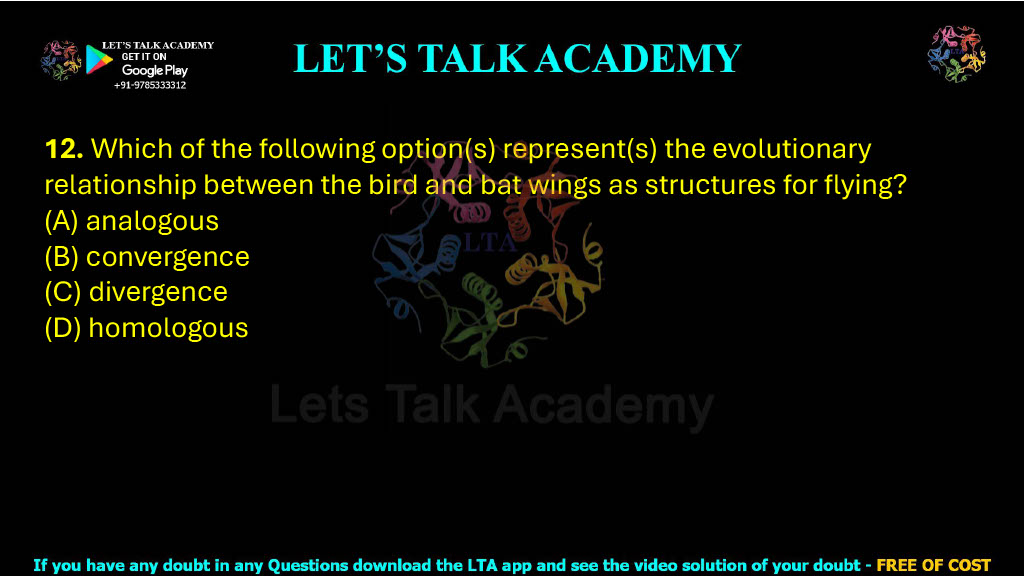
12. Which of the following option(s) represent(s) the evolutionary relationship between the bird and bat wings as structures for flying?
(A) analogous
(B) convergence
(C) divergence
(D) homologous
Evolutionary Relationship Between Bird and Bat Wings: Analogous Structures and Convergent Evolution
Correct Answer: (A) Analogous and (B) Convergence
The wings of birds and bats, when specifically considered as structures used for flying, are classic examples of analogous structures produced by convergent evolution. Therefore, both option (A) analogous and option (B) convergence are correct.
Birds and bats belong to very different evolutionary lineages. Birds are members of the class Aves, whereas bats are mammals belonging to the order Chiroptera. Their last common ancestor did not possess wings capable of powered flight. The ability to fly evolved independently in the bird lineage and the bat lineage. Because both groups faced similar functional demands associated with movement through the air, natural selection independently favored the evolution of wing-like structures.
This evolutionary pattern is called convergent evolution. The resulting structures perform the same general function but evolved independently from different ancestral conditions. Such structures are called analogous structures. Therefore, the relationship can be described both structurally and evolutionarily: bird and bat wings are analogous as organs of flight, and their similarity is the result of convergence.
Why Are Bird and Bat Wings Analogous Structures?
Analogous structures are structures that perform similar functions but have different evolutionary origins. The wings of birds and bats both enable powered flight, yet the wings themselves evolved independently in these two groups.
A bird wing is primarily formed by feathers attached to a modified forelimb. The digits are reduced and several bones are modified or fused to support efficient flight. In contrast, a bat wing consists of a thin skin membrane called the patagium, which is stretched mainly between greatly elongated fingers and extends toward the body and hindlimbs.
Thus, the aerodynamic structures used for flying are fundamentally different. Birds use feathers to create the flight surface, whereas bats use a membrane supported by elongated digits. The same function—flight—was achieved through different structural modifications. This is why bird and bat wings, when considered specifically as structures for flying, are classified as analogous structures.
Why Do Bird and Bat Wings Represent Convergent Evolution?
Convergent evolution occurs when distantly related organisms independently evolve similar adaptations because they experience similar environmental conditions or selective pressures.
Both birds and bats evolved the ability to move efficiently through the air. Powered flight requires several important features, including lift generation, reduced drag, effective control during movement, and adaptations that reduce the energetic cost of flying. Although birds and bats inherited the basic tetrapod forelimb pattern from a distant common ancestor, true wings and powered flight evolved independently in their respective lineages.
Natural selection therefore shaped different ancestral forelimbs into structures capable of performing the same major function. This independent evolution of similar functional adaptations is a clear example of evolutionary convergence.
The relationship can be summarized as follows:
Similar function + independent evolutionary origin = analogous structures
Independent evolution of similar adaptations = convergent evolution
Detailed Explanation of Option (A): Analogous
Option (A) is correct.
The term analogous describes structures that perform similar functions but do not share the same evolutionary origin as those particular functional structures. Bird wings and bat wings both perform the function of flight, but the flight surfaces evolved independently.
In birds, the wing surface is largely formed by feathers. In bats, the flight surface is formed by a skin membrane stretched over highly elongated fingers. These major structural differences indicate that wings did not evolve as functional flying organs in a common winged ancestor of both birds and bats.
Therefore, when the question specifically asks about bird and bat wings “as structures for flying,” the correct relationship is analogy.
This wording is scientifically important. The underlying forelimbs contain corresponding bones because both birds and bats are tetrapods, but their wings as specialized flight structures are analogous. In evolutionary biology, the level at which a structure is being compared must always be considered carefully.
Detailed Explanation of Option (B): Convergence
Option (B) is correct.
Convergence refers to convergent evolution, the independent evolution of similar characteristics in organisms that are not closely related with respect to that particular adaptation.
Birds and bats independently evolved powered flight. Their common ancestor was not a flying animal with the type of wings seen in modern birds and bats. Instead, each lineage developed its own flight adaptations over evolutionary time.
Similar selective pressures associated with aerial movement resulted in similar functional outcomes. Both groups evolved wings capable of producing lift and supporting controlled flight. However, the anatomical mechanisms used to construct these wings are different.
The independent evolution of flight in birds and bats is therefore an excellent example of convergent evolution. Since convergent evolution commonly produces analogous structures, options (A) and (B) are closely connected.
Detailed Explanation of Option (C): Divergence
Option (C) is incorrect.
Divergent evolution occurs when related organisms or structures that share a common ancestral origin become increasingly different because they adapt to different functions or environments.
A classic example of divergent evolution is the modification of the basic vertebrate forelimb into different structures such as the human arm, whale flipper, horse foreleg, and bat forelimb. These structures have the same fundamental ancestral origin but have evolved to perform different functions.
The comparison between bird and bat wings as flying structures does not represent divergence because both structures perform the same broad function—flight—and evolved independently as wings. Their similarity is due to similar selective pressures rather than the modification of a single ancestral wing into different functions.
Therefore, divergence is not the correct evolutionary relationship asked in this question.
Detailed Explanation of Option (D): Homologous
Option (D) is incorrect in the specific context of the question.
Homologous structures share a common evolutionary origin, although they may perform different functions. For example, the human arm, whale flipper, horse foreleg, and bat forelimb share the same basic skeletal arrangement inherited from a common tetrapod ancestor. They are therefore homologous as forelimbs.
Birds and bats also possess the basic tetrapod forelimb skeletal plan, including corresponding elements such as the humerus, radius, ulna, wrist bones, and digits. Therefore, their forelimbs are homologous at the level of basic skeletal ancestry.
However, the question specifically asks about bird and bat wings “as structures for flying.” The specialized wings used for powered flight did not originate from a common winged ancestor. Flight evolved independently in birds and bats. Therefore, as flight structures, the wings are analogous rather than homologous.
This distinction between forelimbs as inherited skeletal structures and wings as independently evolved flight structures is essential for answering the question correctly.
Homologous Forelimbs but Analogous Wings: Understanding the Important Distinction
The comparison of bird and bat wings is a particularly useful example because the answer depends on exactly what is being compared.
At the deeper anatomical level, the forelimbs of birds and bats are homologous because they were inherited from a common tetrapod ancestor. Both contain corresponding skeletal components derived from the same ancestral limb pattern.
At the functional level, however, their wings are analogous because powered flight evolved independently. The bird lineage developed a feather-based flight surface, whereas the bat lineage developed a membrane-based flight surface supported by elongated fingers.
Therefore:
Bird forelimb and bat forelimb → Homologous
Bird wing and bat wing as structures for flying → Analogous
Independent evolution of flight in birds and bats → Convergent evolution
This is why the exact phrase “as structures for flying” makes options (A) analogous and (B) convergence the best answers.
Difference Between Analogy and Homology
Analogy is based mainly on similarity of function without a shared evolutionary origin for that particular adaptation. Homology, in contrast, is based on shared ancestry and common evolutionary origin.
Bird wings and bat wings perform the same function of flight, but the specialized flying structures evolved independently. They are therefore analogous. The underlying forelimbs, however, share an ancestral tetrapod skeletal pattern and are homologous.
This example demonstrates that the same organs can be compared at different biological levels. A structure may show homology in its basic anatomical foundation while also showing analogy in a specialized functional adaptation.
Difference Between Convergent and Divergent Evolution
Convergent evolution produces similar features in independently evolving lineages. It generally occurs when unrelated or distantly related organisms experience similar selective pressures. Bird and bat wings are an example because powered flight evolved independently in both groups.
Divergent evolution follows a different pattern. It begins with a shared ancestral structure and produces increasing differences as different lineages adapt to different functions or environments. The vertebrate pentadactyl limb modified into arms, flippers, legs, and other structures is a classic example of divergence.
Therefore, the evolutionary pattern responsible for the similarity between bird and bat wings as flying organs is convergence, not divergence.
Final Answer
The correct options are (A) analogous and (B) convergence.
Bird and bat wings perform the same function of flight but evolved independently in two different evolutionary lineages. Therefore, they are analogous structures. The independent evolution of similar flight adaptations under similar selective pressures is known as convergent evolution.
Correct Answer: (A) Analogous and (B) Convergence


