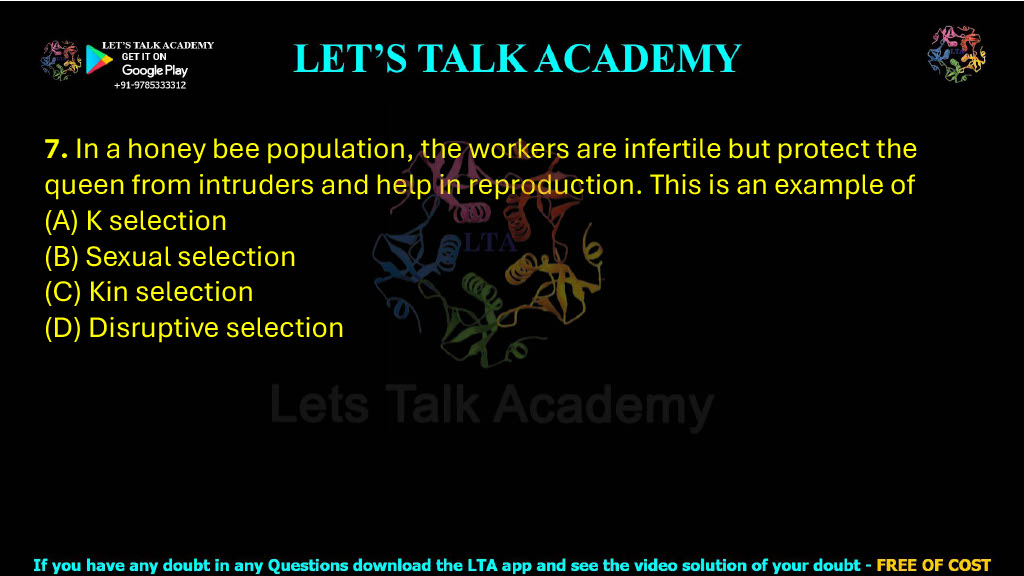
7. In a honey bee population, the workers are infertile but protect the queen from intruders and help in reproduction. This is an example of (2022)
(A) K selection
(B) Sexual selection
(C) Kin selection
(D) Disruptive selection
Why Infertile Honey Bee Workers Protect the Queen: Kin Selection Explained
Correct Option: (C) Kin selection
In a honey bee colony, worker bees are generally infertile, yet they perform essential tasks such as protecting the queen, defending the colony from intruders, collecting food, maintaining the nest, and caring for developing offspring. At first glance, this behavior may appear evolutionarily puzzling because the workers do not usually produce their own offspring. However, the behavior can be explained by kin selection.
Kin selection occurs when an individual increases the reproductive success of genetically related individuals, thereby promoting the transmission of genes that it shares with those relatives. An organism can therefore contribute to the spread of its genes not only by producing its own offspring but also by helping close relatives survive and reproduce.
The infertile honey bee workers help the reproductive queen and support the production and survival of related individuals. In doing so, they gain indirect fitness and contribute to their inclusive fitness.
Therefore, Option (C), kin selection, is the correct answer.
What Is Kin Selection?
Kin selection is a form of natural selection that favors behaviors that increase the reproductive success of an individual’s relatives. The central idea is that relatives share genes because of common ancestry. Therefore, helping a close relative reproduce can indirectly increase the representation of shared genes in future generations.
Traditional discussions of evolutionary fitness often focus on direct reproduction. An individual produces offspring, and those offspring inherit some of its genes. However, evolutionary success can also occur indirectly.
For example, an organism may sacrifice some of its own reproductive opportunities to help a sibling produce more surviving offspring. Because siblings share a proportion of their genes, the helping individual may still increase the transmission of genetic variants that it carries.
This broader view of evolutionary success forms the basis of kin selection and inclusive fitness theory.
Why Option (C) Kin Selection Is the Correct Answer
Infertile Workers Increase the Reproductive Success of Their Relatives
Option (C) is correct because worker honey bees help closely related individuals reproduce rather than reproducing directly themselves.
The queen is the principal reproductive female in a honey bee colony. Worker bees perform many activities that increase her survival and reproductive success. They protect the colony from predators and intruders, obtain food, regulate conditions inside the nest, maintain the hive, and care for developing brood.
These activities allow the colony to survive and enable the queen to produce more offspring.
Although the workers may not produce their own offspring, their behavior can still have an evolutionary benefit because the individuals they help are relatives that share some of their genes.
The worker’s contribution to the reproduction of relatives is called indirect fitness. When direct and indirect genetic contributions are considered together, the result is known as inclusive fitness.
Thus, the behavior of infertile honey bee workers is a classic example of kin selection.
What Is Inclusive Fitness?
Inclusive fitness is the total genetic contribution of an individual to future generations through both direct and indirect pathways.
The first component is direct fitness, which results from an individual’s own reproduction. If an organism produces offspring that survive and reproduce, it directly passes genes to future generations.
The second component is indirect fitness, which results from helping relatives reproduce. Because relatives share genes, increasing their reproductive success can indirectly promote the transmission of shared genetic variants.
Therefore, inclusive fitness can be understood conceptually as:
Inclusive fitness = Direct fitness + Indirect fitness
An infertile worker bee may have very little direct fitness because it does not normally produce offspring. However, it can gain substantial indirect fitness by helping the queen and other relatives survive and reproduce.
This explains why natural selection can favor apparently self-sacrificing behavior in social organisms.
Why Do Infertile Worker Bees Help the Queen?
Worker honey bees perform behaviors that directly support colony reproduction.
They collect nectar and pollen, providing food for the colony. They feed developing larvae, maintain the hive, regulate temperature, remove waste, guard the colony entrance, and attack potential intruders.
These activities require energy and may expose workers to considerable danger. A worker defending the colony may even die.
From the perspective of individual reproduction alone, such behavior may appear difficult to explain. The worker invests effort in the reproduction of another individual rather than producing its own offspring.
Kin selection provides the evolutionary explanation. If the worker and the individuals it helps share genes, the worker can indirectly increase the transmission of shared genetic material by increasing the reproductive success of relatives.
Therefore, helping the queen and colony can be favored by natural selection when the indirect genetic benefits are sufficiently large.
Hamilton’s Rule and Kin Selection
The evolutionary conditions favoring altruistic behavior among relatives are commonly expressed through Hamilton’s rule:
rB > C
In this relationship, r represents the coefficient of genetic relatedness between the individual performing the behavior and the individual receiving the benefit. B represents the reproductive benefit received by the recipient, while C represents the reproductive cost experienced by the individual performing the behavior.
According to Hamilton’s rule, a helping behavior can be favored by natural selection when the benefit to the recipient, weighted by genetic relatedness, is greater than the cost to the helper.
This principle helps explain how a behavior that reduces an individual’s direct reproduction can still spread through a population.
In social insects, helping behavior can provide large reproductive benefits to related colony members. Therefore, under appropriate conditions, natural selection can favor worker behavior that increases the reproductive output of the colony.
Honey Bees and Haplodiploidy
Honey bees have a haplodiploid sex-determination system, an important feature often discussed in relation to the evolution of social behavior.
Females, including queens and workers, develop from fertilized eggs and are diploid. Males, known as drones, develop from unfertilized eggs and are haploid.
Because of this unusual genetic system, relatedness patterns among colony members can differ from those in ordinary diploid organisms. Under simplified conditions involving a singly mated queen, full sisters can be highly related.
A female receives half of her genes from her mother. Because a haploid father passes the same genome to all of his daughters, full sisters can share all of their paternal genes while also sharing, on average, part of their maternal genes.
This can produce an average relatedness of approximately 0.75 between full sisters under specific assumptions.
However, kin selection in social insects should not be explained by haplodiploidy alone. Colony structure, queen mating patterns, ecological conditions, reproductive competition, and other factors also influence the evolution of eusocial behavior.
The central answer to the question remains that workers help related individuals and thereby increase indirect fitness, which is the principle of kin selection.
Altruistic Behavior in Honey Bee Workers
Altruism in evolutionary biology refers to behavior that increases the fitness of another individual while imposing a cost on the individual performing the behavior.
Worker honey bees provide clear examples of apparently altruistic behavior. They may give up direct reproduction, invest energy in caring for the queen’s offspring, and risk death while defending the colony.
Such behavior does not mean that evolution acts for the general good of the species. Instead, kin selection explains how genes influencing helping behavior can spread when the recipients are sufficiently related to the helpers.
If helping relatives leads to greater transmission of shared genes, the behavior can be favored by natural selection.
Therefore, the social behavior of worker bees provides an important example of how genetic relatedness can influence the evolution of cooperation.
Detailed Explanation of Option (A)
K Selection
Option (A) is incorrect because K selection describes a life-history strategy rather than helping behavior among relatives.
K selection is associated with organisms living under relatively stable conditions where populations may remain near the environmental carrying capacity, represented by the letter K.
K-selected organisms are generally characterized by traits such as relatively low reproductive rates, greater investment in individual offspring, longer lifespans, delayed maturation, and strong competitive ability.
Large mammals are commonly discussed as examples of organisms showing many K-selected characteristics.
The behavior described in the question is not about population growth near carrying capacity or the evolution of life-history traits. It specifically concerns infertile workers helping a related queen reproduce.
Therefore, K selection does not explain the behavior of worker honey bees in this question.
Detailed Explanation of Option (B)
Sexual Selection
Option (B) is incorrect because sexual selection concerns differences in mating success, not the evolution of helping behavior toward relatives.
Sexual selection occurs when individuals differ in their ability to obtain mates or achieve fertilization. It can produce traits that improve success in competition for mates or increase attractiveness to potential partners.
Sexual selection commonly operates through two broad mechanisms. Intrasexual selection involves competition among members of the same sex, while intersexual selection involves mate choice.
Examples include competition among males for access to females and the evolution of elaborate displays used to attract mates.
The worker bees described in the question are infertile and are helping the queen and colony rather than competing for mates or displaying traits that increase mating success.
Therefore, sexual selection is not the correct explanation.
Detailed Explanation of Option (C)
Kin Selection
Option (C) is correct because kin selection favors behaviors that increase the reproductive success of genetically related individuals.
Worker bees help the queen reproduce, care for related offspring, and protect the colony. Although the workers sacrifice direct reproductive opportunities, they can increase their indirect fitness by helping relatives.
This behavior can be favored when the genetic benefit obtained through relatives is sufficiently large relative to the cost of helping.
Kin selection is therefore closely associated with the evolution of cooperation, altruism, parental care, alarm behavior, and sociality when these behaviors benefit relatives.
The honey bee example directly matches this evolutionary principle.
Detailed Explanation of Option (D)
Disruptive Selection
Option (D) is incorrect because disruptive selection is a pattern of natural selection acting on phenotypic variation, not a mechanism explaining altruistic behavior.
Disruptive selection occurs when individuals with extreme phenotypes have higher fitness than individuals with intermediate phenotypes.
For example, if very small and very large individuals have greater reproductive success than medium-sized individuals, the intermediate phenotype may decrease in frequency.
Over time, disruptive selection can increase variation within a population and may contribute to divergence under appropriate conditions.
The honey bee question does not describe selection favoring two extreme phenotypes. It describes infertile workers helping genetically related individuals reproduce.
Therefore, disruptive selection is not the correct answer.
Kin Selection Versus Group Selection
Kin selection is sometimes confused with the idea that workers behave for the good of the entire colony or species. However, the evolutionary explanation focuses on the transmission of genes through relatives.
Kin selection operates because individuals share genes with their relatives. A behavior that increases the reproduction of relatives can therefore increase the representation of shared genetic variants.
The important point is not simply that the colony benefits. The important point is that helping behavior can increase inclusive fitness when the beneficiaries are genetically related to the helper.
This distinction is essential for understanding the evolutionary basis of social behavior.
Kin Selection and Eusociality
Honey bees are examples of eusocial organisms. Eusociality is a highly developed form of social organization characterized by cooperative care of offspring, overlapping generations, and reproductive division of labor.
In a honey bee colony, the queen performs most reproduction, while workers carry out tasks that support colony survival and reproductive success.
Kin selection is one of the major evolutionary frameworks used to explain how such reproductive specialization and cooperative behavior can evolve.
When workers help related individuals survive and reproduce, genes associated with effective helping behavior can be transmitted indirectly through those relatives.
This relationship between genetic relatedness and cooperative behavior is central to the study of social evolution.
Why Protecting the Queen Can Increase Indirect Fitness
The queen represents the major reproductive individual in a honey bee colony. If workers successfully protect her from intruders and maintain conditions necessary for reproduction, more offspring can be produced and survive.
Many of these offspring are relatives of the workers.
Therefore, a worker’s defensive behavior can indirectly contribute to the transmission of genes that the worker shares with those relatives.
This is why apparently self-sacrificing behavior can be evolutionarily successful. The worker may not reproduce directly, but its actions can still influence the representation of shared genes in future generations.
The question therefore provides a direct example of the principle of kin selection.
Final Answer
Infertile worker honey bees protect the queen, defend the colony, care for developing offspring, and help related individuals reproduce. Although the workers usually do not gain direct fitness through their own reproduction, they can gain indirect fitness by increasing the reproductive success of genetically related colony members.
This evolutionary process is known as kin selection.
Correct Option: (C) Kin selection


