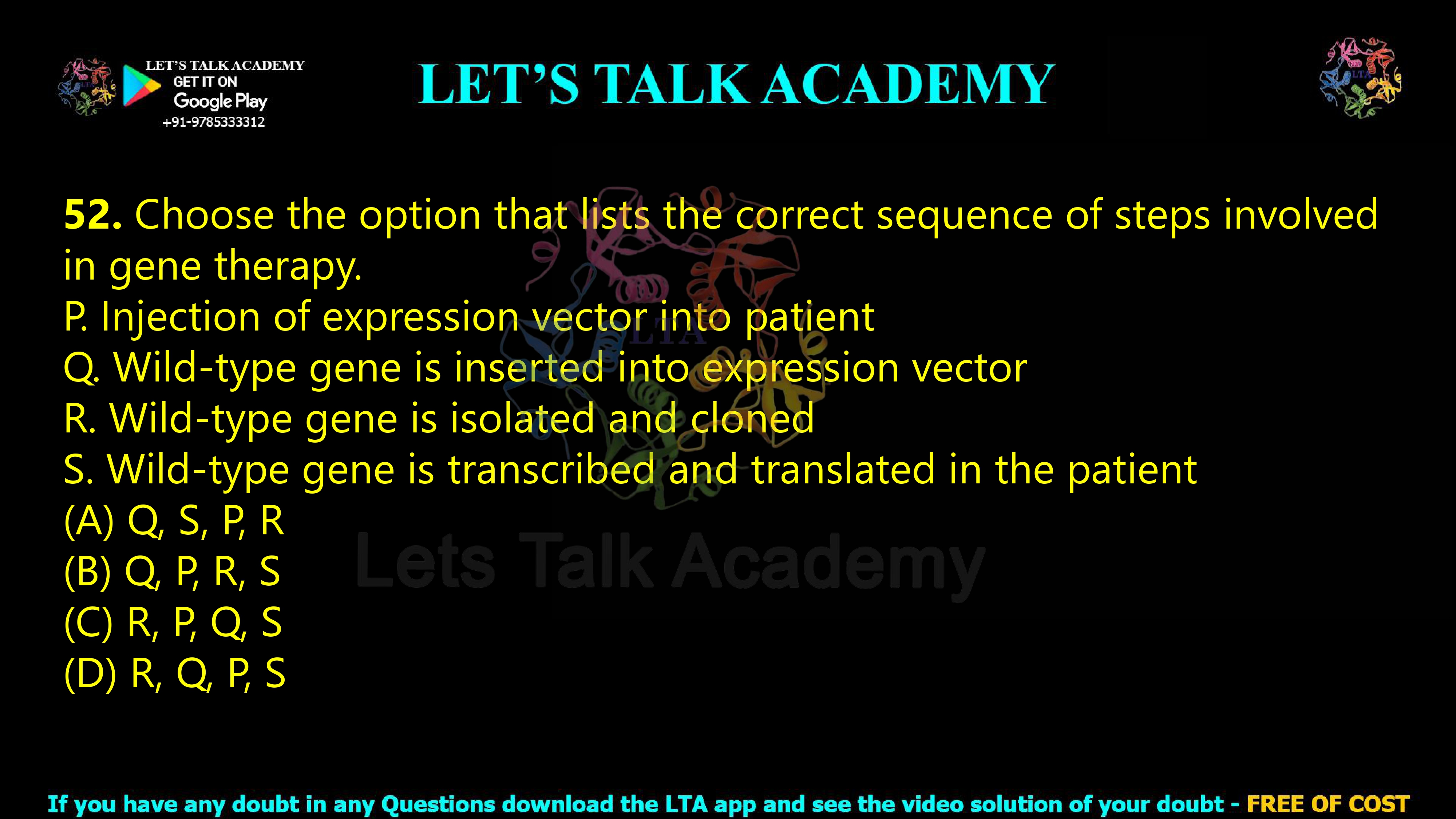
51. Choose the option that lists the correct sequence of steps involved in gene therapy.
P. Injection of expression vector into patient
Q. Wild-type gene is inserted into expression vector
R. Wild-type gene is isolated and cloned
S. Wild-type gene is transcribed and translated in the patient
(A) Q, S, P, R
(B) Q, P, R, S
(C) R, P, Q, S
(D) R, Q, P, S
Correct Sequence of Steps Involved in Gene Therapy Explained
Correct Answer
Correct Option: (D) R, Q, P, S
The correct sequence of steps involved in the simplified gene therapy process described in the question is R → Q → P → S. First, the normal or wild-type gene must be isolated and cloned. Next, this functional gene is inserted into a suitable expression vector. The recombinant expression vector is then delivered to the patient. Finally, after successful delivery to appropriate target cells, the wild-type gene is transcribed into RNA and translated into the functional protein.
Therefore, the correct order is:
R. Wild-type gene is isolated and cloned
↓
Q. Wild-type gene is inserted into expression vector
↓
P. Injection of expression vector into patient
↓
S. Wild-type gene is transcribed and translated in the patient
Final Answer: (D) R, Q, P, S
Understanding the Basic Principle of Gene Therapy
Gene therapy is a therapeutic approach in which genetic material is introduced, removed, or modified with the aim of treating or preventing disease. In the simplified gene-addition model represented in this question, a functional copy of a gene is introduced so that cells can produce a useful gene product that is absent, defective, or insufficient because of a genetic abnormality.
The question uses the term wild-type gene. A wild-type gene refers to the functional form of a gene used as the reference or normal version in the context of the question. If a disease is associated with a defective gene and insufficient production of a functional protein, introducing an appropriate functional copy may allow target cells to produce the required gene product.
The process must follow a logical biological order. A gene cannot be expressed in the patient before it has been obtained, placed into a suitable delivery system, and delivered to the target cells. Therefore, the sequence begins with gene isolation and ends with transcription and translation.
Step 1: R — Wild-Type Gene Is Isolated and Cloned
Why Gene Isolation Must Be the First Step
The first step is to obtain the functional gene that is intended for therapeutic use. Before a gene can be inserted into an expression vector, researchers must have access to the appropriate DNA sequence.
The required wild-type gene may be obtained and amplified using suitable molecular biology methods. In the simplified sequence given in the question, this process is described as isolation and cloning of the wild-type gene.
This step must occur before all the other listed steps because the therapeutic DNA sequence is the fundamental genetic material required to construct the recombinant expression vector.
Therefore:
First step = R. Wild-type gene is isolated and cloned
What Is the Purpose of Cloning the Wild-Type Gene?
Cloning allows the desired DNA sequence to be obtained in sufficient quantity and prepared for further manipulation. A gene intended for therapeutic expression must be accurately identified and made available for insertion into a suitable expression construct.
At this stage, the goal is not yet to produce the protein inside the patient. The immediate objective is to obtain the functional genetic sequence that will later be delivered to appropriate cells.
Thus, gene isolation and cloning form the starting point of the sequence described in this question.
Step 2: Q — Wild-Type Gene Is Inserted into an Expression Vector
Why Is an Expression Vector Required?
After the functional gene has been isolated and cloned, it must be placed into a suitable expression vector. An expression vector is a genetic delivery construct designed not only to carry the gene but also to support its expression in the intended target cells.
A gene by itself is not automatically guaranteed to be expressed efficiently after delivery. The expression construct must provide the necessary regulatory context so that the target cell can recognize and use the introduced genetic information.
Therefore, the wild-type gene must first be inserted into an appropriate expression vector before the vector is administered to the patient.
Hence:
Second step = Q. Wild-type gene is inserted into expression vector
Role of the Expression Vector in Gene Therapy
The expression vector acts as the vehicle that carries the therapeutic genetic material. Depending on the gene therapy strategy, delivery systems may be based on viral or non-viral approaches. The simplified question does not ask about the detailed type of vector; it focuses only on the correct sequence of events.
The key point is that vector construction must occur before delivery. Injecting or administering a vector before inserting the desired gene would not provide the therapeutic genetic information required for the final expression step.
Step 3: P — Injection of Expression Vector into Patient
Why Vector Delivery Occurs After Recombinant Vector Construction
Once the wild-type gene has been inserted into the expression vector, the resulting construct is ready for delivery. In the terminology used by the question, the next step is the injection of the expression vector into the patient.
This order is essential. The vector must already contain the therapeutic gene before administration. Otherwise, it would not be able to deliver the required functional genetic sequence to the patient’s cells.
Therefore:
Third step = P. Injection of expression vector into patient
What Happens After the Vector Is Delivered?
After administration, the therapeutic genetic material must reach suitable target cells. Successful gene delivery allows the introduced gene to become available to the cellular machinery required for gene expression.
The precise events after delivery depend on the vector system, target tissue, and therapeutic strategy. However, in the simplified framework of this question, successful vector administration is followed by expression of the wild-type gene in the patient.
Step 4: S — Wild-Type Gene Is Transcribed and Translated in the Patient
Why Gene Expression Is the Final Step
After the functional gene has been isolated, inserted into an expression vector, and delivered to the patient, the therapeutic sequence can be expressed in appropriate target cells.
Gene expression occurs through two major processes. First, the DNA sequence is transcribed into RNA. For a protein-coding gene, the relevant messenger RNA is then used as a template for translation, resulting in production of the encoded protein.
The simplified flow is:
Wild-type DNA → Transcription → mRNA → Translation → Functional protein
Because transcription and translation depend on the prior presence of the therapeutic gene inside suitable cells, this must be the final event among the four steps listed in the question.
Therefore:
Fourth step = S. Wild-type gene is transcribed and translated in the patient
Complete Sequence of Gene Therapy Steps
The sequence can be understood as a continuous biological process. The functional gene must first be obtained. It must then be incorporated into an expression vector. The recombinant vector must next be delivered to the patient. Only after successful delivery can the introduced gene be transcribed and translated in appropriate cells.
The complete sequence is therefore:
R → Q → P → S
In words:
Gene isolation and cloning → Insertion into expression vector → Delivery to patient → Transcription and translation
This sequence corresponds to Option (D).
Detailed Explanation of Every Option
Option (A): Q, S, P, R
Option (A) is incorrect. This sequence begins with insertion of the wild-type gene into an expression vector before the question has described isolation and cloning of that gene. Logically, the required gene must first be obtained before it can be inserted into a vector.
The sequence then places transcription and translation before injection of the expression vector into the patient. In the process described by the question, the therapeutic gene must first be delivered before it can be expressed in the patient’s cells.
Finally, this option places gene isolation at the end, even though gene isolation is the starting step required for construction of the therapeutic vector. Therefore, the sequence Q, S, P, R is biologically incorrect.
Option (B): Q, P, R, S
Option (B) is incorrect. This option also begins by inserting the wild-type gene into the expression vector before the gene has been isolated and cloned. The sequence is therefore incorrect from its first step.
Although it correctly places gene expression at the end, it places isolation and cloning of the wild-type gene after injection of the vector into the patient. This cannot represent the proper construction and delivery sequence because the therapeutic gene must be obtained before vector preparation and administration.
The correct order must begin with R, not Q. Therefore, option (B) is incorrect.
Option (C): R, P, Q, S
Option (C) is incorrect. This option correctly begins with isolation and cloning of the wild-type gene and correctly ends with transcription and translation. However, the two middle steps are reversed.
According to this option, the expression vector is injected into the patient before the wild-type gene is inserted into it. A vector intended to deliver a therapeutic gene must first be constructed with that gene before administration.
The correct middle sequence is Q followed by P, meaning that the wild-type gene is inserted into the expression vector before the vector is delivered to the patient. Therefore, option (C) is incorrect.
Option (D): R, Q, P, S
Option (D) is correct. It presents the steps in their proper logical and biological order.
First, the wild-type gene is isolated and cloned. Second, the gene is inserted into a suitable expression vector. Third, the recombinant expression vector is delivered to the patient. Finally, after successful delivery to appropriate target cells, the wild-type gene is transcribed and translated.
The complete sequence is:
R → Q → P → S
Therefore, option (D) is the correct answer.
Why R Must Come Before Q
Statement R describes obtaining the wild-type gene, while statement Q describes inserting that gene into an expression vector. A DNA sequence cannot be inserted into a vector before it has been obtained for use in constructing the recombinant molecule.
Therefore, the relationship between these two steps must always be:
R before Q
This immediately eliminates options (A) and (B), both of which place Q before R.
Why Q Must Come Before P
Statement Q describes construction of the recombinant expression vector, while statement P describes administration of that vector to the patient. The vector must contain the desired therapeutic gene before it is delivered.
Therefore:
Q before P
This eliminates option (C), which incorrectly places P before Q.
Why S Must Be the Final Step
Statement S describes transcription and translation of the introduced wild-type gene in the patient. For this to occur, the gene must first be isolated, placed into an appropriate vector, and delivered to suitable cells.
Therefore, gene expression is the final outcome of the sequence described in the question:
R → Q → P → S
Among the given options, only option (D) satisfies all three essential relationships: R before Q, Q before P, and P before S.
Gene Therapy as a Flow of Genetic Information
The entire question can be understood by following the movement of the therapeutic genetic information. Initially, the functional gene exists as the DNA sequence that must be obtained. It is then packaged into an appropriate expression construct. The construct is delivered to the patient, allowing the genetic information to reach target cells. Finally, the cellular machinery uses that information to produce RNA and protein.
The sequence is therefore:
Functional gene → Recombinant expression vector → Delivery → Gene expression
This logical progression explains why the answer is R, Q, P, S.
Difference Between Gene Cloning and Gene Expression in This Sequence
Gene cloning and gene expression represent different stages. Cloning is concerned with obtaining and preparing the desired DNA sequence. Expression occurs later, when the introduced gene is used to produce RNA and, for a protein-coding gene, a protein product.
In this question, statement R belongs to the gene preparation stage, Q belongs to vector construction, P belongs to delivery, and S belongs to the expression stage.
Thus:
R = Gene preparation
Q = Vector construction
P = Vector delivery
S = Therapeutic gene expression
Arranging these stages in their natural order gives R → Q → P → S.
Importance of the Expression Vector in the Sequence
The expression vector connects the isolated gene with the final production of the gene product. It serves as the genetic vehicle carrying the therapeutic sequence and providing the context needed for expression in target cells.
For this reason, vector construction occupies the middle of the sequence. It cannot occur before the gene is obtained, and vector delivery cannot logically precede construction of the recombinant vector.
The correct relationship is therefore:
Isolate gene → Construct expression vector → Deliver vector
In Vivo and Ex Vivo Gene Therapy Context
The wording of this question represents a simplified direct-delivery or in vivo sequence because it states that the expression vector is injected into the patient. In broader gene therapy practice, different delivery strategies can be used.
In an in vivo approach, therapeutic genetic material is delivered directly into the body or target tissue. In an ex vivo approach, cells are removed from the patient, genetically modified outside the body, and then returned to the patient.
However, the distinction between in vivo and ex vivo therapy does not change the answer to this question. The sequence must be determined strictly from the four steps provided, and their correct order is R, Q, P, S.
Why This Question Is Important for Life Science and Biotechnology Exams
Sequence-based questions on gene therapy test whether students understand the logical relationship between recombinant DNA construction, gene delivery, and gene expression. Memorizing individual definitions is not enough; the steps must be arranged according to biological dependency.
This topic is important for CSIR NET Life Science, DBT JRF, GATE Biotechnology, IIT JAM Biotechnology, ICMR JRF, CUET PG, and other life science examinations. Similar questions may ask about recombinant DNA technology, cloning workflows, production of recombinant proteins, transgenic organisms, viral vectors, non-viral delivery systems, or gene expression.
The best approach is to identify which event must happen before another event can occur. A gene must be obtained before vector construction, vector construction must occur before delivery, and delivery must occur before expression in the target cells.
Concept Summary
The correct sequence begins with isolation and cloning of the functional wild-type gene. The gene is then inserted into a suitable expression vector. After the recombinant expression vector has been prepared, it is delivered to the patient. Finally, the introduced gene is transcribed and translated in appropriate target cells.
Therefore:
R. Wild-type gene is isolated and cloned
↓
Q. Wild-type gene is inserted into expression vector
↓
P. Injection of expression vector into patient
↓
S. Wild-type gene is transcribed and translated in the patient
Final Answer
Correct Option: (D) R, Q, P, S
R → Wild-type gene is isolated and cloned
Q → Wild-type gene is inserted into expression vector
P → Expression vector is injected into the patient
S → Wild-type gene is transcribed and translated in the patient
Final Answer: (D) R, Q, P, S


