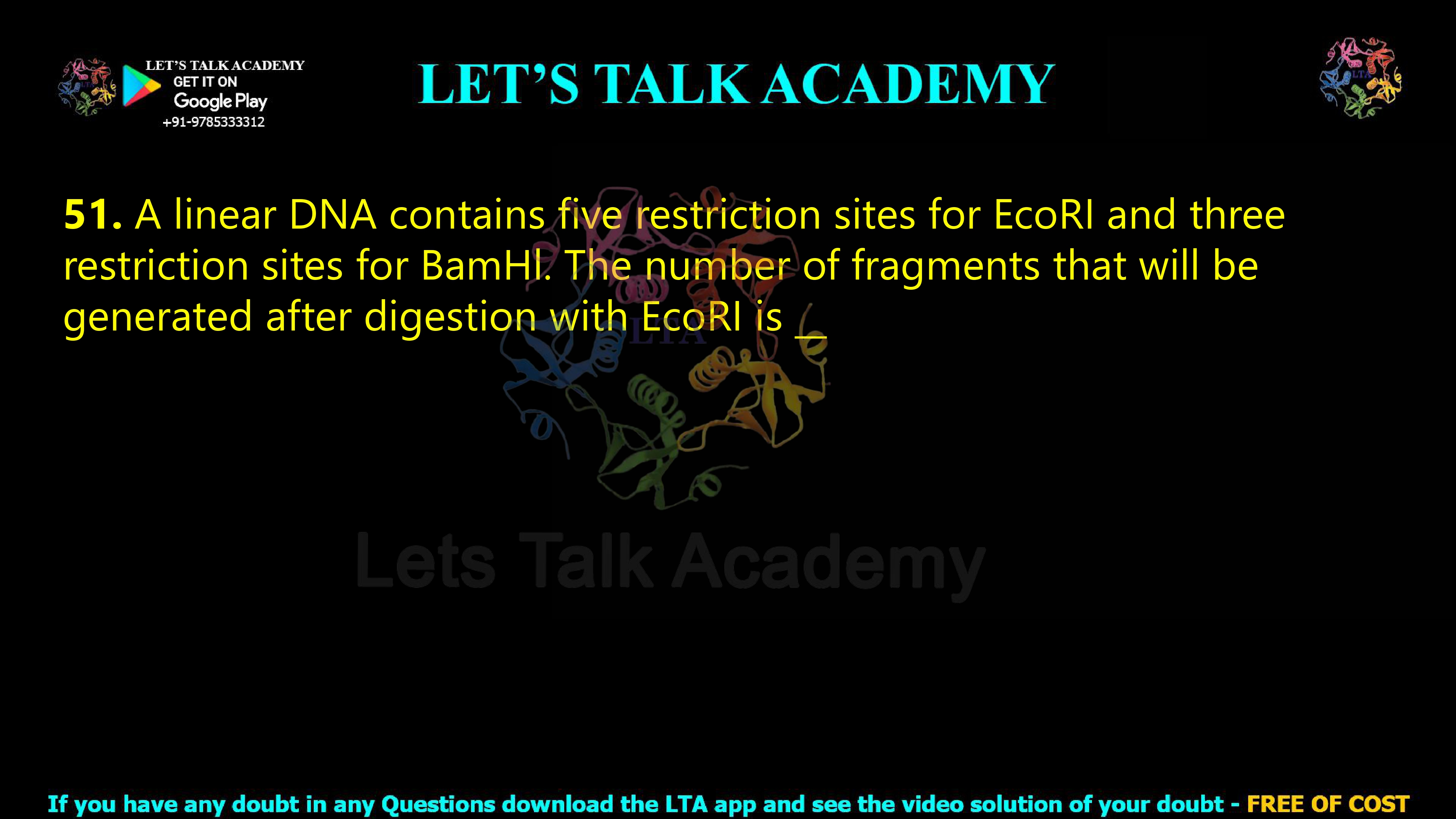
50. A linear DNA contains five restriction sites for EcoRI and three restriction sites for BamHl. The number of fragments that will be generated after digestion with EcoRI is
How Many Fragments Are Generated When Linear DNA with Five EcoRI Sites Is Digested?
Detailed Explanation
Restriction fragment calculation is a fundamental concept in molecular biology, recombinant DNA technology, genetic engineering, and restriction mapping. The number of DNA fragments produced after digestion depends mainly on three factors: whether the DNA molecule is linear or circular, how many recognition sites are present for the restriction enzyme being used, and whether the digestion is complete.
In this question, the DNA molecule is specifically described as linear DNA. It contains five restriction sites for EcoRI and three restriction sites for BamHI. However, the DNA is digested only with EcoRI. Therefore, only the five EcoRI sites are relevant to the calculation. The three BamHI sites do not affect the number of fragments because BamHI is not being used for digestion.
For a linear DNA molecule containing n restriction sites for a particular enzyme, complete digestion generates:
Number of fragments = n + 1
Since the linear DNA contains five EcoRI sites:
Number of fragments = 5 + 1
Number of fragments = 6
Therefore, complete digestion of the linear DNA with EcoRI produces 6 DNA fragments.
Understanding the Information Given in the Question
Linear DNA Contains Five EcoRI Sites and Three BamHI Sites
The question provides two different types of restriction sites:
EcoRI sites = 5
BamHI sites = 3
The next step is to identify which restriction enzyme is actually used in the experiment. The question asks for the number of fragments generated after digestion with EcoRI.
Therefore, EcoRI cuts at its five recognition sites, while the BamHI sites remain completely uncut.
The calculation must therefore be based only on:
5 EcoRI restriction sites
The three BamHI sites are additional information that tests whether the reader can distinguish between restriction sites that are present in the DNA and restriction sites that are actually cleaved during the experiment.
Why Does Linear DNA Follow the n + 1 Rule?
Number of Fragments = Number of Cuts + 1
A linear DNA molecule already has two physical ends before restriction digestion begins. Every new cut made within the DNA increases the number of separate fragments by one.
Consider an intact linear DNA molecule with no cuts. It exists as:
1 DNA fragment
If a restriction enzyme cuts it once, the original molecule is divided into:
2 fragments
If the DNA is cut twice, it produces:
3 fragments
If it is cut three times, it produces:
4 fragments
This pattern continues for any number of restriction sites. Therefore:
1 cut → 2 fragments
2 cuts → 3 fragments
3 cuts → 4 fragments
4 cuts → 5 fragments
5 cuts → 6 fragments
The general relationship is:
For linear DNA: Number of fragments = Number of restriction sites + 1
Therefore, five EcoRI sites produce six fragments.
Step-by-Step Calculation
Step 1: Identify the Shape of the DNA Molecule
The DNA is described as:
Linear DNA
This is essential because linear and circular DNA follow different rules for calculating the number of restriction fragments.
Step 2: Identify the Restriction Enzyme Used
The DNA contains sites for two enzymes:
EcoRI = 5 sites
BamHI = 3 sites
However, digestion is performed only with:
EcoRI
Therefore, only the five EcoRI sites are cleaved.
Step 3: Count the Number of Cuts
Each EcoRI site is cut once during complete digestion.
Therefore:
Number of cuts = 5
Step 4: Apply the Formula for Linear DNA
The formula is:
Number of fragments = n + 1
where n is the number of restriction sites.
Substituting the value:
Number of fragments = 5 + 1
Therefore:
Number of fragments = 6
Visualizing the Five EcoRI Restriction Sites
A linear DNA molecule containing five EcoRI sites can be represented as:
End — EcoRI — EcoRI — EcoRI — EcoRI — EcoRI — End
The five restriction sites divide the DNA into six separate regions.
These regions can be represented as:
Fragment 1 | Fragment 2 | Fragment 3 | Fragment 4 | Fragment 5 | Fragment 6
After complete EcoRI digestion, each of these regions becomes an independent DNA fragment.
Therefore, the total number of fragments is 6.
Why Are the Three BamHI Sites Not Included?
BamHI Is Not Used for Digestion
The DNA contains three BamHI sites, but simply having a restriction site in a DNA molecule does not cause the DNA to break automatically. Cleavage occurs only when the corresponding restriction enzyme is added under appropriate reaction conditions.
Since the question specifies digestion with EcoRI, only EcoRI recognition sites are cut.
Therefore:
EcoRI cuts = 5
BamHI cuts = 0
The three BamHI sites remain intact and have no effect on the number of fragments produced in an EcoRI-only digestion.
Thus, the calculation remains:
5 EcoRI cuts + 1 = 6 fragments
What Would Happen If the DNA Were Digested with BamHI Instead?
If the same linear DNA were digested only with BamHI, the five EcoRI sites would be irrelevant.
The DNA contains:
3 BamHI sites
For linear DNA:
Number of fragments = n + 1
Therefore:
Number of fragments = 3 + 1 = 4
Thus, BamHI digestion alone would produce 4 fragments.
This comparison shows why it is essential to focus on the restriction enzyme actually used in the experiment.
What Would Happen After Double Digestion with EcoRI and BamHI?
If the linear DNA were completely digested with both EcoRI and BamHI, and all restriction sites were distinct, the total number of cuts would be:
5 EcoRI sites + 3 BamHI sites = 8 restriction sites
For linear DNA:
Number of fragments = Total cuts + 1
Therefore:
Number of fragments = 8 + 1
Number of fragments = 9
Thus, complete double digestion would produce 9 fragments, assuming none of the sites overlap.
However, the present question asks only about EcoRI digestion, so the correct answer remains 6 fragments.
Difference Between Linear and Circular DNA Restriction Digestion
The physical structure of DNA determines the relationship between the number of restriction sites and the number of fragments.
For a linear DNA molecule:
n restriction sites → n + 1 fragments
For a circular DNA molecule:
n restriction sites → n fragments
The difference occurs because linear DNA already has two free ends, whereas circular DNA has no free ends.
For example, five restriction sites in linear DNA produce:
5 + 1 = 6 fragments
However, five restriction sites in circular DNA produce:
5 fragments
Therefore, identifying whether the DNA is linear or circular is one of the most important steps in solving restriction digestion problems.
Why Does One Cut Produce Two Fragments in Linear DNA?
Imagine a single continuous piece of linear DNA. Before digestion, it is one molecule.
When a restriction enzyme cuts the DNA at one internal position, the original molecule is separated into a left piece and a right piece.
Therefore:
1 original fragment + 1 cut = 2 fragments
A second cut divides one of the existing pieces again, increasing the total number from two to three.
Each additional cut increases the number of fragments by exactly one. This is the molecular basis of the n + 1 rule for linear DNA.
Complete Digestion and Partial Digestion
The answer of six fragments assumes complete restriction digestion. Complete digestion means that EcoRI successfully cleaves every EcoRI recognition site in every DNA molecule.
Since there are five EcoRI sites, complete digestion produces five cuts and six fragments.
In partial digestion, some restriction sites may remain uncut. As a result, larger intermediate fragments may also be present, and the fragment pattern becomes more complex.
Unless a question specifically mentions partial digestion, restriction enzyme problems generally assume complete digestion.
EcoRI as a Restriction Endonuclease
EcoRI is a well-known type II restriction endonuclease widely used in molecular biology and genetic engineering. It recognizes a specific palindromic DNA sequence and cleaves the DNA at defined positions.
When EcoRI encounters its recognition sequence in a DNA molecule, it cuts the phosphodiester backbone of both strands. If a linear DNA molecule contains five EcoRI recognition sites, complete digestion produces five double-stranded cuts.
These five cleavage positions divide the linear DNA molecule into six separate fragments.
Therefore:
5 EcoRI sites = 5 cuts = 6 fragments
Why the Word “Linear” Is Essential in This Question
The word linear directly determines the mathematical rule used to calculate the answer.
If the question had described a circular DNA molecule with five EcoRI sites, the answer would be five fragments. However, because the DNA is linear, one additional fragment is produced relative to the number of cuts.
Thus:
Linear DNA: 5 sites → 6 fragments
Circular DNA: 5 sites → 5 fragments
This difference is central to restriction mapping and molecular cloning calculations.
Final Calculation
Given:
Nature of DNA = Linear
Number of EcoRI sites = 5
Number of BamHI sites = 3
Enzyme used for digestion = EcoRI only
Formula for linear DNA:
Number of fragments = Number of restriction sites + 1
Calculation:
Number of fragments = 5 + 1
Number of fragments = 6
Final Answer
The number of DNA fragments generated after complete digestion of the linear DNA with EcoRI is:
Correct Answer: 6 fragments
The linear DNA contains five EcoRI restriction sites, and every EcoRI site is cleaved during complete digestion. For a linear DNA molecule, n restriction sites produce n + 1 fragments. Therefore, five EcoRI sites generate 5 + 1 = 6 DNA fragments. The three BamHI sites are irrelevant because the DNA is digested only with EcoRI.


