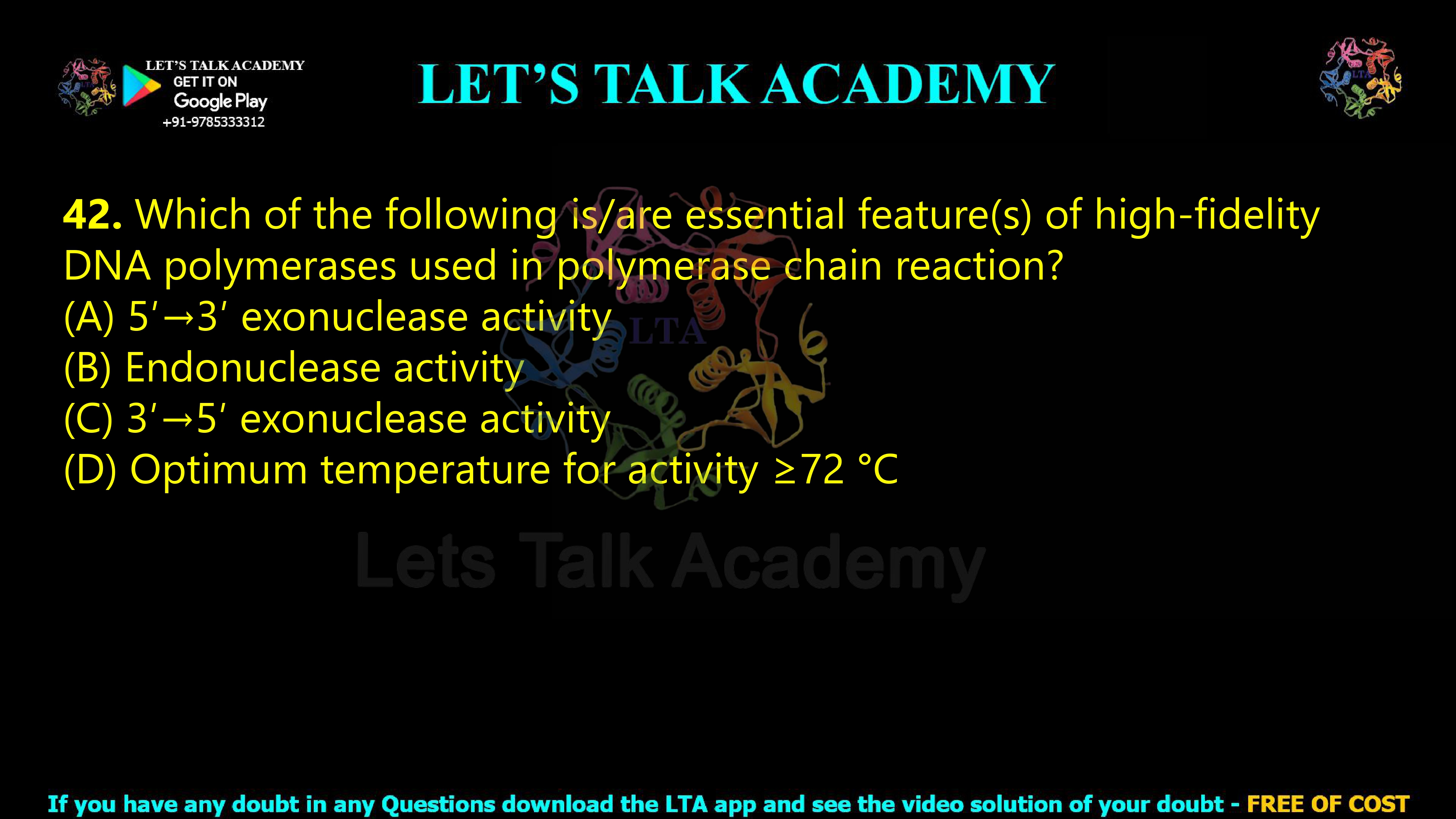
41. Which of the following is/are essential feature(s) of high-fidelity DNA polymerases used in polymerase chain reaction?
(A) 5′→3′ exonuclease activity
(B) Endonuclease activity
(C) 3′→5′ exonuclease activity
(D) Optimum temperature for activity ≥72 °C
Which Features Are Essential for High-Fidelity DNA Polymerases Used in PCR?
Detailed Explanation
High-fidelity DNA polymerases are specialized enzymes used in the polymerase chain reaction when highly accurate DNA amplification is required. The word fidelity refers to the ability of a DNA polymerase to copy a DNA template correctly without introducing unwanted mutations. Therefore, a high-fidelity DNA polymerase must not only synthesize DNA efficiently but must also detect and correct errors that occur during DNA synthesis.
Among the given options, 3′→5′ exonuclease activity is essential because it provides proofreading ability. If the polymerase accidentally incorporates an incorrect nucleotide, the enzyme can move backward, remove the mismatched nucleotide, and resume DNA synthesis with the correct nucleotide.
A high-fidelity polymerase used in PCR must also function efficiently at the high temperatures used during the amplification cycle. The extension step of PCR is generally performed at a high temperature, commonly around 72 °C for many thermostable polymerases. Therefore, high-temperature activity is another important feature of polymerases used for efficient PCR amplification.
In contrast, 5′→3′ exonuclease activity does not provide proofreading, and endonuclease activity is not required for normal PCR amplification. Therefore, options (C) and (D) are correct.
What Is a High-Fidelity DNA Polymerase?
A high-fidelity DNA polymerase is an enzyme capable of synthesizing new DNA strands with a very low error rate. During PCR, the polymerase repeatedly copies a target DNA sequence. Even a small error rate can become important because PCR involves many cycles of amplification, and an error introduced during an early cycle may itself be copied in subsequent cycles.
This is especially important in applications such as DNA cloning, gene synthesis, mutational analysis, next-generation sequencing library preparation, protein expression studies, and other experiments where the exact nucleotide sequence must be preserved.
The major property that distinguishes many high-fidelity polymerases from standard non-proofreading PCR polymerases is the presence of 3′→5′ exonuclease activity. This activity allows the enzyme to inspect the newly synthesized DNA strand and remove incorrectly incorporated nucleotides.
A PCR polymerase must also be sufficiently thermostable to survive repeated exposure to the high temperatures used during PCR. Each amplification cycle includes DNA denaturation at a high temperature, followed by primer annealing and DNA extension. Therefore, the enzyme must retain its structure and catalytic activity throughout repeated thermal cycling.
Why Is 3′→5′ Exonuclease Activity Essential for High-Fidelity DNA Polymerases?
Option (C): 3′→5′ Exonuclease Activity — Correct
The 3′→5′ exonuclease activity of a DNA polymerase is responsible for proofreading newly synthesized DNA. This is the most important molecular feature associated with high-fidelity DNA synthesis.
During DNA replication or PCR amplification, the polymerase adds nucleotides to the 3′ end of the growing DNA strand. Although DNA polymerases are highly selective, an incorrect nucleotide may occasionally be incorporated. Such an error creates a mismatch between the newly synthesized strand and the template strand.
A high-fidelity DNA polymerase can recognize that the newly incorporated nucleotide does not pair correctly with the template. The mismatched 3′ end is transferred from the polymerase active site to the exonuclease active site. The enzyme then removes the incorrect nucleotide in the 3′→5′ direction.
After removal of the mismatched nucleotide, the corrected 3′ end returns to the polymerase active site, and DNA synthesis continues. This process dramatically reduces the frequency of mutations introduced during PCR.
The direction of this proofreading activity is extremely important. DNA synthesis proceeds in the 5′→3′ direction, so the most recently added nucleotide is located at the 3′ end of the growing DNA strand. To remove this incorrectly incorporated terminal nucleotide, the enzyme requires exonuclease activity operating in the opposite direction, from 3′ to 5′.
Therefore, 3′→5′ exonuclease activity is an essential feature of high-fidelity DNA polymerases, making option (C) correct.
How Does Proofreading Increase DNA Polymerase Fidelity?
Proofreading can be understood as an immediate quality-control mechanism during DNA synthesis. When the correct nucleotide is incorporated, the polymerase continues extending the DNA strand. When an incorrect nucleotide is incorporated, the mismatch distorts the structure of the primer–template junction and slows further DNA synthesis.
This delay gives the polymerase an opportunity to transfer the mismatched 3′ end to its proofreading exonuclease site. The incorrect nucleotide is removed, and DNA synthesis resumes.
Without proofreading activity, an incorrectly incorporated nucleotide may remain in the amplified DNA. During subsequent PCR cycles, that mutation can be copied and propagated into many descendant DNA molecules.
This is why proofreading polymerases are preferred when sequence accuracy is more important than simply obtaining a large amount of amplified DNA.
Why Is High-Temperature Activity Important in PCR?
Option (D): Optimum Temperature for Activity ≥72 °C — Correct
PCR is a thermal cycling technique in which the reaction mixture is repeatedly exposed to different temperatures. A DNA polymerase used for PCR must therefore be capable of functioning under high-temperature conditions.
A typical PCR cycle contains three major stages: denaturation, annealing, and extension. During denaturation, double-stranded DNA is separated into single strands at a high temperature, commonly around 94–98 °C. The temperature is then lowered so that primers can anneal to their complementary sequences. Finally, the temperature is adjusted to a suitable level for DNA synthesis.
For many classical thermostable PCR polymerases, DNA extension is efficiently performed around 72 °C. A polymerase capable of high activity at such elevated temperatures can rapidly extend primers and synthesize complementary DNA strands.
High-temperature activity also provides another important advantage. Elevated extension temperatures help maintain the DNA template in a relatively accessible state and can reduce some forms of undesirable non-specific primer binding compared with reactions performed entirely at lower temperatures.
High-fidelity PCR polymerases are therefore designed to combine accurate DNA synthesis with strong thermostability and efficient catalytic activity under elevated-temperature PCR conditions.
Thus, option (D) is considered correct in the context of this question.
Why Is 5′→3′ Exonuclease Activity Not an Essential Feature of High-Fidelity DNA Polymerases?
Option (A): 5′→3′ Exonuclease Activity — Incorrect
The 5′→3′ exonuclease activity of a DNA polymerase is different from proofreading activity. It removes nucleotides from the 5′ end of a DNA strand rather than correcting an incorrectly incorporated nucleotide at the 3′ end of the newly synthesized strand.
Because DNA polymerases add new nucleotides to the 3′ end of a growing DNA chain, replication errors occur at this growing 3′ terminus. Therefore, error correction requires 3′→5′ exonuclease activity, not 5′→3′ exonuclease activity.
Some DNA polymerases possess 5′→3′ exonuclease activity for specialized functions. For example, such activity can participate in the removal of nucleic acid sequences located ahead of the polymerase. In certain molecular biology applications, 5′→3′ nuclease activity can also be useful in probe-based detection systems.
However, this activity does not define high fidelity. A polymerase can possess 5′→3′ exonuclease activity without having the ability to proofread newly synthesized DNA.
The essential distinction is that 5′→3′ exonuclease activity removes nucleotides ahead of the direction of synthesis, whereas 3′→5′ exonuclease activity removes incorrectly incorporated nucleotides from the growing 3′ end.
Therefore, option (A) is incorrect.
Why Is Endonuclease Activity Not Required for High-Fidelity PCR?
Option (B): Endonuclease Activity — Incorrect
An endonuclease is an enzyme that cleaves phosphodiester bonds at internal positions within a nucleic acid strand. This activity is fundamentally different from exonuclease activity, which removes nucleotides from the ends of a DNA molecule.
High-fidelity PCR requires the controlled synthesis of new DNA strands. The polymerase must extend primers and, when necessary, remove an incorrectly incorporated nucleotide from the 3′ end. Random or unnecessary cleavage within DNA molecules would not improve the accuracy of PCR amplification.
Endonucleases are extremely important in other areas of molecular biology. Restriction endonucleases, for example, recognize specific DNA sequences and cut DNA at defined locations. Other endonucleases participate in DNA repair, recombination, genome editing, and nucleic acid processing.
However, endonuclease activity is not an essential feature that makes a PCR DNA polymerase highly accurate. The proofreading function required for high fidelity is specifically associated with 3′→5′ exonuclease activity.
Therefore, option (B) is incorrect.
Difference Between 3′→5′ and 5′→3′ Exonuclease Activities
The direction of exonuclease activity determines its biological function. A 3′→5′ exonuclease removes nucleotides from the 3′ end of a DNA strand. Since the growing DNA chain is extended at its 3′ end, this activity can remove the most recently added incorrect nucleotide and therefore acts as a proofreading mechanism.
In contrast, a 5′→3′ exonuclease removes nucleotides beginning from a 5′ end. This activity may be useful for processing nucleic acids or removing sequences located ahead of a polymerase, but it does not directly correct a mismatch at the growing 3′ end.
This difference explains why only 3′→5′ exonuclease activity is directly associated with the high fidelity of a DNA polymerase.
High-Fidelity DNA Polymerase and Standard PCR Polymerase
Not all thermostable DNA polymerases have the same level of accuracy. Some commonly used PCR polymerases efficiently synthesize DNA but lack strong proofreading activity. When such an enzyme incorporates an incorrect nucleotide, it has limited ability to remove the error.
High-fidelity polymerases contain proofreading activity and therefore produce amplified DNA with fewer unwanted mutations. This makes them especially valuable when the amplified product will be cloned, sequenced, expressed as a protein, or used in experiments where sequence accuracy is critical.
The most important combination for a high-fidelity PCR enzyme is therefore accurate proofreading and effective function under PCR thermal conditions.
Why Options (C) and (D) Are the Best Answer
The wording of the question asks about the essential features of high-fidelity DNA polymerases used in PCR. Two separate requirements are being tested.
The first requirement is fidelity. High fidelity depends on proofreading, which is provided by 3′→5′ exonuclease activity. This makes option (C) correct.
The second requirement is suitability for PCR conditions. A PCR polymerase must function efficiently at elevated temperatures during the extension phase and remain stable through repeated thermal cycles. This supports option (D).
Neither 5′→3′ exonuclease activity nor endonuclease activity provides the proofreading function required for high-fidelity DNA amplification.
Final Answer
The essential features of high-fidelity DNA polymerases used in the polymerase chain reaction are 3′→5′ exonuclease activity and high-temperature activity with an optimum temperature of approximately 72 °C or above in the context of the given options.
Correct Option: (C) and (D)
The 3′→5′ exonuclease activity provides proofreading by removing incorrectly incorporated nucleotides from the growing 3′ end of the DNA strand. High-temperature activity allows the polymerase to function efficiently during PCR extension and withstand repeated thermal cycling. The 5′→3′ exonuclease activity is not responsible for proofreading, while endonuclease activity is not an essential feature of high-fidelity PCR polymerases.


