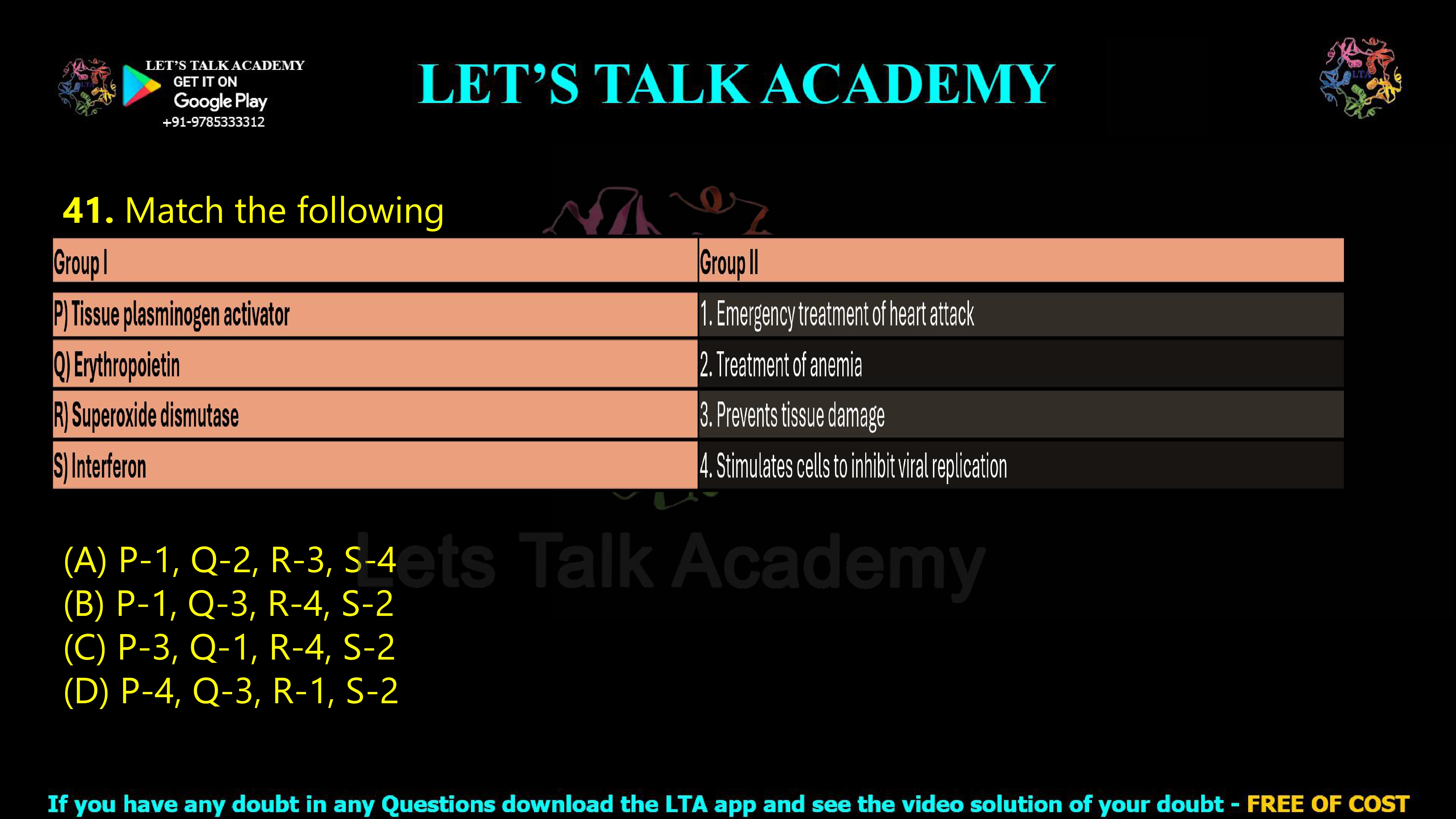
40. Match the following
| Group I | Group II |
| P) Tissue plasminogen activator | 1. Emergency treatment of heart attack |
| Q) Erythropoietin | 2. Treatment of anemia |
| R) Superoxide dismutase | 3. Prevents tissue damage |
| S) Interferon | 4. Stimulates cells to inhibit viral replication |
(A) P-1, Q-2, R-3, S-4
(B) P-1, Q-3, R-4, S-2
(C) P-3, Q-1, R-4, S-2
(D) P-4, Q-3, R-1, S-2
Tissue Plasminogen Activator, Erythropoietin, Superoxide Dismutase and Interferon: Correct Matching Explained
Understanding the Basis of the Matching Question
This question focuses on biologically important proteins that have major physiological or therapeutic roles. Some of these molecules are naturally produced in the human body, while recombinant forms of several of them have important applications in medicine and biotechnology. To solve the question correctly, it is necessary to connect each protein with its most characteristic biological function.
Tissue plasminogen activator acts on the blood clot-dissolving system, erythropoietin controls red blood cell production, superoxide dismutase protects cells from oxidative damage, and interferon activates antiviral defense mechanisms. Each protein therefore has a clearly distinct function, making option (A) the only completely correct combination.
P) Tissue Plasminogen Activator Matches with 1. Emergency Treatment of Heart Attack
What Is Tissue Plasminogen Activator?
Tissue plasminogen activator, commonly abbreviated as tPA, is a serine protease involved in the natural breakdown of blood clots. It is produced mainly by endothelial cells lining blood vessels and plays a central role in fibrinolysis, the physiological process through which fibrin-containing blood clots are dissolved.
A blood clot contains a network of fibrin that provides structural stability to the clot. Tissue plasminogen activator promotes clot dissolution by converting the inactive precursor plasminogen into the active enzyme plasmin. Plasmin then degrades fibrin and helps break down the blood clot.
Why Is Tissue Plasminogen Activator Used in Heart Attack Treatment?
A heart attack, also known as myocardial infarction, commonly occurs when a coronary artery supplying blood to the heart muscle becomes blocked by a thrombus or blood clot. This blockage reduces or stops the supply of oxygen to a region of the heart. If blood flow is not restored rapidly, cardiac muscle cells may undergo irreversible damage.
Because tissue plasminogen activator can promote the breakdown of fibrin-rich blood clots, thrombolytic forms of this protein have been used in selected emergency clinical situations to restore blood flow. The fundamental principle is that rapid dissolution of the obstructing clot may reduce the duration of oxygen deprivation and limit damage to the affected tissue.
Therefore, tissue plasminogen activator correctly matches with:
P → 1. Emergency treatment of heart attack
Q) Erythropoietin Matches with 2. Treatment of Anemia
What Is Erythropoietin?
Erythropoietin, commonly abbreviated as EPO, is a glycoprotein hormone that plays a central role in the regulation of red blood cell production. In adults, it is produced primarily by specialized cells in the kidneys in response to reduced oxygen availability in the tissues.
When oxygen levels fall, the kidneys increase the production and release of erythropoietin into the bloodstream. The hormone travels to the bone marrow, where it acts on erythroid progenitor cells and promotes their survival, proliferation, and differentiation. This ultimately increases the production of mature red blood cells.
Why Is Erythropoietin Used for the Treatment of Anemia?
Anemia is characterized by an insufficient number of functional red blood cells or an inadequate amount of hemoglobin, reducing the oxygen-carrying capacity of the blood. Because erythropoietin stimulates erythropoiesis, recombinant forms of this hormone can be used in specific types of anemia where increased red blood cell production is clinically required.
The association between erythropoietin and anemia is especially important in biotechnology because recombinant human erythropoietin is a major example of a therapeutic protein produced using recombinant DNA technology. Its biological action directly addresses reduced red blood cell production by stimulating the bone marrow to generate more erythrocytes.
Therefore, erythropoietin correctly matches with:
Q → 2. Treatment of anemia
R) Superoxide Dismutase Matches with 3. Prevents Tissue Damage
What Is Superoxide Dismutase?
Superoxide dismutase, commonly abbreviated as SOD, is an important antioxidant enzyme that protects cells against oxidative stress. During normal cellular metabolism, reactive oxygen species can be generated. One such highly reactive species is the superoxide radical.
Excessive accumulation of superoxide radicals can damage cellular components, including proteins, membrane lipids, and nucleic acids. Superoxide dismutase provides protection by catalyzing the conversion of superoxide radicals into hydrogen peroxide and molecular oxygen.
The reaction can be represented as:
2O2•− + 2H+ → H2O2 + O2
The hydrogen peroxide formed in this reaction can subsequently be removed by other antioxidant enzymes, particularly catalase and glutathione peroxidase. Together, these antioxidant defense systems reduce the harmful effects of reactive oxygen species.
How Does Superoxide Dismutase Prevent Tissue Damage?
Oxidative stress occurs when the generation of reactive oxygen species exceeds the capacity of cellular antioxidant defenses. Under such conditions, free radicals can attack biological molecules and contribute to cellular and tissue injury.
By removing superoxide radicals, superoxide dismutase represents one of the first major lines of enzymatic antioxidant defense. Its activity helps protect cellular membranes, proteins, and genetic material from oxidative injury. For this reason, its function is appropriately associated with the prevention of tissue damage.
Therefore, superoxide dismutase correctly matches with:
R → 3. Prevents tissue damage
S) Interferon Matches with 4. Stimulates Cells to Inhibit Viral Replication
What Is Interferon?
Interferons are a group of signaling proteins belonging to the cytokine family. They are produced and released by cells in response to particular biological signals, especially viral infection. Their name reflects their ability to interfere with viral multiplication.
When a cell detects viral infection, it can release interferons that act on the same cell and nearby cells. These signals stimulate the expression of antiviral genes and help establish an antiviral state. As a result, surrounding cells become better prepared to resist viral replication and spread.
How Do Interferons Inhibit Viral Replication?
Interferons generally do not destroy viruses directly. Instead, they bind to specific receptors on target cells and activate intracellular signaling pathways. These pathways induce the expression of proteins that can interfere with different stages of viral replication.
The antiviral response may involve inhibition of viral protein synthesis, degradation of viral nucleic acids, and activation of other components of the immune system. By stimulating cells to produce antiviral proteins, interferons reduce the ability of viruses to replicate efficiently.
Therefore, interferon correctly matches with:
S → 4. Stimulates cells to inhibit viral replication
Complete Correct Matching
After understanding the function of each protein, the complete matching becomes clear. Tissue plasminogen activator promotes fibrinolysis and is associated with emergency treatment of a heart attack. Erythropoietin stimulates red blood cell formation and is used in the treatment of anemia. Superoxide dismutase neutralizes harmful superoxide radicals and helps prevent tissue damage. Interferon activates antiviral responses in cells and inhibits viral replication.
P) Tissue plasminogen activator → 1. Emergency treatment of heart attack
Q) Erythropoietin → 2. Treatment of anemia
R) Superoxide dismutase → 3. Prevents tissue damage
S) Interferon → 4. Stimulates cells to inhibit viral replication
Thus, the correct matching is:
P-1, Q-2, R-3, S-4
Detailed Explanation of Every Option
Option (A): P-1, Q-2, R-3, S-4
Option (A) is correct. Every pair in this combination accurately represents the major biological or therapeutic function of the corresponding protein. Tissue plasminogen activator is associated with emergency thrombolytic treatment because it promotes the conversion of plasminogen into plasmin and helps dissolve fibrin-rich blood clots. Erythropoietin is associated with anemia treatment because it stimulates the production of red blood cells in the bone marrow.
Superoxide dismutase correctly matches with the prevention of tissue damage because it neutralizes superoxide radicals and reduces oxidative injury. Interferon correctly matches with the inhibition of viral replication because it stimulates cells to express antiviral proteins. Since all four matches are correct, option (A) is the correct answer.
Option (B): P-1, Q-3, R-4, S-2
Option (B) is incorrect. The first match, P-1, is correct because tissue plasminogen activator is associated with emergency treatment of heart attack. However, the remaining matches are incorrect.
Erythropoietin does not primarily prevent tissue damage; its major function is to stimulate red blood cell production and it therefore matches with the treatment of anemia. Superoxide dismutase does not stimulate cells to inhibit viral replication; its main function is antioxidant protection against superoxide radicals. Interferon is also not used primarily to stimulate red blood cell formation in anemia. Therefore, option (B) contains only the first correct pair and cannot be the answer.
Option (C): P-3, Q-1, R-4, S-2
Option (C) is incorrect. Tissue plasminogen activator should not be matched primarily with the prevention of tissue damage. Its characteristic function in this question is the dissolution of blood clots during emergency treatment of heart attack. Erythropoietin is not a thrombolytic protein and therefore cannot be matched with emergency heart attack treatment.
Superoxide dismutase does not produce the cellular antiviral response described in statement 4. That function belongs to interferon. Similarly, interferon does not primarily treat anemia because stimulation of erythrocyte production is the function of erythropoietin. Since all the relationships in option (C) are incorrectly assigned, this option can be eliminated.
Option (D): P-4, Q-3, R-1, S-2
Option (D) is incorrect. Tissue plasminogen activator does not stimulate cells to inhibit viral replication because that is the characteristic function of interferons. Erythropoietin is not primarily responsible for preventing oxidative tissue damage; instead, it stimulates red blood cell production.
Superoxide dismutase is an antioxidant enzyme and is not used as the protein responsible for emergency dissolution of coronary blood clots. Interferon also does not function as the principal treatment for anemia. Therefore, none of the matches in option (D) represents the correct set of biological functions.
Biotechnology Importance of These Therapeutic and Protective Proteins
This question connects fundamental biology with medical biotechnology. Tissue plasminogen activator and erythropoietin are important examples of proteins whose recombinant forms have had major therapeutic applications. Their production through biotechnology demonstrates how knowledge of genes, protein expression, and recombinant DNA technology can be translated into clinically useful biological products.
Superoxide dismutase represents the cellular antioxidant defense system and illustrates how enzymes protect biological tissues from reactive oxygen species. Interferons demonstrate the importance of cell signaling and innate antiviral defense. Together, these four proteins cover important concepts from enzymology, hematology, oxidative stress, immunology, virology, and medical biotechnology.
Why This Question Is Important for Life Science and Biotechnology Exams
Matching questions involving therapeutic proteins are frequently asked because they test whether students can connect a biological molecule with its physiological mechanism and medical application. Simply remembering the names of proteins is not sufficient. A clear understanding of how each protein works makes it much easier to identify the correct match.
This topic is particularly relevant for CSIR NET Life Science, DBT JRF, GATE Biotechnology, IIT JAM Biotechnology, ICMR JRF, and other life science entrance examinations. Similar questions may ask about recombinant insulin, growth hormone, clotting factors, monoclonal antibodies, cytokines, therapeutic enzymes, and other biologically important proteins.
Concept Summary
Tissue plasminogen activator promotes fibrinolysis by helping convert plasminogen into plasmin, making it associated with emergency treatment of a heart attack. Erythropoietin stimulates erythropoiesis in the bone marrow and is therefore associated with the treatment of anemia. Superoxide dismutase neutralizes damaging superoxide radicals and helps prevent oxidative tissue damage. Interferon activates antiviral defense mechanisms in cells and stimulates them to inhibit viral replication.
Therefore, the correct matching is P-1, Q-2, R-3, S-4.
Final Answer
Correct Option: (A) P-1, Q-2, R-3, S-4
Tissue plasminogen activator → Emergency treatment of heart attack; Erythropoietin → Treatment of anemia; Superoxide dismutase → Prevents tissue damage; Interferon → Stimulates cells to inhibit viral replication.


