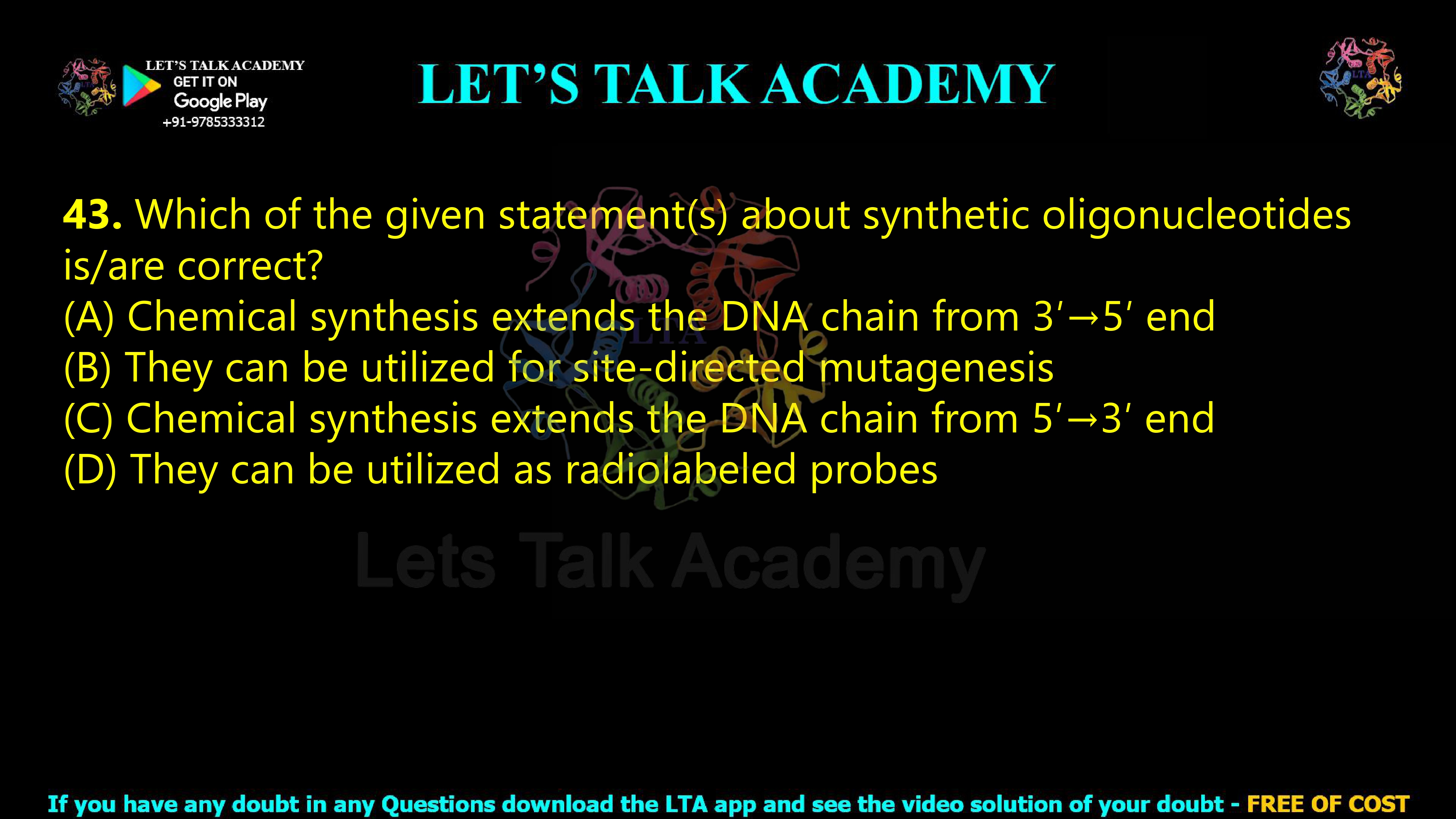
42. Which of the given statement(s) about synthetic oligonucleotides is/are correct?
(A) Chemical synthesis extends the DNA chain from 3′→5′ end
(B) They can be utilized for site-directed mutagenesis
(C) Chemical synthesis extends the DNA chain from 5′→3′ end
(D) They can be utilized as radiolabeled probes
Synthetic Oligonucleotides: Chemical Synthesis Direction and Major Applications Explained
Correct Answer
Correct Statements: (A), (B) and (D)
Statements (A), (B), and (D) are correct. During conventional chemical synthesis of synthetic oligonucleotides, the nucleotide chain is assembled in the 3′→5′ direction, which is opposite to the direction of DNA synthesis catalyzed by DNA polymerases. Synthetic oligonucleotides can also be designed to introduce specific mutations into DNA during site-directed mutagenesis, and they can be radiolabeled for use as probes in nucleic acid detection experiments.
Statement (C) is incorrect because the conventional chemical synthesis of oligonucleotides does not normally extend the chain in the 5′→3′ direction. The 5′→3′ direction is characteristic of enzymatic DNA synthesis by DNA polymerases.
Therefore, the correct combination is:
(A), (B) and (D)
What Are Synthetic Oligonucleotides?
Synthetic oligonucleotides are short, artificially produced sequences of DNA or RNA whose nucleotide composition is designed according to the requirements of a particular experiment. The word “oligonucleotide” refers to a relatively short chain of nucleotides, while “synthetic” indicates that the sequence is produced by controlled chemical methods rather than being isolated directly from a biological organism.
The ability to manufacture a DNA molecule with a predetermined sequence has transformed modern molecular biology. A researcher can specify the exact order of adenine, thymine, guanine, and cytosine residues required for an experiment, and the desired oligonucleotide can then be chemically synthesized.
Synthetic oligonucleotides have numerous applications in molecular biology, genetics, biotechnology, diagnostics, and genomics. They are widely used as PCR primers, DNA sequencing primers, hybridization probes, mutagenic primers, gene synthesis components, adapters, linkers, and tools for detecting specific nucleic acid sequences.
How Does Chemical Synthesis of Oligonucleotides Work?
The chemical synthesis of oligonucleotides differs fundamentally from biological DNA replication. Inside a living cell, DNA polymerases add nucleotides to the free 3′-OH group of a growing DNA strand, so enzymatic DNA synthesis proceeds in the 5′→3′ direction. Conventional chemical oligonucleotide synthesis, however, is commonly performed using solid-phase phosphoramidite chemistry and assembles the sequence in the opposite direction.
During solid-phase oligonucleotide synthesis, the first nucleoside is attached through its 3′ end to a solid support. The 5′ end of this immobilized nucleoside is made available for reaction with the next incoming nucleotide. Successive nucleotide residues are then added to the 5′ end of the growing chain.
As a result, the chemically synthesized oligonucleotide grows from the 3′ end toward the 5′ end. Therefore, conventional chemical oligonucleotide synthesis proceeds in the 3′→5′ direction.
Why Chemical DNA Synthesis Proceeds from 3′→5′
Attachment of the First Nucleoside to a Solid Support
In conventional solid-phase oligonucleotide synthesis, the first nucleoside corresponding to the 3′-terminal residue of the desired sequence is attached to a solid support. The solid support may consist of a material such as controlled-pore glass or another suitable polymeric matrix.
Because the 3′ end is associated with the solid support, nucleotide addition occurs at the exposed 5′ end of the growing oligonucleotide. Each new nucleotide is therefore added toward the 5′ side of the sequence.
Stepwise Addition of Nucleotides
Oligonucleotide synthesis occurs through repeated chemical cycles. A temporary protecting group on the 5′ end is removed, allowing the next activated nucleotide to react with the growing chain. The newly formed linkage is chemically stabilized, unreacted molecules are capped to prevent unwanted products from continuing through later cycles, and the process is repeated.
Each cycle adds one nucleotide to the 5′ end of the growing oligonucleotide. Consequently, the complete sequence is assembled from the 3′ end toward the 5′ end.
Option (A): Chemical Synthesis Extends the DNA Chain from 3′→5′ End
Option (A) is correct. Conventional chemical synthesis of synthetic oligonucleotides proceeds in the 3′→5′ direction. The first nucleoside is attached through its 3′ end to a solid support, and subsequent nucleotides are added to the available 5′ end of the growing chain.
This direction is one of the most important differences between chemical oligonucleotide synthesis and enzymatic DNA synthesis. In chemical synthesis, the chain grows toward the 5′ end, whereas DNA polymerase extends a DNA strand by adding nucleotides to its 3′-OH group.
Therefore:
Chemical oligonucleotide synthesis = 3′→5′ chain assembly
For this reason, statement (A) is correct.
Option (B): Synthetic Oligonucleotides Can Be Utilized for Site-Directed Mutagenesis
Option (B) is correct. Synthetic oligonucleotides are extensively used in site-directed mutagenesis, a molecular biology technique that allows a specific and predetermined change to be introduced into a DNA sequence.
What Is Site-Directed Mutagenesis?
Site-directed mutagenesis is a technique used to introduce a deliberate mutation at a selected position in a gene or another DNA sequence. The mutation may involve substitution of one nucleotide, deletion of one or more nucleotides, or insertion of additional nucleotides.
This technique is especially useful when researchers want to study the function of a particular amino acid in a protein, analyze the role of a regulatory DNA sequence, modify enzyme activity, investigate promoter function, or create a specific genetic variant.
How Are Synthetic Oligonucleotides Used in Site-Directed Mutagenesis?
A synthetic oligonucleotide can be designed so that most of its sequence is complementary to the target DNA but one or more selected nucleotides are intentionally altered. This oligonucleotide can hybridize with the target sequence despite the designed mismatch.
The synthetic oligonucleotide then acts as a primer for DNA synthesis. As DNA replication or amplification proceeds, the deliberately altered nucleotide becomes incorporated into the newly synthesized DNA molecule. After subsequent replication, the desired mutation becomes established in the DNA sequence.
For example, if a researcher wants to replace one amino acid in a protein, an oligonucleotide can be synthesized containing a changed codon at the desired location. The oligonucleotide introduces this specific sequence alteration into the gene, allowing the effect of the amino acid substitution to be studied.
Therefore:
Synthetic oligonucleotide containing a designed sequence change → Site-directed mutagenesis
For this reason, statement (B) is correct.
Option (C): Chemical Synthesis Extends the DNA Chain from 5′→3′ End
Option (C) is incorrect. This statement describes the direction of enzymatic DNA synthesis rather than the conventional chemical synthesis of synthetic oligonucleotides.
Why DNA Polymerase Synthesizes DNA from 5′→3′
DNA polymerases require a free 3′-OH group on an existing primer. During DNA synthesis, the 3′-OH group of the growing strand reacts with the incoming nucleotide, causing the new nucleotide to be added to the 3′ end.
Since nucleotides are continuously added to the 3′ end of the growing strand, DNA polymerase synthesizes DNA in the 5′→3′ direction.
This principle applies to biological DNA replication, PCR amplification, and many other enzyme-mediated DNA synthesis reactions.
Why This Statement Does Not Apply to Conventional Chemical Oligonucleotide Synthesis
In conventional solid-phase chemical synthesis, the first nucleotide is immobilized through its 3′ end and the chain grows by repeated addition of nucleotides to the exposed 5′ end. Therefore, the direction of chain assembly is 3′→5′ rather than 5′→3′.
The distinction can be summarized as follows:
DNA polymerase-mediated synthesis = 5′→3′
Conventional chemical oligonucleotide synthesis = 3′→5′
Because the question specifically asks about synthetic oligonucleotides produced by chemical synthesis, statement (C) is incorrect.
Option (D): Synthetic Oligonucleotides Can Be Utilized as Radiolabeled Probes
Option (D) is correct. Synthetic oligonucleotides can be labeled with radioactive isotopes and used as probes to detect complementary nucleic acid sequences.
What Is a Nucleic Acid Probe?
A nucleic acid probe is a labeled single-stranded DNA or RNA molecule that can hybridize with a complementary target sequence. The probe is designed so that its nucleotide sequence is complementary to the DNA or RNA molecule that the researcher wants to detect.
When the probe encounters its complementary target, hydrogen bonds form between complementary bases, producing a stable hybrid. The label attached to the probe then allows the location or presence of the target sequence to be detected.
How Are Synthetic Oligonucleotides Radiolabeled?
Synthetic oligonucleotides can be labeled with radioactive isotopes, commonly phosphorus-32. One frequently used strategy is to label the 5′ end of an oligonucleotide using a radioactive phosphate group.
Once radiolabeled, the oligonucleotide can hybridize with a complementary DNA or RNA sequence. The radioactive signal can then be detected using suitable imaging methods, allowing researchers to determine whether the target nucleic acid sequence is present.
Applications of Radiolabeled Oligonucleotide Probes
Radiolabeled synthetic oligonucleotide probes have been used in Southern blotting, Northern blotting, colony hybridization, plaque hybridization, detection of specific genes, analysis of mutations, identification of microorganisms, and other nucleic acid hybridization experiments.
The major advantage of a synthetic oligonucleotide probe is that its sequence can be designed precisely. If the sequence of a target gene or genomic region is known, a complementary oligonucleotide can be synthesized and labeled for highly specific detection.
Therefore:
Synthetic oligonucleotide + radioactive label = Radiolabeled hybridization probe
For this reason, statement (D) is correct.
Detailed Explanation of All Four Statements Together
Statement (A) is correct because conventional solid-phase chemical synthesis assembles an oligonucleotide in the 3′→5′ direction. The first nucleoside is attached to a solid support through its 3′ end, and each additional nucleotide is added toward the 5′ end of the growing chain.
Statement (B) is also correct because synthetic oligonucleotides can be designed with deliberate nucleotide changes and used to introduce specific mutations into target DNA. This is the fundamental basis of oligonucleotide-directed site-directed mutagenesis.
Statement (C) is incorrect because 5′→3′ synthesis is the characteristic direction of DNA synthesis catalyzed by DNA polymerases. It is not the conventional direction of chain assembly during standard chemical oligonucleotide synthesis.
Statement (D) is correct because synthetic oligonucleotides can be labeled with radioactive isotopes and used as probes to detect complementary DNA or RNA sequences through nucleic acid hybridization.
Difference Between Chemical and Enzymatic DNA Synthesis
The central concept in this question is the difference between chemical oligonucleotide synthesis and enzyme-mediated DNA synthesis. In living cells and PCR reactions, DNA polymerase adds each incoming nucleotide to the 3′ end of a growing strand. Therefore, enzymatic DNA synthesis always proceeds in the 5′→3′ direction.
In conventional solid-phase chemical oligonucleotide synthesis, however, the 3′-terminal nucleoside is attached to a solid support. The sequence is built by adding new nucleotide residues to the exposed 5′ end. Therefore, the chemical assembly of the oligonucleotide proceeds in the 3′→5′ direction.
This difference is highly important because questions often compare the direction of biological DNA replication with the direction of conventional chemical oligonucleotide synthesis.
Major Applications of Synthetic Oligonucleotides
Synthetic oligonucleotides have become indispensable tools in modern molecular biology. Their most familiar application is as primers in PCR, where two oligonucleotides define the boundaries of the DNA region to be amplified. They are also used as primers in DNA sequencing and other DNA synthesis reactions.
Another important application is site-directed mutagenesis, where a deliberately modified oligonucleotide introduces a selected nucleotide change into a gene. Synthetic oligonucleotides can also function as hybridization probes for detecting specific DNA or RNA sequences. Depending on the experimental requirement, these probes may carry radioactive, fluorescent, enzymatic, or other detectable labels.
Additional applications include gene synthesis, molecular cloning, DNA library construction, preparation of adapters and linkers, detection of sequence variations, and many modern genomic and diagnostic techniques.
Why This Question Is Important for Life Science and Biotechnology Exams
This question tests two important areas of molecular biology simultaneously: the chemistry of artificial DNA synthesis and the practical applications of synthetic oligonucleotides. A student must distinguish chemical DNA synthesis from DNA polymerase-mediated synthesis and must also understand how custom-designed DNA sequences are used experimentally.
The topic is particularly important for CSIR NET Life Science, DBT JRF, GATE Biotechnology, IIT JAM Biotechnology, ICMR JRF, and other molecular biology examinations. Similar questions may ask about phosphoramidite chemistry, solid-phase synthesis, PCR primers, mutagenic oligonucleotides, hybridization probes, radioactive labeling, or the direction of nucleotide chain growth.
Concept Summary
Conventional chemical synthesis of synthetic oligonucleotides proceeds in the 3′→5′ direction because the first nucleoside is attached to a solid support through its 3′ end and subsequent nucleotides are added toward the 5′ end. Therefore, statement (A) is correct, while statement (C) is incorrect.
Synthetic oligonucleotides can be designed with specific nucleotide alterations and used for site-directed mutagenesis, making statement (B) correct. They can also be labeled with radioactive isotopes and used as probes to detect complementary nucleic acid sequences, making statement (D) correct.
Final Answer
Correct Statements: (A), (B) and (D)
(A) Chemical synthesis extends the DNA chain from 3′→5′ end — Correct
(B) They can be utilized for site-directed mutagenesis — Correct
(C) Chemical synthesis extends the DNA chain from 5′→3′ end — Incorrect
(D) They can be utilized as radiolabeled probes — Correct
Final Answer: (A), (B) and (D)


