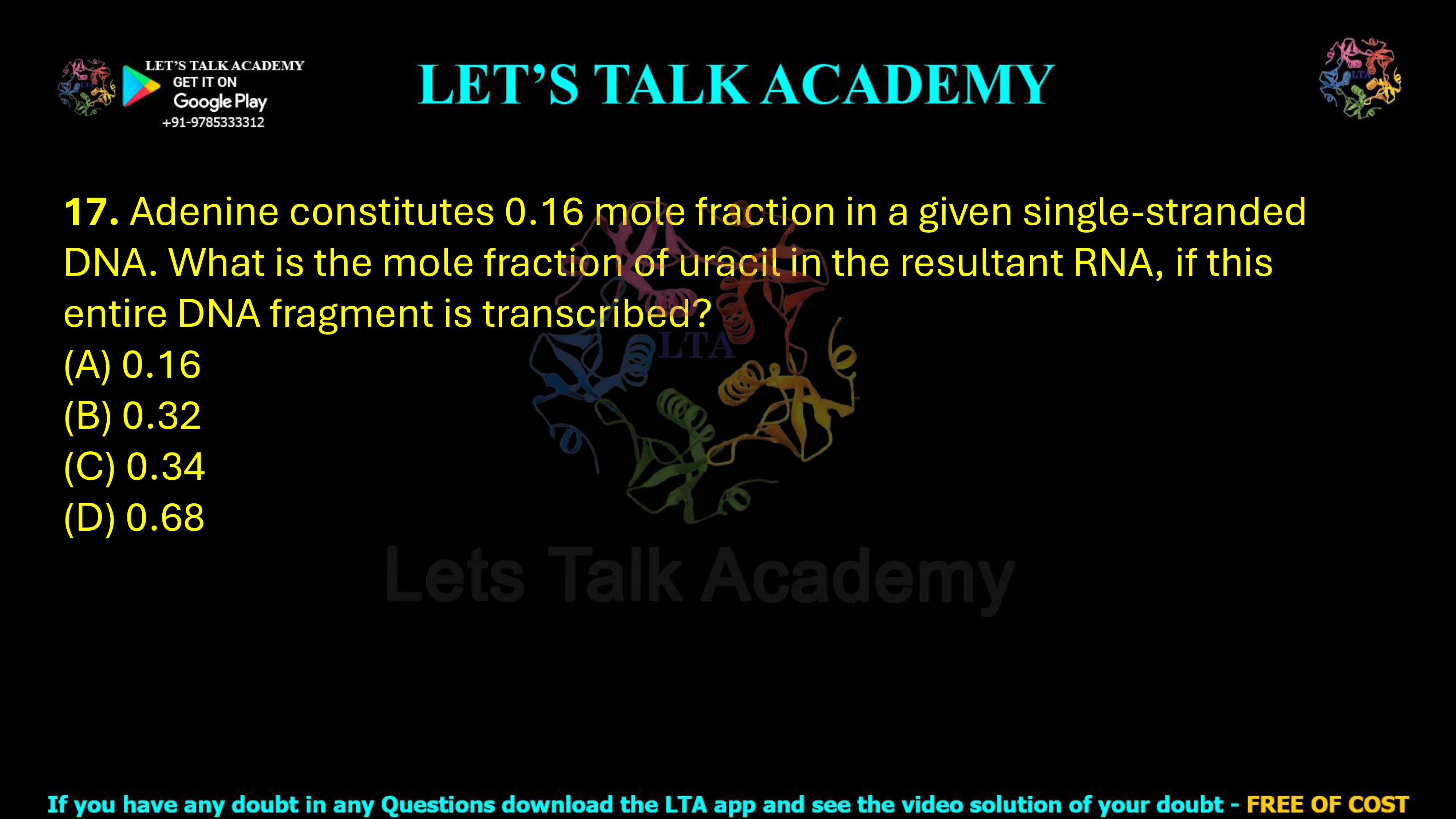
17. Adenine constitutes 0.16 mole fraction in a given single-stranded DNA. What is the mole fraction of uracil in the resultant RNA, if this entire DNA fragment is transcribed?
(A) 0.16
(B) 0.32
(C) 0.34
(D) 0.68
Adenine Mole Fraction in Single-Stranded DNA and Uracil Mole Fraction in RNA
Introduction
Transcription is the biological process in which the nucleotide sequence of a DNA template is copied into a complementary RNA molecule. To solve questions based on the base composition of DNA and RNA, it is essential to understand the rules of complementary base pairing during RNA synthesis. RNA polymerase reads the DNA template strand and incorporates complementary ribonucleotides into the growing RNA chain.
During transcription, adenine present in the DNA template pairs with uracil in RNA. Similarly, thymine in DNA pairs with adenine in RNA, guanine pairs with cytosine, and cytosine pairs with guanine. Therefore, if the mole fraction of adenine in a single-stranded DNA template is known, the mole fraction of uracil in the complementary RNA transcript can be determined directly.
Correct Answer
Correct Answer: (A) 0.16
Detailed Explanation
The question provides a single-stranded DNA fragment that is completely transcribed. During transcription, this DNA strand acts as the template for RNA synthesis. RNA polymerase reads the template DNA and synthesizes a complementary RNA molecule according to specific base-pairing rules.
The relevant complementary relationship is:
Adenine (A) in template DNA → Uracil (U) in RNA
The mole fraction of adenine in the DNA is given as:
Mole fraction of A in DNA = 0.16
Since every adenine nucleotide in the DNA template produces one complementary uracil nucleotide in the RNA:
Mole fraction of U in RNA = Mole fraction of A in template DNA
Therefore:
Mole fraction of U in RNA = 0.16
Hence, the correct answer is option (A).
Step-by-Step Solution
Step 1: Identify the Given Information
The mole fraction of adenine in the single-stranded DNA is:
A = 0.16
This means that adenine represents 16% of all nucleotides present in the DNA strand.
Step 2: Apply the DNA-RNA Base-Pairing Rule
During transcription, RNA nucleotides are incorporated according to the sequence of the DNA template strand. The complementary base-pairing rules are:
DNA A → RNA U
DNA T → RNA A
DNA G → RNA C
DNA C → RNA G
Therefore, every adenine nucleotide present in the DNA template corresponds to one uracil nucleotide in the RNA transcript.
Step 3: Determine the Uracil Mole Fraction
Because the entire DNA fragment is transcribed, the relative number of adenine nucleotides in the template directly determines the relative number of uracil nucleotides in the RNA.
A in DNA = 0.16
Therefore:
U in RNA = 0.16
Complete Calculation
Mole fraction of adenine in DNA = 0.16
DNA adenine pairs with RNA uracil
Therefore, mole fraction of uracil in RNA = 0.16
Final Answer = 0.16
DNA-RNA Complementary Base Pairing During Transcription
| Base in Template DNA | Complementary Base in RNA |
|---|---|
| Adenine (A) | Uracil (U) |
| Thymine (T) | Adenine (A) |
| Guanine (G) | Cytosine (C) |
| Cytosine (C) | Guanine (G) |
Explanation of Option (A): 0.16
This option is correct.
The mole fraction of adenine in the DNA template is 0.16. During transcription, every adenine nucleotide in the template DNA pairs with a uracil nucleotide in the newly synthesized RNA. Since the complete DNA fragment is transcribed, the mole fraction of uracil in the RNA must be equal to the mole fraction of adenine in the DNA template.
Therefore:
DNA A = 0.16 → RNA U = 0.16
Hence, option (A) is correct.
Explanation of Option (B): 0.32
This option is incorrect.
A value of 0.32 would incorrectly double the mole fraction of adenine. Transcription follows a one-to-one complementary relationship. One adenine nucleotide in the DNA template directs the incorporation of one uracil nucleotide into RNA. There is no multiplication by two.
Therefore, an adenine mole fraction of 0.16 cannot produce a uracil mole fraction of 0.32.
Explanation of Option (C): 0.34
This option is incorrect.
The value 0.34 cannot be determined from the information given in the question. Since the DNA molecule is single stranded, the mole fraction of adenine does not allow us to calculate the frequencies of the other three bases by applying Chargaff’s equality relationships.
The only direct relationship relevant to this question is the complementary pairing of adenine in the DNA template with uracil in RNA. Therefore, the RNA uracil mole fraction is 0.16, not 0.34.
Explanation of Option (D): 0.68
This option is incorrect.
The value 0.68 represents neither the complementary base fraction nor a value that can be calculated from the given information. The uracil content of the RNA depends directly on the adenine content of the DNA template.
Since adenine constitutes only 0.16 of the DNA template, uracil must also constitute 0.16 of the complementary RNA transcript. Therefore, option (D) is incorrect.
Summary of Each Option
| Option | Uracil Mole Fraction | Correct/Incorrect | Reason |
|---|---|---|---|
| (A) | 0.16 | Correct | DNA adenine pairs directly with RNA uracil. |
| (B) | 0.32 | Incorrect | The adenine fraction should not be doubled. |
| (C) | 0.34 | Incorrect | This value cannot be derived from the given adenine fraction. |
| (D) | 0.68 | Incorrect | It does not follow the DNA-RNA complementary relationship. |
Why Does Adenine Pair with Uracil During Transcription?
DNA contains the nitrogenous bases adenine, thymine, guanine, and cytosine. RNA differs because it contains uracil instead of thymine. Therefore, when an adenine nucleotide is encountered in the DNA template, RNA polymerase incorporates uracil into the growing RNA molecule.
Adenine and uracil form two hydrogen bonds, similar to the two hydrogen bonds formed between adenine and thymine in double-stranded DNA. This complementary interaction helps ensure accurate transfer of genetic information from DNA to RNA.
Why Is the Single-Stranded Nature of DNA Important?
The question specifically states that the DNA is single stranded. This is important because Chargaff’s equalities cannot automatically be applied to a single DNA strand. In a double-stranded DNA molecule, the overall amount of adenine equals thymine and the overall amount of guanine equals cytosine because of complementary base pairing between the two strands.
In a single-stranded DNA molecule, however, adenine does not necessarily equal thymine, and guanine does not necessarily equal cytosine. Therefore, from the given adenine mole fraction of 0.16, we cannot calculate the individual mole fractions of thymine, guanine, or cytosine.
Fortunately, these values are not required. The question asks only for the uracil content of the complementary RNA, and this can be obtained directly from the adenine content of the transcribed DNA template.
Does Chargaff’s Rule Apply to This Question?
Chargaff’s rule is primarily applicable to double-stranded DNA. It states that in a double-stranded DNA molecule:
A = T
G = C
However, the DNA in this question is specifically described as single stranded. Therefore, it would be incorrect to assume that adenine and thymine are present in equal amounts within this strand.
The solution should instead use transcriptional complementarity:
ADNA template = URNA
Thus:
0.16 = 0.16
Template DNA Strand and RNA Sequence
The RNA molecule synthesized during transcription is complementary to the DNA template strand. For example:
Template DNA: 3′-A T G C A-5′
RNA: 5′-U A C G U-3′
In this example, every adenine in the template DNA produces a uracil in the RNA. Therefore, if adenine accounts for 16% of all nucleotides in the complete template, uracil will account for 16% of all nucleotides in the complete RNA transcript.
Relationship Between Template DNA and Resultant RNA
| Template DNA Property | Resultant RNA Property |
|---|---|
| Mole fraction of A | Mole fraction of U |
| Mole fraction of T | Mole fraction of A |
| Mole fraction of G | Mole fraction of C |
| Mole fraction of C | Mole fraction of G |
General Formula for Similar Questions
For a completely transcribed single-stranded DNA template:
URNA = ADNA template
ARNA = TDNA template
CRNA = GDNA template
GRNA = CDNA template
Therefore, in the present question:
URNA = ADNA = 0.16
Biological Significance
Complementary base pairing is the foundation of accurate transcription. By using one DNA strand as a template, RNA polymerase produces an RNA sequence that carries the genetic information required for cellular functions. In the case of messenger RNA, this information can later be decoded during translation to synthesize a protein.
The specific pairing of DNA adenine with RNA uracil is also important in many molecular biology techniques, including RNA sequencing, reverse transcription, hybridization experiments, probe design, and analysis of gene expression.
Final Answer
During transcription, every adenine nucleotide in the DNA template directs the incorporation of one uracil nucleotide into the resultant RNA.
ADNA = 0.16
Therefore, URNA = 0.16
Correct Answer: (A) 0.16


