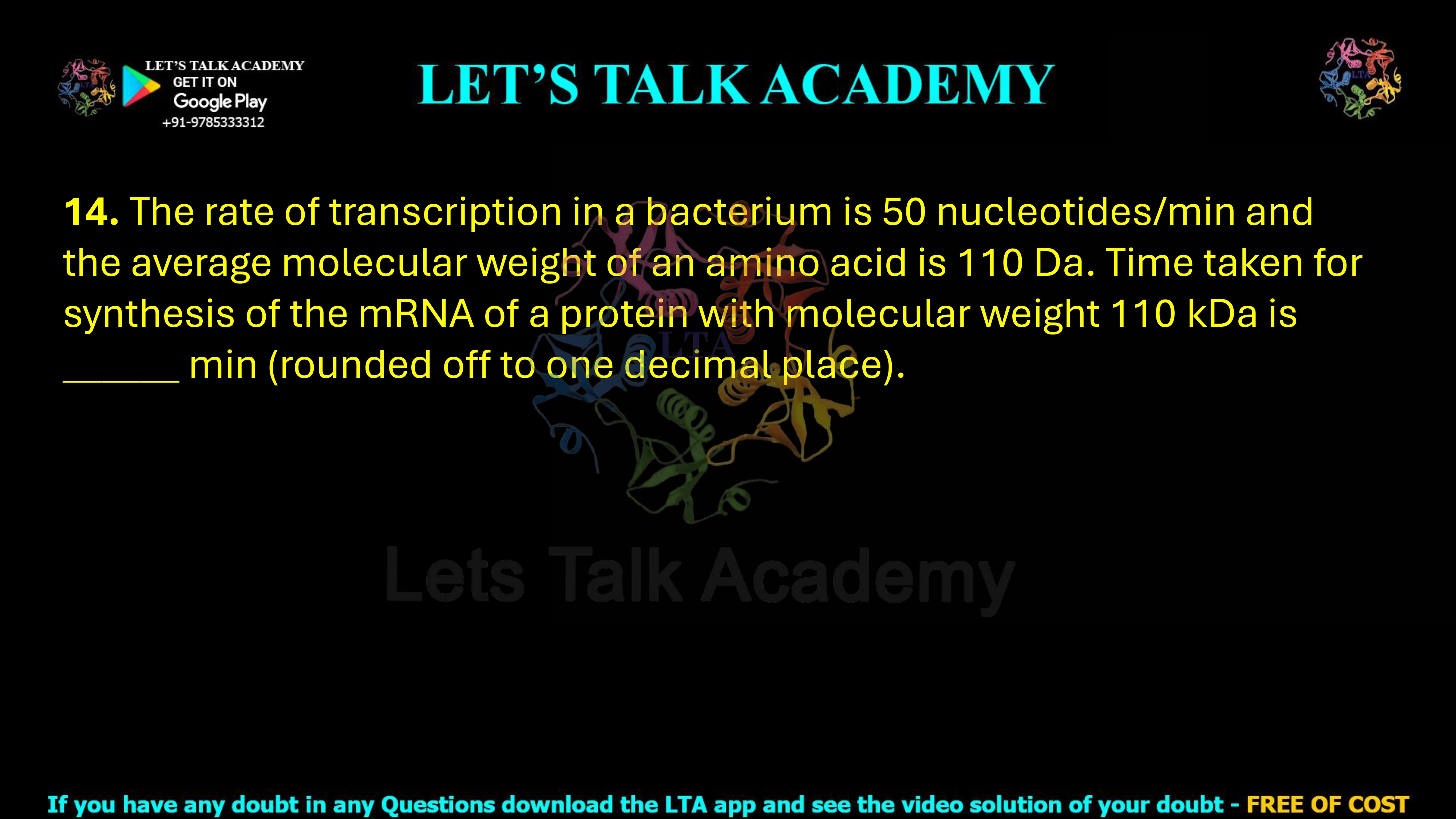
14. The rate of transcription in a bacterium is 50 nucleotides/min and the average molecular weight of an amino acid is 110 Da. Time taken for synthesis of the mRNA of a protein with molecular weight 110 kDa is ______ min (rounded off to one decimal place).
Time Required for mRNA Synthesis from Protein Molecular Weight
Introduction
Numerical questions connecting protein molecular weight, the number of amino acids, the number of nucleotides in mRNA, and the rate of transcription are frequently asked in molecular biology examinations. These problems test whether a student can correctly connect the flow of genetic information from DNA to RNA and finally to protein.
The basic logic is straightforward. First, the molecular weight of the protein is used to determine the number of amino acids present in the polypeptide. Since each amino acid is specified by one codon and every codon contains three nucleotides, the number of amino acids can then be converted into the number of nucleotides required in the protein-coding region of the mRNA. Finally, the transcription rate is used to calculate the total time required to synthesize that mRNA.
Correct Answer
Correct Answer: 60.0 min
Detailed Explanation
To determine the time required for mRNA synthesis, we must first calculate how many amino acids are present in the protein. Once the number of amino acids is known, it can be converted into the number of nucleotides required to encode the protein. The transcription rate can then be applied to calculate the total synthesis time.
The calculation follows three major relationships:
Protein molecular weight → Number of amino acids → Number of mRNA nucleotides → Transcription time
Step-by-Step Calculation
Step 1: Convert the Protein Molecular Weight into Daltons
The molecular weight of the protein is given as:
110 kDa
Since:
1 kDa = 1000 Da
Therefore:
110 kDa = 110 × 1000 Da
110 kDa = 110,000 Da
Step 2: Calculate the Number of Amino Acids in the Protein
The average molecular weight of one amino acid is given as:
110 Da per amino acid
Therefore, the number of amino acids in the protein is:
Number of amino acids = Molecular weight of protein ÷ Average molecular weight of one amino acid
Number of amino acids = 110,000 ÷ 110
Number of amino acids = 1000
Thus, the protein contains approximately 1000 amino acid residues.
Step 3: Calculate the Number of Nucleotides Required in the mRNA
According to the triplet nature of the genetic code, each amino acid is specified by one codon, and each codon contains three nucleotides.
Therefore:
1 amino acid = 3 nucleotides
For a protein containing 1000 amino acids:
Number of nucleotides = 1000 × 3
Number of nucleotides = 3000 nucleotides
Therefore, the protein-coding region of the mRNA contains approximately 3000 nucleotides.
Step 4: Apply the Transcription Rate
The rate of transcription is given as:
50 nucleotides per minute
The total time required is calculated using:
Time = Total number of nucleotides ÷ Transcription rate
Substituting the values:
Time = 3000 ÷ 50
Time = 60 minutes
Rounded off to one decimal place:
Time = 60.0 min
Complete Calculation in One Sequence
Protein molecular weight = 110 kDa = 110,000 Da
Number of amino acids = 110,000 ÷ 110 = 1000 amino acids
Number of mRNA nucleotides = 1000 × 3 = 3000 nucleotides
Time required = 3000 ÷ 50 = 60 minutes
Final Answer = 60.0 min
Calculation Summary
| Parameter | Calculation | Result |
|---|---|---|
| Protein Molecular Weight | 110 × 1000 | 110,000 Da |
| Number of Amino Acids | 110,000 ÷ 110 | 1000 amino acids |
| Number of Coding Nucleotides | 1000 × 3 | 3000 nucleotides |
| Transcription Rate | Given | 50 nucleotides/min |
| Time Required | 3000 ÷ 50 | 60.0 min |
Why Is the Protein Molecular Weight Divided by 110 Da?
A protein is a polymer made of amino acid residues. Although the twenty standard amino acids have different molecular weights, molecular biology numerical problems commonly use an average molecular weight of approximately 110 Da per amino acid residue. Therefore, dividing the total molecular weight of a protein by 110 gives an approximate number of amino acids present in that protein.
In this question:
110,000 Da ÷ 110 Da per amino acid = 1000 amino acids
This conversion is the essential first step because the length of the mRNA cannot be calculated directly from the molecular weight of the protein.
Why Are Three Nucleotides Required for Each Amino Acid?
The genetic code is a triplet code. This means that every three consecutive nucleotides in an mRNA molecule form a codon. Each codon generally specifies one amino acid during translation.
Therefore:
1 amino acid = 1 codon = 3 nucleotides
A protein containing 1000 amino acids consequently requires:
1000 codons × 3 nucleotides per codon = 3000 nucleotides
Important Note About the Stop Codon
A stop codon consists of three nucleotides but does not encode an amino acid. If the stop codon were included explicitly, the coding sequence would contain 3003 nucleotides instead of 3000 nucleotides. At a transcription rate of 50 nucleotides per minute, this would give:
3003 ÷ 50 = 60.06 min ≈ 60.1 min
However, in standard competitive examination calculations of this type, the mRNA length is obtained directly from the number of amino acids using number of amino acids × 3, unless the question specifically asks to include the termination codon or other untranslated sequences. Therefore, the expected answer is 60.0 min.
Relationship Between Protein Size and Coding Sequence Length
| Protein Size | Approximate Number of Amino Acids | Approximate Coding Nucleotides |
|---|---|---|
| 11 kDa | 100 | 300 |
| 55 kDa | 500 | 1500 |
| 110 kDa | 1000 | 3000 |
| 220 kDa | 2000 | 6000 |
General Formula for Similar Questions
The number of amino acids can be calculated as:
Number of amino acids = Protein molecular weight in Da ÷ Average molecular weight of one amino acid
The number of coding nucleotides can then be calculated as:
Number of nucleotides = Number of amino acids × 3
Finally, the transcription time is:
Time = Number of nucleotides ÷ Transcription rate
Combining all three relationships gives:
Time = [(Protein molecular weight ÷ Average amino acid molecular weight) × 3] ÷ Transcription rate
Biological Significance
The relationship between protein size, coding sequence length, and transcription rate reflects the central flow of genetic information in the cell. The nucleotide sequence of a gene determines the sequence of codons in mRNA, and these codons determine the amino acid sequence of the final protein. Therefore, a larger protein generally requires a longer coding sequence and a longer transcription time.
In real bacterial cells, transcription and translation can occur simultaneously because bacteria lack a nuclear membrane. Ribosomes can begin translating the 5′ end of an mRNA while RNA polymerase is still synthesizing the downstream portion of the same transcript. Nevertheless, the present question asks only for the time required to synthesize the mRNA based on the given transcription rate.
Final Answer
110 kDa = 110,000 Da
Number of amino acids = 110,000 ÷ 110 = 1000
Number of nucleotides = 1000 × 3 = 3000
Time = 3000 ÷ 50 = 60 minutes
Correct Answer: 60.0 min


